
AI Review Writing Tools Compared: Which One Actually Works?
ChatGPT, Jasper, Copy.ai, MapLift, Birdeye, Localo, EmbedSocial — all promise to help with AI review writing. Most will get your Google Business Profile suspended. Here is the honest comparison, including the ethical line Google draws.

TL;DR — Key Takeaways
Four distinct categories exist — most people use the wrong one
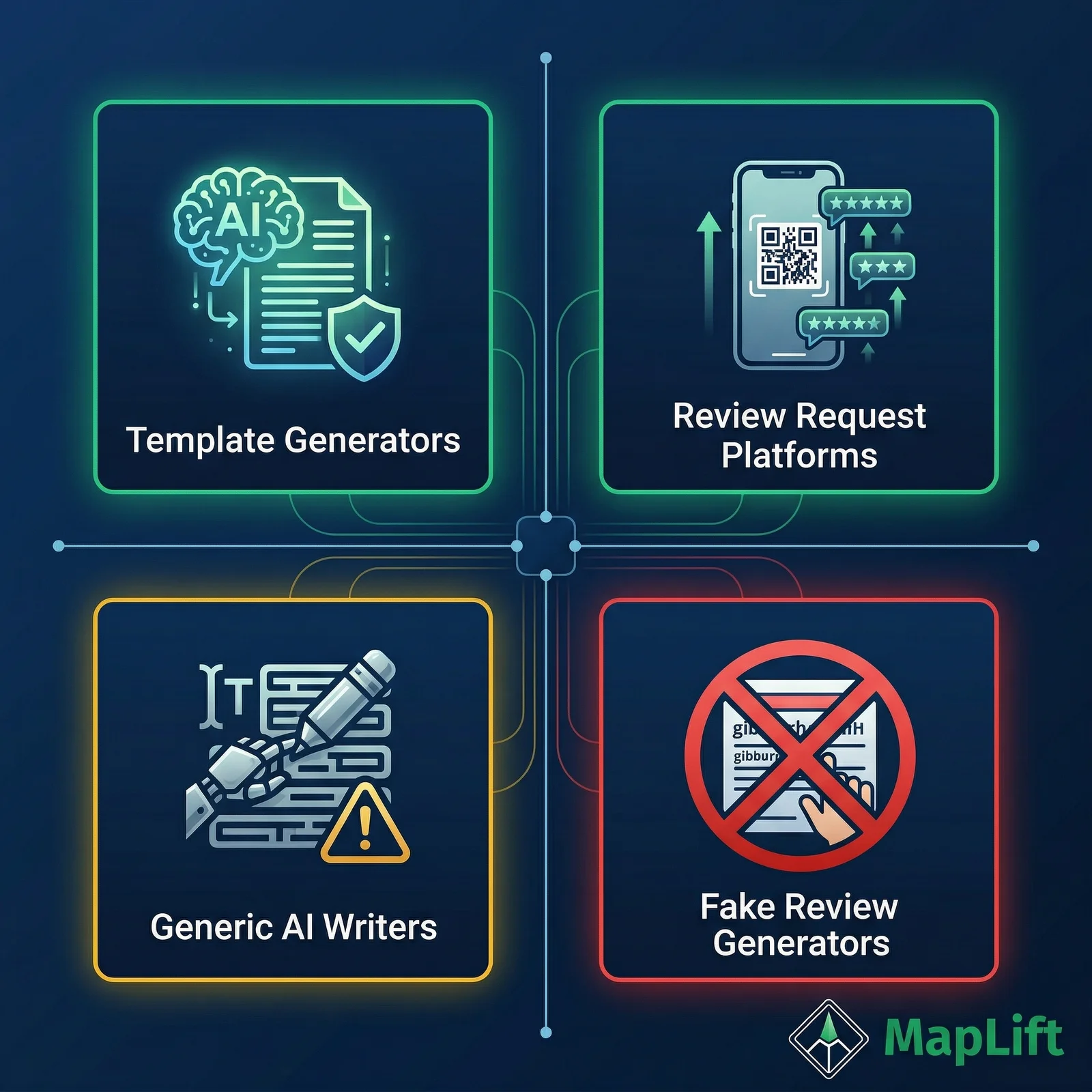
Generic AI writers (ChatGPT, Jasper, Copy.ai), response generators (Localo), review request platforms (EmbedSocial, Birdeye), and template generators (MapLift) all get called "AI review tools." Only the last two categories are ethical for review-related use.
Google removed 170 million fake reviews in 2023 — enforcement is accelerating
AI-generated reviews now constitute approximately 10% of reviews on major platforms (December 2025 research). Google's detection systems specifically flag AI-generated linguistic patterns. Businesses caught face profile suspension and a permanent consumer alert on their listing.
The ethical approach generates templates, not fake reviews
Review templates prompt real customers to describe their genuine experience in specific terms. The customer writes the review. The template guides what they write about. This is what Google permits — and what actually improves Maps ranking.
MapLift is the only tool that analyzes your actual business data first
Every other tool generates generic prompts. MapLift analyzes your Google Business Profile, your categories, and your competitors' review content before generating templates — producing prompts specific to your services, location, and the semantic gaps your ranking needs filled.
Every local business owner has heard the same advice: get more Google reviews. What the advice rarely covers is how to get reviews that actually move the needle — reviews that contain enough specific, descriptive language to improve your Maps ranking and, increasingly, your visibility in AI-generated search results.
A growing category of tools now promises to solve this with AI. But "AI review writing tool" covers a wide spectrum — from legitimate platforms that help customers express their genuine experience more clearly, to tools that generate fabricated reviews and post them in bulk. Understanding the difference matters enormously. Google removed 170 million fake reviews in 2023 alone, and businesses caught using fake review services face profile suspension and a permanent "suspected fake reviews" alert on their listing.
This comparison covers seven tools across the full spectrum, evaluates them honestly, and explains what makes the difference between a tool that helps your business and one that puts it at risk.
What Is an AI Review Writing Tool?
Before comparing tools, it helps to define the category precisely — because the term "AI review writing tool" currently describes at least four distinct types of software with very different functions and very different ethical standing.
Category 1: Generic AI Writers
General-purpose LLM tools that can generate text on any topic including reviews. The output is fluent and plausible-sounding — but with no real customer behind it, posting this text violates Google policy.
Examples: ChatGPT, Jasper, Copy.ai
Category 2: Review Response Generators
Tools that draft responses to reviews your customers have already left. You are responding to real reviews, just more efficiently. Entirely legitimate and useful for managing review volume.
Examples: Localo Free Tool, AI Review Reply Chrome Extension, GBP Suggested Responses
Category 3: Review Request Platforms
Platforms that automate the process of inviting customers to leave reviews — via email, SMS, or QR code. They do not write review content. They make it easier to collect authentic reviews at scale.
Examples: Birdeye, EmbedSocial, Podium
Category 4: Review Template Generators
Tools that create prompts you share with real customers after their actual visit, guiding them toward writing a specific, descriptive review of their genuine experience. The customer writes. The tool guides.
Examples: MapLift (SERP-Mind AI)
Why the category confusion matters
When someone searches for "AI review writing tools," they might be looking for any of these four things. The tools that appear in generic "best AI writing tools" lists — ChatGPT, Jasper, Copy.ai — are not designed for the review use case and using them for it creates significant risk. The tools designed specifically for review workflows operate on entirely different principles.
The Ethical Line: Templates vs. Fake Reviews
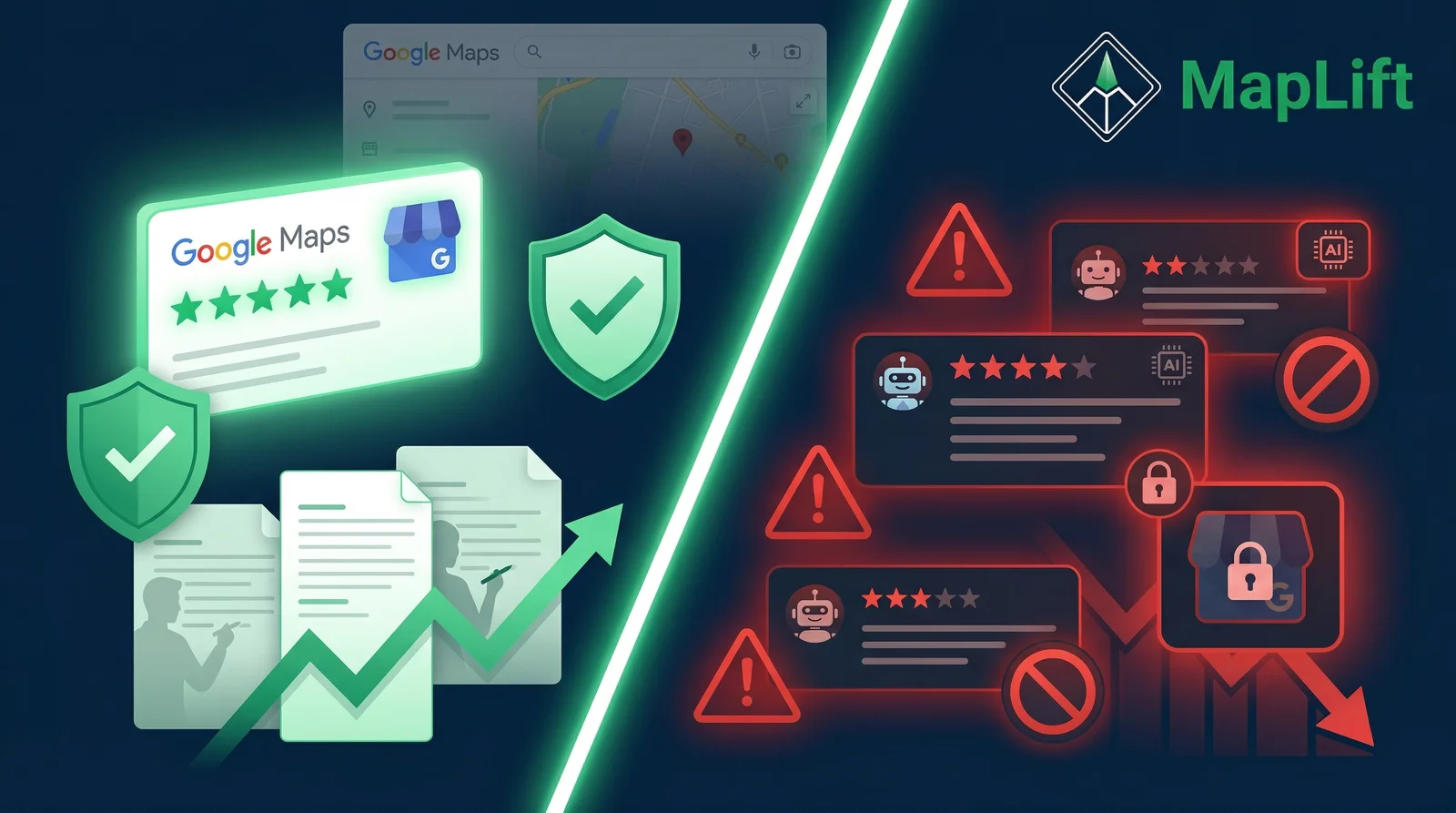
Understanding where Google draws the line is essential before choosing any tool in this space. The consequences of getting it wrong are serious and not easily reversed.
What Google Prohibits
Google's prohibited content policy explicitly bans "reviews that are not based on a genuine experience" and "content posted in exchange for rewards." AI-generated reviews — meaning text fabricated by a language model with no real customer behind it — fall squarely into this category regardless of how plausible they sound.
Google's enforcement systems analyze hundreds of signals: unusual review patterns, linguistic fingerprints associated with AI generation, IP address anomalies, account age, and review timing. A December 2025 study found AI-generated reviews had surged over 1,000% on major platforms — which is precisely why Google accelerated its detection investment throughout 2025.
What Google Permits
Using AI to help real customers write better reviews of their real experiences is legitimate and encouraged by ethical review experts. The ethical boundary is simple: did a real customer have a real experience with your business? If yes, helping them articulate that experience in specific terms is permitted. If no real customer is involved, it is fake regardless of how the text was generated.
The FTC's proposed rules, still moving through regulatory review as of early 2026, would explicitly prohibit undisclosed AI-generated testimonials — further reinforcing why the template approach is the only defensible path.
The plain-language test
Ask yourself: "Did a real person visit my business, have a genuine experience, and write this review?" If yes — regardless of what tools helped structure the request — the review is authentic. If no real visit happened, the review is fake. This test applies regardless of how compelling the AI-generated text sounds.
7 AI Review Writing Tools Compared in Detail
Each tool is evaluated on its actual function, pricing, India support, and suitability for the review use case. Ratings are out of 10 specifically for the review use case — not overall product quality.
ChatGPT
2/10
for review use
ChatGPT can generate fluent, convincing review text for any business. This is precisely the problem. When you use ChatGPT to write reviews and post them from accounts not connected to real customers, you are generating prohibited content. ChatGPT has no way to verify or incorporate your actual business data — the reviews it produces are fictional narratives, not customer experiences.
Strengths
- Excellent for drafting your responses to real customer reviews
- Useful for writing your GBP business description and post content
- Strong general writing quality and tone flexibility
- Free tier accessible to all businesses
Limitations for Review Use
- Generates fabricated reviews with no real customer behind them
- No integration with Google Business Profile or local business data
- Produces generic text without specific business knowledge
- Using it for reviews violates Google prohibited content policy
Verdict: NOT safe for review generation — violates Google policy
Useful as a general writing assistant. Should never be used to generate reviews. Legitimate use: drafting your own responses to authentic customer reviews.
Jasper
2/10
for review use
Jasper is a sophisticated content platform with strong brand voice tools, Surfer SEO integration, and a large template library. It excels for blog posts, ad copy, and product descriptions — but faces the same fundamental ethical problem as ChatGPT when used for review generation. Any review Jasper writes for your business is fabricated content with no real customer behind it.
Strengths
- Strong SEO-focused content generation with Surfer integration
- Consistent brand voice across long-form content
- Large template library for marketing copy
- Useful for GBP posts and business descriptions
Limitations for Review Use
- Generates fabricated review text without real customer data
- Expensive for small businesses at $49+ per month
- No local business data integration or GBP connectivity
- SEO strengths do not apply to the review use case
Verdict: NOT safe for review generation — violates Google policy
Excellent content marketing tool. Wrong tool for review generation. The same ethical constraint as ChatGPT applies — any review it generates is prohibited content.
Copy.ai
1/10
for review use
Copy.ai is positioned for quick short-form content generation with a generous free tier. For reviews, the same ethical constraint as every generic AI writer applies — Copy.ai can generate the text, but the text represents no real experience. It produces generic-sounding output that trained detection systems increasingly recognize as non-authentic.
Strengths
- Free tier reduces barrier to entry
- Fast generation for short-form marketing copy
- Reasonable output quality for social media content
Limitations for Review Use
- No local business features whatsoever
- Produces highly generic text — no business-specific data
- Ethically inappropriate for review generation
- Loses structure in longer formats per independent testing
Verdict: NOT safe for review generation — violates Google policy
Low-cost general copywriting tool. Not appropriate for the review use case in any form. Generates prohibited content if used for review writing.
Localo Free AI Review Response Generator
7/10
for review use
Localo's free tool is genuinely useful and completely legitimate. You paste in a review your customer left, select tone (professional, friendly, apologetic), and receive a draft response. You edit and publish it yourself. The AI assists your response workflow — it does not fabricate customer feedback. This is an entirely ethical and valuable use of AI in the review context.
Strengths
- Completely free with no account required
- Legitimate use case — responds to real reviews
- Tone customization options
- Works globally including India
Limitations for Review Use
- Helps you respond but not collect more reviews
- Does not improve review quality or specificity
- No template generation for customer outreach
- No local business data integration
Verdict: Ethical for review use
Excellent free tool for its specific use case. Use it to respond to real reviews more efficiently. Does not solve the review quality or volume problem.
EmbedSocial
6/10
for review use
EmbedSocial automates review request campaigns across multiple platforms — Google, Facebook, Yelp — and provides website widgets to display collected reviews. It handles the logistics of asking for reviews at scale. The platform does not write reviews or templates — it automates the invitation to leave one. Strong on the widget and social proof display side.
Strengths
- Multi-platform review collection automation
- Competitive pricing vs Birdeye (similar features at lower cost)
- Works globally including India
- Strong website widget and social proof display tools
Limitations for Review Use
- Does not generate business-specific templates or content
- Standardized requests tend to produce generic reviews
- No local business intelligence or competitor analysis
- Review content quality depends entirely on what customers choose to write
Verdict: Ethical for review use
Good for automating review collection volume. Does not address review quality or the specific semantic signals that improve Maps ranking.
Birdeye
3/10
for review use
Birdeye is one of the most comprehensive review management platforms available — AI-powered response drafting, review generation campaigns, reputation monitoring across 150+ sites, CRM integrations. For a US multi-location enterprise, it is serious. For Indian local businesses, the fundamental limitation is that India is not a supported market. Pricing is calibrated for US enterprise budgets.
Strengths
- Most comprehensive enterprise feature set available
- AI-powered responses and review generation campaigns
- Monitoring across 150+ review sites
- Strong CRM and automation integrations
Limitations for Review Use
- India is explicitly not a supported market
- Pricing inappropriate for Indian SMB budgets
- No India-specific platforms (Zomato, JustDial, MagicPin)
- US/UK-centric support and onboarding
Verdict: Ethical for review use
Market leader for US enterprises. Not viable for Indian local businesses due to lack of market support and pricing mismatch.
MapLift
9/10
for review use
MapLift analyzes your actual Google Business Profile — your categories, services, attributes, existing reviews, competitive landscape — and generates review request templates tailored to your specific business. Your customers write the reviews. MapLift writes the prompts that guide them toward describing their specific experience in detail. Purpose-built for Indian local businesses with India-first pricing.
Strengths
- Only tool that analyzes your actual GBP data before generating templates
- Competitor review analysis identifies your specific keyword gaps
- India-first: WhatsApp templates, QR codes, INR pricing
- Ethical by design — generates prompts, never fake reviews
- Works for any business category: restaurants, salons, clinics, retail
Limitations for Review Use
- Requires real customer visits to generate authentic reviews (by design)
- Full competitive analysis requires paid plan
- Newer platform — smaller integration ecosystem than enterprise tools
Verdict: Ethical for review use
Purpose-built for this exact use case. The only tool in this comparison that solves both the quality problem (specific, descriptive reviews) and the ethics problem (real customers, real experiences) simultaneously.
Side-by-Side Comparison Table
| Tool | Category | Price/Month | India | Ethical | Rating | Best For |
|---|---|---|---|---|---|---|
| ChatGPT | Generic AI Writer | Free / $20 | Yes | No | 2/10 | Review responses only |
| Jasper | Generic AI Writer | $49+ | Yes | No | 2/10 | Content marketing |
| Copy.ai | Generic AI Writer | Free / $49 | Yes | No | 1/10 | Short-form copy |
| Localo | Response Generator | Free / $24+ | Yes | Yes | 7/10 | Review responses |
| EmbedSocial | Review Platform | $29+ | Yes | Yes | 6/10 | Multi-platform collection |
| Birdeye | Enterprise Platform | ~Rs.25,000+ | No | Yes | 3/10 | US/UK enterprise |
| MapLift | Template Generator | Free / Rs.299+ | Yes | Yes | 9/10 | Indian local businesses |

What Makes a Review "SEO-Optimized" vs. Just "AI-Written"?
This distinction gets to the core of why most AI review tools fail at their stated purpose — even when used ethically as response aids.
AI-Written Review (What ChatGPT produces)
"This restaurant offered an exceptional dining experience. The food was delicious and the service was excellent. The ambiance was pleasant and the staff was very friendly. I highly recommend this place to anyone looking for a great meal."
No specific dishes mentioned
No neighborhood context
No unique experience details
Linguistic pattern Google flags as AI-generated
Matches zero specific search queries
Template-Guided Review (What a real customer writes)
"Came here for dinner on a Friday night — had the butter chicken and the garlic naan. The butter chicken has a proper rich gravy, not the watery kind you get at most places in Koramangala. Got a table immediately even though it was peak time, staff remembered our order without writing it down."
Specific dish names (keyword signals)
Neighborhood mention (location signal)
Timing and availability detail
Natural human linguistic pattern
Matches 4+ specific search queries
The second review is more useful for search visibility for two reasons beyond the ethical one. First, Google's detection systems are increasingly sophisticated at identifying AI linguistic patterns — superlative stacking, generic structure, absence of personal detail. Second, AI-generated text tends toward genericism because it has no real data about your specific dishes, your specific staff, or your specific customer. The template approach achieves specificity because it works with reality, not around it.
For Google Ask Maps optimization, this matters even more. Gemini reads review text semantically to match businesses to conversational queries. A review containing "butter chicken," "Koramangala," and "Friday night" is evidence Gemini can cite when someone asks "best North Indian dinner in Koramangala for a weekend outing." A generic AI-written review contributes nothing to that matching.
How MapLift's SERP-Mind AI Differs
Most review tools are agnostic to your specific business. They generate generic prompts or — in the unethical cases — generic fake reviews. MapLift's approach starts from a fundamentally different premise.
Analyze Your Business
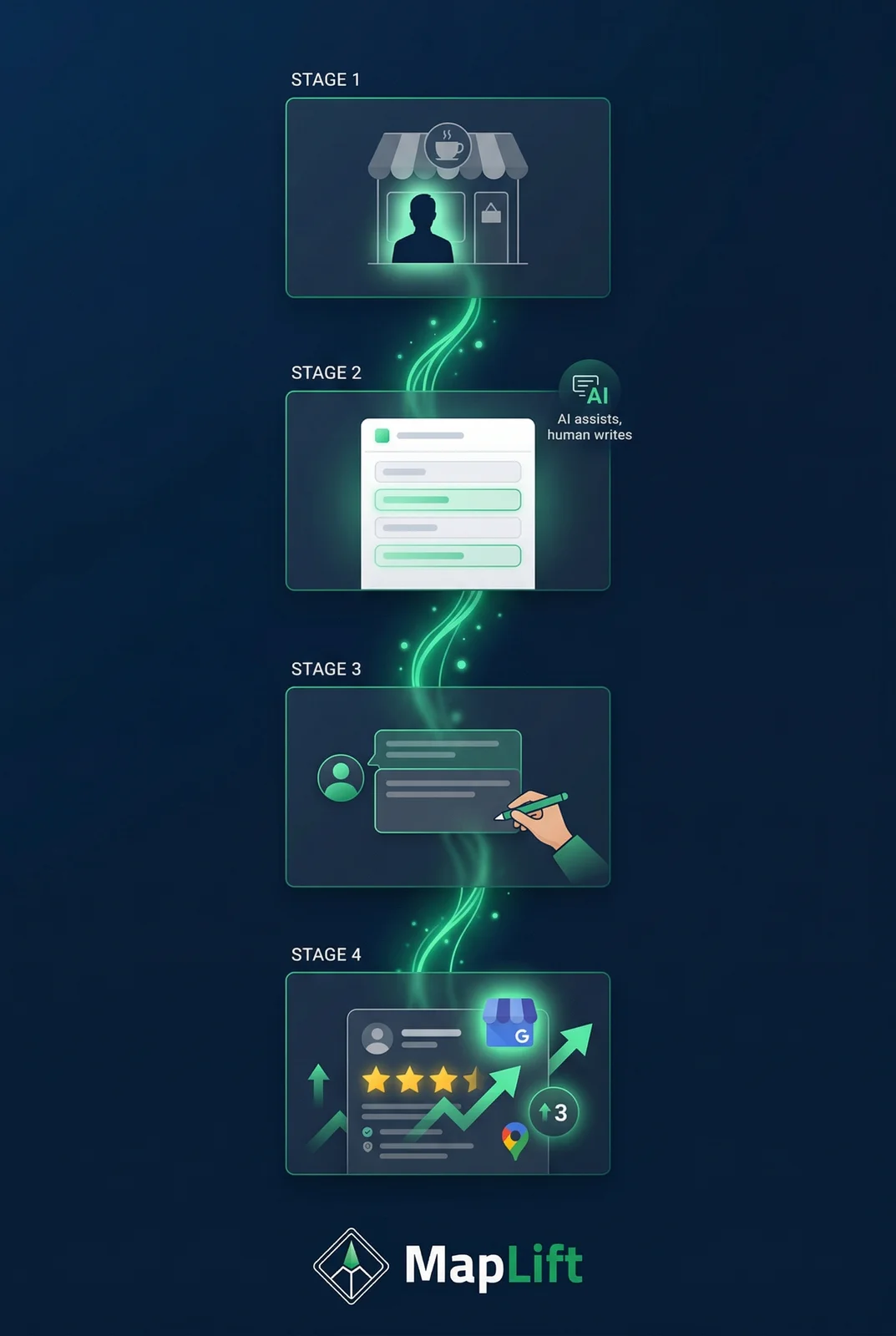
MapLift reads your Google Business Profile — your primary category, secondary categories, services listed, attributes, and existing review content. This gives it the specific context that generic tools lack.
Identify Competitor Signals
SERP-Mind AI scans the review corpora of your top-ranked competitors to identify which keywords and topics appear most frequently. These are the signals Google already rewards for your category and location.
Generate Gap-Filling Templates
Templates are generated specifically to fill the gap between what your competitors' reviews contain and what yours are missing — producing prompts that guide real customers toward writing the specific details your ranking needs.
The design principle behind MapLift is that a review template for a South Mumbai dental clinic should be fundamentally different from one for a Koramangala coffee shop. The clinic needs reviews mentioning specific procedures, chairside manner, pain management, and hygiene. The coffee shop needs reviews referencing specific drinks, work-friendly atmosphere, wifi quality, and neighborhood context. Generic prompts produce generic reviews regardless of how sophisticated the AI behind them is.
SERP-Mind AI generates templates by first identifying which keywords appear most frequently in the review corpora of your top-ranked competitors — businesses Google already considers authoritative for your category and location. It then checks which of those keywords your own reviews are missing. The templates it generates are designed to fill those specific gaps, producing prompts tailored to what your ranking needs rather than generic review-writing advice.
For a detailed look at how review management software fits into the broader local SEO stack, and how MapLift compares to enterprise tools like Birdeye and Podium, see our full review software comparison.
Who Should Use Which Tool
The right tool depends on what you are actually trying to accomplish — and your geographic context matters more than most comparisons acknowledge.
You need help responding to reviews faster
Use Localo's free response generator or Google's own suggested responses in GBP. Both are free, legitimate, and save meaningful time at scale.
You need to collect more reviews via automated campaigns
EmbedSocial at $29/month handles multi-platform requests efficiently and works globally including India. Good for volume automation.
You are a US or UK multi-location enterprise with CRM needs
Birdeye is the market leader for this profile. Worth the investment at enterprise scale in supported markets.
You are an Indian local business that needs higher-quality, more specific reviews
MapLift at Rs.299–1,499/month is built specifically for this. Analyzes your actual business data, generates templates for WhatsApp and QR code deployment, priced for Indian SMBs.
You want to use AI for your GBP description, posts, and Q&A
ChatGPT, Jasper, or Copy.ai work well for this — these are legitimate content writing tasks, not review generation. Use them freely for GBP content that you publish under your own name.
One recommendation applies universally
Do not use ChatGPT, Jasper, or Copy.ai to generate and post reviews on behalf of customers. The short-term gain does not justify the risk of profile suspension, permanent review removal, or a "suspected fake reviews" alert that damages consumer trust in your business. These tools have no place in your review strategy except for drafting your own responses to existing reviews — which is an entirely different and legitimate use.
Frequently Asked Questions
Is it legal to use AI to write Google reviews?
Using AI to generate reviews that are then posted as if from real customers is prohibited by Google's review policies and, in many jurisdictions, by consumer protection laws. The FTC's proposed rules would explicitly ban undisclosed AI-generated testimonials. Using AI to help real customers express their genuine experience — through templates or prompts — is legitimate and encouraged by ethical review experts. The key question is whether a real person had a real experience with your business.
Can Google detect AI-generated reviews?
Yes, and increasingly well. Google's AI detection systems analyze hundreds of signals including linguistic patterns associated with AI generation, account history, review timing patterns, IP anomalies, and business-reviewer relationship signals. Google removed 170 million fake reviews in 2023. In 2025, enforcement accelerated significantly — businesses flagged for fake reviews receive a visible "consumer alert" on their profile and, in serious cases, temporary "review jail" that prevents new reviews from appearing. A December 2025 study found AI-generated reviews had surged over 1,000% on major platforms, which directly accelerated Google's investment in detection.
What is a review template generator and how is it different from a fake review generator?
A review template generator creates short prompts or messages you share with real customers after their actual visit, guiding them toward writing a specific, descriptive review of their genuine experience. The customer writes the review. The template just helps them know what to write about.
A fake review generator creates the review text itself — fabricating a customer experience that never happened. The first approach is legitimate and helps both ranking and customer experience. The second violates Google's policy, risks profile suspension, and increasingly triggers Google's AI detection systems.
Does MapLift generate reviews automatically?
No. MapLift generates templates — the prompts you share with real customers. The customer visits your business, has a real experience, receives your template via WhatsApp or QR code, and writes their review in their own words guided by your prompt. MapLift never posts reviews on behalf of customers, never generates fake review text, and never bypasses Google's authenticity requirements. This is the core ethical distinction that separates MapLift from generic AI writing tools used for review generation.
Which AI review tool is best for Indian local businesses?
For Indian local businesses, MapLift is the only tool in this category designed specifically for the Indian market. It supports WhatsApp template deployment (the primary customer communication channel in India), QR code generation, INR pricing (Rs.299–1,499/month), and analysis of Indian review platforms. Birdeye — the US market leader — explicitly does not support India as a market. EmbedSocial works in India and is useful for volume automation but lacks the business-specific intelligence that MapLift provides through its SERP-Mind AI analysis.
How many reviews do I need before AI review tools add value?
Even with zero existing reviews, MapLift adds value by generating templates informed by competitor review analysis and your GBP data. For SERP-Mind AI's competitive gap analysis to be most meaningful, having 10–20 existing reviews gives the system a baseline to compare your review content against competitors. The template generation itself works from day one. For response tools like Localo, you obviously need existing reviews to respond to — but for template generators, earlier is better since you start building the right review signals from your first customer.
The Right Tool Depends on What You Are Trying to Do
The "AI review writing tools" category is genuinely useful when you understand which part of the problem each tool solves. Response generators save you time replying to existing reviews. Review request platforms automate outreach to collect more reviews. Template generators improve the quality and specificity of what customers write.
What no tool can do legitimately is generate the reviews themselves. The moment a review is fabricated — regardless of how convincing the AI-generated text sounds — it violates Google's policy, increasingly triggers detection, and puts years of business reputation at risk. The tools built around this model are not a shortcut. They are a risk with no proportionate upside.
The tools built around the ethical model — helping real customers express real experiences more specifically — are the ones that produce durable results. A review mentioning your specific Holi special thali, your quiet corner table, and your Bandra location does more for your Maps ranking and AI search visibility than a hundred generic five-star fabrications ever could.
MapLift: Review templates built from your actual business data
Enter your business details and MapLift analyzes your Google Business Profile, your category, and your competitors' review content to generate templates specifically calibrated to your ranking gaps. Free plan available. Essentials from Rs.299/month.
Comparing the broader review software landscape? See our full review software comparison covering enterprise and SMB tools.
Sources & References
- Ethical Use of AI Review Generators- Birdeye
- The Global Wave of Google Reviews Being Deleted: AI Detection, Legal Takedowns- ALM Corp
- Review Jail for Fake 5-Star Google Reviews- Sterling Sky
- Fake Review Statistics (2025): How Big the Problem Is- Shapo
- Understand the SEO Risks of Fake Review Generators- GoMega AI
- Google Review Policy 2025: What Multi-Location Businesses Need to Know- Birdeye
- Authentic Review Generator: Why You Need One- Trustmary
- Copy.ai vs Jasper: Which Is Better for SEO?- SearchAtlas
- Cheaper Birdeye Alternative: Feature Comparison with EmbedSocial- EmbedSocial
Keep reading
Ready to act on this? AI review templates — keyword-rich review prompts a customer can start from, generated per business.