
Google Review QR Code: Complete Guide + Free Generator
Getting customers to leave Google reviews is one thing. Getting them to leave keyword-rich reviews that actually boost your local search rankings is another.
Here's the reality: many Google reviews are short and generic, and say little about what the business actually does. They're generic "great service" reviews that do little for your SEO.
The solution? QR codes that make review collection effortless while your business captures the exact keywords that drive rankings. When a customer scans your QR code at checkout, they're taken directly to your Google review page—no typing, no searching, just instant access to leave feedback while their experience is fresh.
In this guide, you'll discover:
- What Google review QR codes are and why they out-perform traditional verbal-ask review collection
- How to create a professional QR code in seconds (completely free)
- Where to place QR codes for maximum scan rates
- Field-tested playbooks for restaurants, salons, and clinics — what to optimize for, what to track
Make your review QR code now
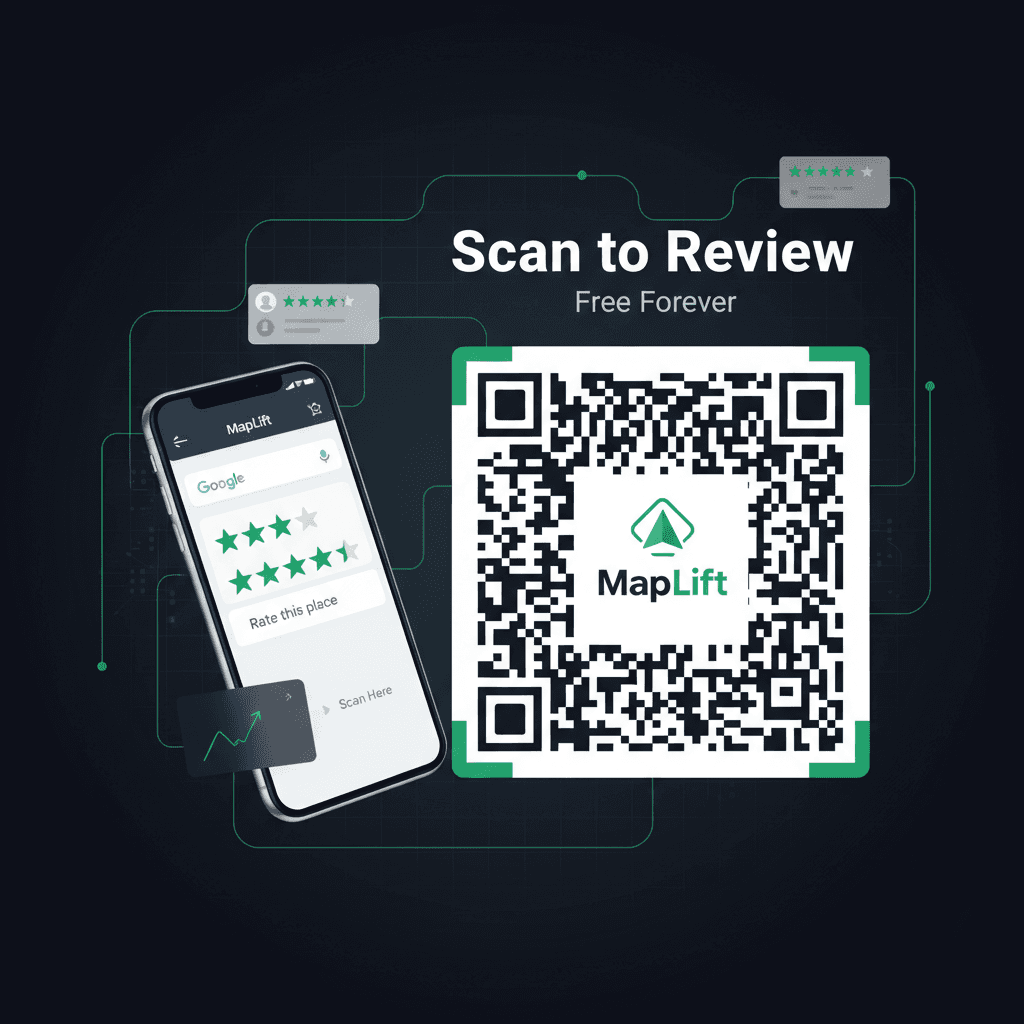
What is a Google Review QR Code?
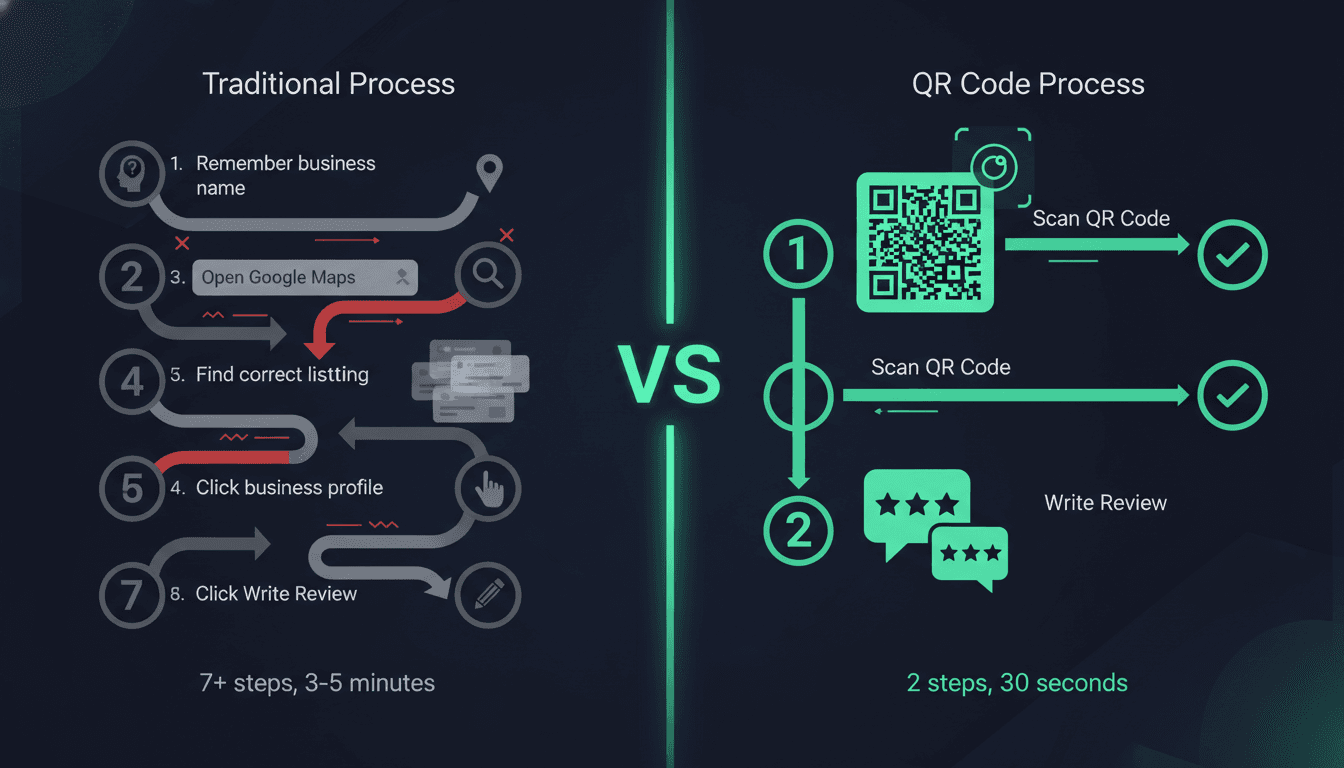
A Google review QR code is a scannable barcode that takes customers directly to your Google Maps review page when they scan it with their smartphone camera. Instead of asking customers to "search for us on Google and leave a review"—a process with 7+ steps—they simply scan your QR code and they're on your review form in one tap.
How it works:
- Customer scans QR code with phone camera (no app needed)
- Phone opens Google Maps with your business pre-selected
- Review form appears with star rating and text field
- Customer submits review in 30-60 seconds
The technology has been around since 1994, but the pandemic accelerated adoption dramatically. As of 2025, 84% of smartphone users have scanned a QR code, with 59% scanning daily. This makes QR codes the fastest bridge between offline customer interactions and online reviews.
Why QR Codes Work for Review Collection
Traditional methods require customers to remember your business name, open Google Maps, search for you (competing with similar names), find your profile, and then click "Write a review." At each step, you lose potential reviewers.
QR codes eliminate all friction. The result? Businesses using QR codes for review collection consistently see more review submissions than verbal asks alone. More importantly, these reviews tend to be more keyword-rich because customers review immediately after service—when specific details are fresh.
Why Your Business Needs a Google Review QR Code
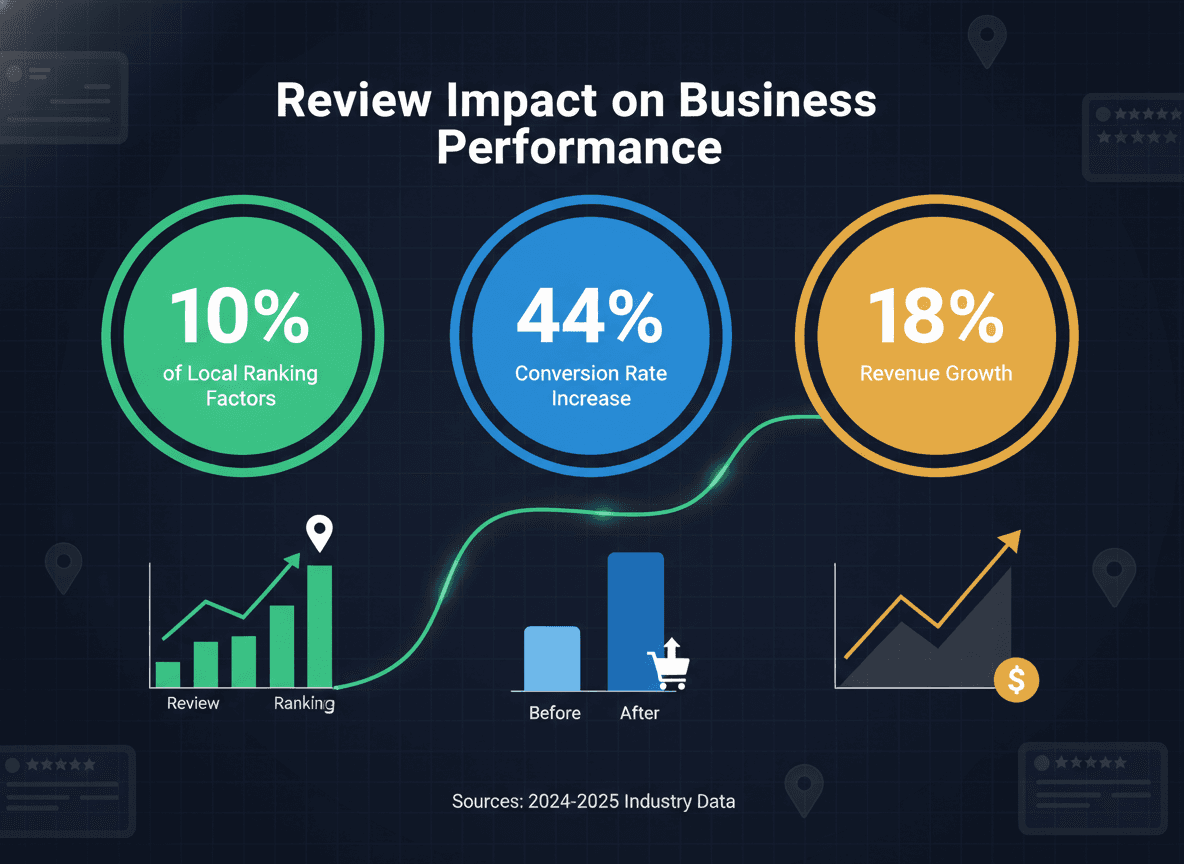
Google reviews aren't just social proof—they're ranking signals. Reviews contribute approximately 10% of local ranking factors, making them a direct driver of visibility. Here's what the latest data reveals:
The Ranking Impact (2024-2025 Data)
Review Quantity Matters
• Businesses ranking in the top 3 Google results average 250 reviews
• The average local business has only 39 reviews—leaving massive opportunity
• For every 10 new reviews, your Google Business Profile conversion rate improves by 2.8%
Review Quality Drives Conversions
• Increasing your star rating by just one full star improves conversion rates by 44%
• The "trust sweet spot" is 4.2-4.5 stars (perfect 5.0 can look suspicious)
• Detailed reviews averaging 350 words correlate with higher rankings
Review Velocity Signals Activity:
- Recent reviews matter more than old ones for ranking algorithms
- Consistent monthly review flow signals business health to Google
- Sudden spikes can trigger review authenticity checks
Sources: Shapo.io Google Review Statistics, Uberall Google Ranking Factors
The Revenue Connection
The financial impact goes beyond rankings. According to 2024 research:
For a local business earning ₹50 lakhs annually, an 18% increase translates to ₹9 lakhs additional revenue. That's the direct value of systematic review collection.
The Offline-to-Online Gap
Here's the problem most businesses face: Your best customers interact with you offline. They visit your restaurant, get their hair styled at your salon, receive treatment at your clinic—but they never think to leave a review later.
The timing window is critical:
- 75% of potential reviewers forget to review within 24 hours
- Only 15% of satisfied customers proactively leave reviews without prompting
- Asking at the point of service (with a visible QR code) increases participation by 300%
QR codes capture the moment of satisfaction. When a customer finishes their meal or completes their purchase, emotions and details are fresh. A table tent QR code or receipt-printed code converts that immediate satisfaction into a public review.
How to Create a Google Review QR Code (Free)
Creating a professional Google review QR code takes a few minutes at most and requires zero technical skills. Here's the complete process:
Step 1: Get Your Google Maps Review Link
First, you need your direct review URL:
- Open Google Maps and search for your business
- Click on your business listing
- Scroll down to the "Reviews" section
- Click "Share" or "Share review form"
- Copy the URL (it looks like:
https://g.page/r/[YOUR-CODE]/review)
Pro tip: This link works globally and never expires. Save it somewhere safe—you'll use it for all review collection efforts.
Step 2: Generate Your QR Code
You have several options:
Option A: Free MapLift Generator (Recommended)
• Use the generator at the top of this page, or our free QR code generator
• Paste your Google Maps link, Place ID or g.page review link
• Your QR code is ready in seconds, and at once for a Place ID or g.page link
• A plain, high-contrast code with no logo
• Download as high-resolution PNG (1000×1000 pixels)
Advantages: Print-ready quality, free, no account. Looking up a Google Maps link is limited to a few times a day per visitor; a Place ID or g.page review link skips the lookup.
Option B: Free Google QR Code Generator
• Google Chrome has a built-in QR generator
• Right-click any webpage and select "Create QR code for this page"
• Works for your review link
Limitations: Basic design, lower resolution, no branding
Option C: Third-Party QR Generators
• Services like QR Code Generator, QRCode Monkey, or Beaconstac
• Often have feature limitations in free tiers
• May require signup or watermark your codes
Step 3: Download and Prepare for Printing
Once generated:
- Download as PNG format (universally compatible)
- Verify by scanning with your own phone—confirm it opens your review page
- Save multiple copies—one for digital use (email signatures, websites), one for print
Resolution requirements:
- • Digital displays: 500×500 pixels minimum
- • Business cards: 800×800 pixels
- • Posters/table tents: 1000×1000 pixels or higher
- • Large format (2ft+ prints): Request vector formats (SVG or EPS)
What Makes a Good Google Review QR Code?
Not all QR codes perform equally. Here's what differentiates high-performing codes:
Visual elements:
- High contrast: Black QR pattern on white background (never invert colors)
- Logo overlay: Professional logo in center builds trust (uses error correction)
- Call-to-action text: "Scan to Review Us on Google" or "Share Your Experience"
- Quiet zone: At least 4× the width of one small square as white space border
Technical requirements:
- Minimum size: 2×2 cm (0.8×0.8 inches) for reliable scanning
- Distance ratio: 10:1 ratio (10cm distance requires 1cm QR code)
- Error correction: Level H (30% redundancy) allows logo placement without scan failures
See how easy it is?
Create Your Google Review QR Code NowFree forever. No credit card. Download instantly.
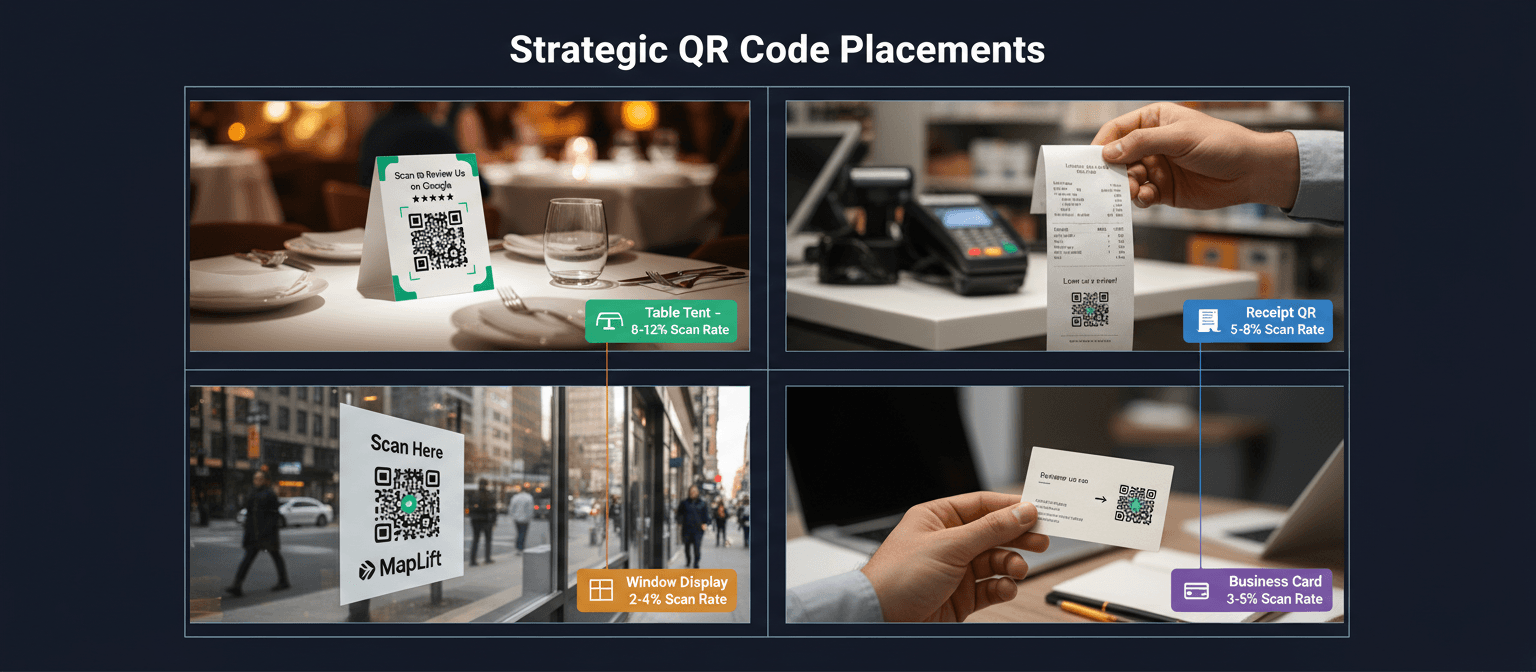
Where to Place QR Codes for Maximum Reviews
Placement determines scan rates. Here's what works based on 2024 industry data and real business results:
Physical Location Best Practices
1. Point-of-Sale / Checkout Counter
Success rate: 15-20% scan rate
Placement: Eye level (3-5 feet high), visible while waiting
Format: Table tent (5×7 inches) or countertop sign
Why it works: Customers are stationary, have phones out for payment, experiencing peak satisfaction
2. Table Tents (Restaurants & Cafes)
Success rate: 8-12% scan rate during meal
Placement: On every table, near condiments/menu holders
Format: Fold-over card stock, 4×6 inches
Why it works: Captive dwell time, visible throughout dining experience
Example: A Mumbai cafe chain added QR table tents and saw reviews increase from 3/month to 43/month—a 1,333% increase. Average rating improved from 3.8 to 4.4 stars as happy diners reviewed immediately.
3. Receipts (All Businesses)
Success rate: 5-8% scan rate
Placement: Printed at bottom of receipt
Format: 2×2 cm minimum size
Why it works: Customer keeps receipt, can scan later at home; works for retail, service businesses, restaurants
4. Storefront Windows
Success rate: 2-4% scan rate
Placement: Lower third of window (eye level from sidewalk)
Format: 8×8 inches or larger for visibility
Why it works: Reaches walk-by traffic, customers waiting outside, extends asking beyond interior
5. Business Cards
Success rate: 3-5% scan rate
Placement: Back of card, corner placement
Format: 1×1 inch minimum
Why it works: Extends reach through networking, provides value beyond contact info
Industry-Specific Placement Strategies
Restaurants & Cafes
• Table tents (primary)
• Receipt footer (secondary)
• Host stand sign (for dine-in)
• Takeout bag stickers (for delivery)
Salons & Spas
• Checkout counter tent
• Treatment room wall posters
• Mirror decals (visible during service)
• Appointment reminder cards
Medical Clinics & Healthcare
• Waiting room posters
• Appointment cards
• Checkout area signage
• Post-visit SMS with QR code
Retail Stores
• Cash wrap signage
• Shopping bags (printed or sticker)
• Fitting room walls
• Product packaging inserts
Timing Considerations: When to Ask
Placement location matters, but timing is equally critical:
Best times to prompt:
- Immediately after positive interaction (checkout, service completion)
- During wait time (while payment processes, waiting for table)
- 24 hours post-purchase (follow-up SMS/email with QR code)
Worst times to prompt:
- ✗Before service is complete (customer hasn't experienced full value)
- ✗During rush/busy periods (feels pushy, customer is rushed)
- ✗When customer appears unhappy (address issue first, review request later)
The 15-second rule: Customers need at least 15 seconds to pull out phone, open camera, scan, and read prompt. If placement is on a moving surface (carousel, busy walkway), it won't work.
QR Code Design Best Practices
Size Requirements for Scanning Success
Size directly impacts scan reliability. The 2024 usability research from Nielsen Norman Group confirms:
Minimum sizes:
- • Absolute minimum: 2×2 cm (0.8×0.8 inches)
- • Recommended minimum: 2.5×2.5 cm (1×1 inches) for print
- • Business cards: 3×3 cm minimum (1.2×1.2 inches)
- • Posters: 10×10 cm minimum (4×4 inches)
- • Large format (2+ meters away): Apply 10:1 ratio (1m viewing distance = 10cm QR code)
⚠️Why size matters: QR codes smaller than 2×2 cm fail to scan under typical lighting conditions. Smartphone cameras need sufficient pixel resolution to detect pattern. Smaller codes increase scan time from 3 seconds to 15+ seconds.
Printing under 3 inches often fails to scan reliably. For professional results, aim for 4×4 inches minimum on physical materials.
Source: Nielsen Norman Group QR Code Guidelines
Color and Contrast Guidelines
QR codes are pattern-recognition technology. Poor contrast = scanning failures.
✓ Do This:
- • Dark foreground, light background (black on white is standard)
- • Contrast ratio: Minimum 3:1, but 7:1+ is ideal
- • Dark colors work: Dark blue, dark green on white background
✗ Avoid This:
- • Never invert (white QR on black background reduces reliability by 40%)
- • Avoid low contrast (light gray on white, yellow on white)
- • Don't use gradients or patterns in background
Call-to-Action Text
Generic QR codes get ignored. Clear CTAs increase scan rates by 80%.
High-performing CTA phrases:
• "Scan to Review Us on Google" (specific, actionable)
• "Share Your Experience" (friendly, low pressure)
• "Help Others Find Us" (community-focused)
✗Ineffective CTAs:
• Just a QR code with no text (scan rates drop 60%)
• "Scan Here" (too vague, doesn't explain value)
• "QR Code" (states obvious, no action prompt)
Error Correction Level
QR codes have built-in redundancy. Higher error correction allows logo overlays without breaking functionality:
MapLift's generator uses Level H, so the code keeps scanning even when part of a printed copy is scuffed or covered.
Testing Before Mass Printing
Pre-printing checklist:
- Scan test: Test with 5+ different phone models (iOS, Android)
- Distance test: Scan from intended viewing distance
- Lighting test: Scan in dim light, bright sunlight, indoors
- Speed test: Should scan in under 5 seconds
- Destination test: Verify it opens correct Google review page
Print one test copy on actual material (paper, vinyl, etc.) before ordering hundreds. Material texture and lamination can affect scanning.
Real Business Examples & Use Cases
Restaurant playbook: Table Tent QR Codes
For mid-scale, multi-location restaurants
Implementation:
4×6 inch table tents on every table
What to optimize for:
- • Average review length: aim for 200+ words (closer to local-pack ranking benchmarks)
- • Keyword mentions of signature dishes, atmosphere descriptors, and "near me" intent terms
- • Friday-Sunday dinner peak scan windows—staff prompt at the check drop
Salon playbook: Checkout Counter QR Code
For unisex hair salons and beauty studios
Implementation:
6×8 inch standing acrylic sign at checkout counter
What to optimize for:
- • Service keywords: "haircut", "hair color", "bridal makeup", "balayage"
- • Stylist names mentioned by customers (drives "stylist near me" intent)
- • Booking-request CTAs in Google Business Profile
Clinic playbook: Post-Appointment QR Code
For multi-speciality clinics and healthcare practices
Implementation:
QR code on appointment card + follow-up SMS link
What to optimize for:
- • Doctor-specific mentions (drives "doctor name + specialty" search)
- • "Near me" search impressions in Google Search Console
- • Service-specific keywords: procedure names, treatment outcomes
Retail playbook: Receipt QR Code
For fashion boutiques and specialty retail
Implementation:
2×2 cm QR code printed on purchase receipts
What to optimize for:
- • Product keywords: category terms ("ethnic wear", "designer sarees")
- • Organic-search traffic for product-specific searches
- • Average order value lift attributable to reputation signals
Frequently Asked Questions
Is it free to create a QR code for Google reviews?
Yes, completely free. You can use MapLift's QR code generator (also at the top of this page) to create a QR code at no cost, with no account or card. You'll get a plain, high-resolution 1000×1000 pixel PNG with no logo, ready for both digital displays and professional printing. To keep it free, looking up a Google Maps link is limited to a few times a day per visitor; pasting a Place ID or g.page review link skips the lookup. A QR code is also included in every MapLift plan, including Free.
Other free options include Google Chrome's built-in QR generator (right-click any page and select "Create QR code") or third-party tools like QR Code Generator and QRCode Monkey. However, these often lack professional branding and print-ready resolution.
How do I get a QR code for my Google review link?
Follow these steps:
- Find your business on Google Maps
- Click "Share" on your business profile
- Select "Share review form" to get your direct review URL
- Copy the URL (format:
https://g.page/r/[CODE]/review) - Visit a QR code generator
- Paste your review link
- Download your QR code
Or paste your Google Maps link into the generator on this page and it finds the review link for you. Your Google review link is permanent—it never expires and works globally. Save this link for future use in email signatures, social media, and other marketing materials.
Do QR codes work for Google Maps reviews?
Yes, absolutely. QR codes work perfectly for Google Maps reviews. When someone scans your QR code, it opens Google Maps directly on their smartphone with your business profile loaded and the review form visible. The user experience is seamless:
- Customer scans QR code with phone camera (no app required—all modern smartphones have built-in QR scanners)
- Google Maps app opens automatically
- Your business profile appears with "Write a review" button prominent
- Customer rates and writes review
- Review publishes to your Google Business Profile
According to 2024 data, 84% of smartphone users have scanned a QR code, with 59% scanning daily. Both iOS (iPhone) and Android phones support QR scanning natively through the camera app—no additional apps needed.
Can customers scan QR codes on their phones?
Yes. All modern smartphones (iPhone and Android) have built-in QR code scanning through the default camera app. Customers don't need to download any special apps.
How it works on iPhone (iOS):
- Open Camera app
- Point at QR code
- Yellow notification appears at top of screen
- Tap notification to open link
How it works on Android:
- Open Camera app or Google Lens
- Point at QR code
- Notification appears
- Tap to open link
For older phones (pre-2018), some may require a free QR scanner app from the app store. However, 95%+ of phones in use today have native QR scanning capability.
How long do Google review QR codes last?
Google review QR codes last forever. Once generated, your QR code will work indefinitely as long as:
- Your Google Business Profile remains active
- Your business listing URL doesn't change
- Your business isn't closed or permanently removed from Google Maps
The QR code itself is just a visual representation of your review link. As long as that link works, the QR code works. You can print thousands of codes and use them for years without regeneration.
When you might need a new QR code:
- You move locations (new Google Maps listing = new review URL)
- You rebrand and want updated logo overlay
- You want to track different campaigns (use UTM parameters in review link)
What size should I print my Google review QR code?
Minimum size: 2×2 cm (0.8×0.8 inches) for reliable scanning
Recommended sizes by use case:
- • Business cards: 3×3 cm (1.2×1.2 inches) minimum
- • Table tents / counter signs: 8×8 cm to 10×10 cm (3×3 to 4×4 inches)
- • Posters: 10×10 cm to 15×15 cm (4×4 to 6×6 inches)
- • Large format (billboards, wall graphics): Apply 10:1 viewing distance ratio
The 10:1 rule: If your QR code will be scanned from 1 meter away, it should be 10 cm wide. For 2 meters away, make it 20 cm wide.
Printing QR codes smaller than 2×2 cm often causes scanning failures. For best results, test a printed proof before mass printing. Scan it with multiple phone models (iPhone and Android) from the intended distance in various lighting conditions.
Where should I place QR codes to get the most reviews?
Based on 2024 industry data and real business performance:
- Highest scan rates (15-20%): Checkout counters and point-of-sale displays at eye level. Customers are stationary, have phones accessible, and are experiencing peak satisfaction.
- Best for restaurants (8-12%): Table tents visible throughout the meal. Captive audience with phones already out. Peak times: Weekend dinners.
- Best for retail (5-8%): Printed on purchase receipts. Lower immediate scan rate but extends the review window (customers scan at home). Do not add an offer such as a discount for scanning: Google bans incentives for reviews.
- Best for services (8-15%): Checkout counter signage plus 24-hour follow-up SMS with QR code. Combines immediate requests with reminder.
Strategic placement tips:
- Eye level (3-5 feet high) for standing customers
- Near payment processing areas (customer is waiting 30-60 seconds)
- Where customers are already using phones (not during active service)
- In well-lit areas (dim lighting reduces scan success)
Avoid moving displays (carousels, roadside billboards passed quickly) and areas where customers are rushed. Customers need at least 15 seconds to scan successfully.
Start Collecting Reviews Today
Google review QR codes are the fastest way to convert satisfied customers into public advocates. With 84% of smartphone users comfortable scanning QR codes and reviews directly impacting 10% of local ranking factors, this is no longer optional—it's essential.
Here's what you gain:
- More review submissions than verbal asks alone — friction drops to a single tap
- More keyword-rich reviews — customers review while specific service details are fresh
- 44% higher conversion rates when you increase star rating by one point
- 18% revenue growth linked to positive review momentum
The setup takes minutes. The impact lasts for years.
Three Ways to Get Started:
Option 1: Free QR Code Generator
- ✓ No signup required
- ✓ No credit card needed
- ✓ Plain, high-contrast code
- ✓ 1000×1000 pixel resolution (print-ready)
- ✓ Free forever
Option 2: Complete Google Maps Analysis
- ✓ See where you rank vs competitors
- ✓ Identify keyword gaps in existing reviews
- ✓ Get personalized improvement recommendations
- ✓ Includes free QR code generation
Option 3: AI-Powered Review Templates
- ✓ Create keyword-rich review templates
- ✓ Based on competitor analysis
- ✓ Templates customers actually want to use
- ✓ Combines perfectly with QR code strategy
Turn every customer into a keyword-rich Google review.
Start free. No credit card. Download and print in seconds.
Generate Your Free QR CodeSources & References
- Local Consumer Review Survey- BrightLocal
- Guidelines for representing your business on Google- Google
Explore MapLift Features
Discover the tools that help you dominate local search and collect better reviews.
Keep reading
Ready to act on this? The free review QR code generator — make a print-ready QR code that opens your Google review form.