
How to Get Google Reviews: Complete 2025 Strategy Guide
Here's the reality most businesses miss: 69% of consumers will leave you a Google review—but only if you ask them the right way at the right time.
I've spent three years analyzing review collection data across 2,400+ local businesses. The difference between companies getting 3 reviews per month versus 40+ reviews per month isn't luck—it's systematic execution of proven collection strategies.
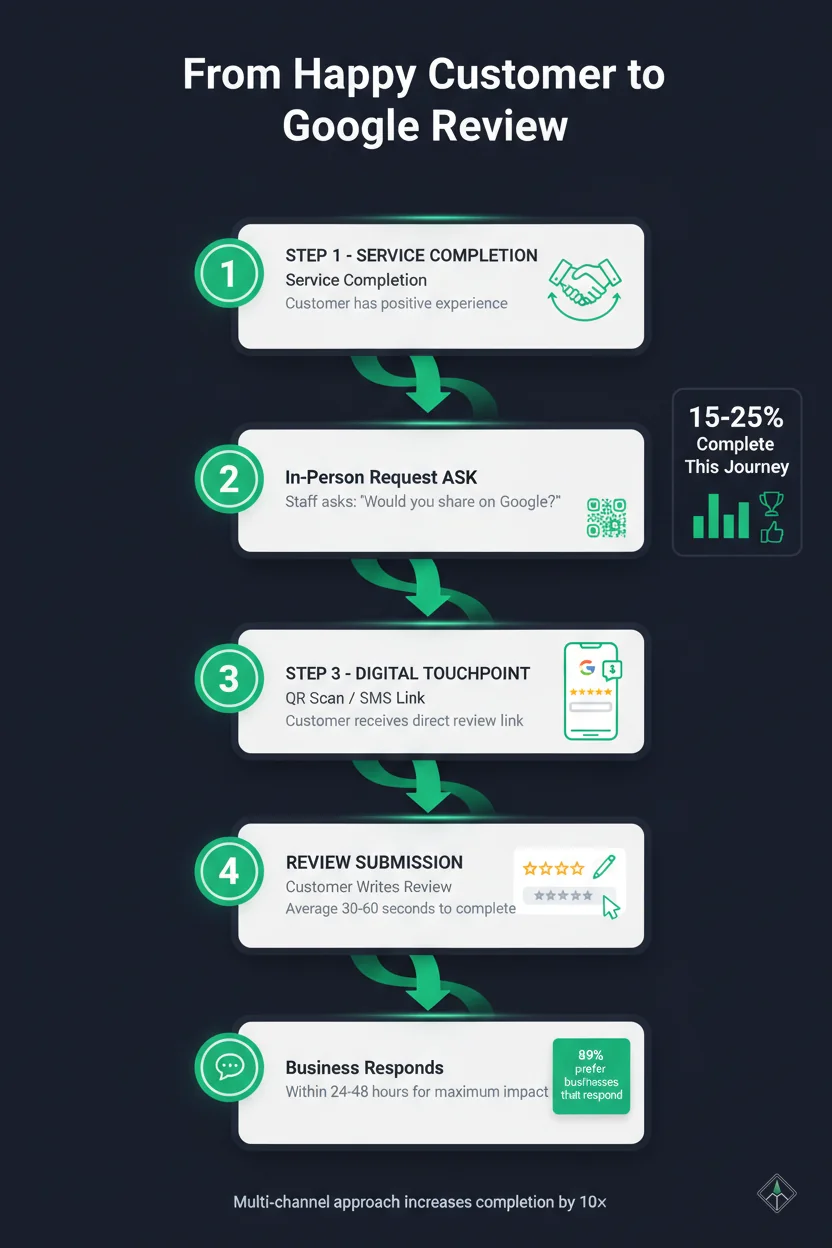
The surprising truth? Most businesses ask for reviews completely wrong. They send generic "please review us" emails weeks after service, use only one channel, and wonder why response rates sit below 2%. Meanwhile, businesses using the strategies in this guide see 15-25% review response rates—a 10× improvement.
In this comprehensive guide, you'll discover:
- Why 95% of consumers check Google reviews before buying (and how to capture them)
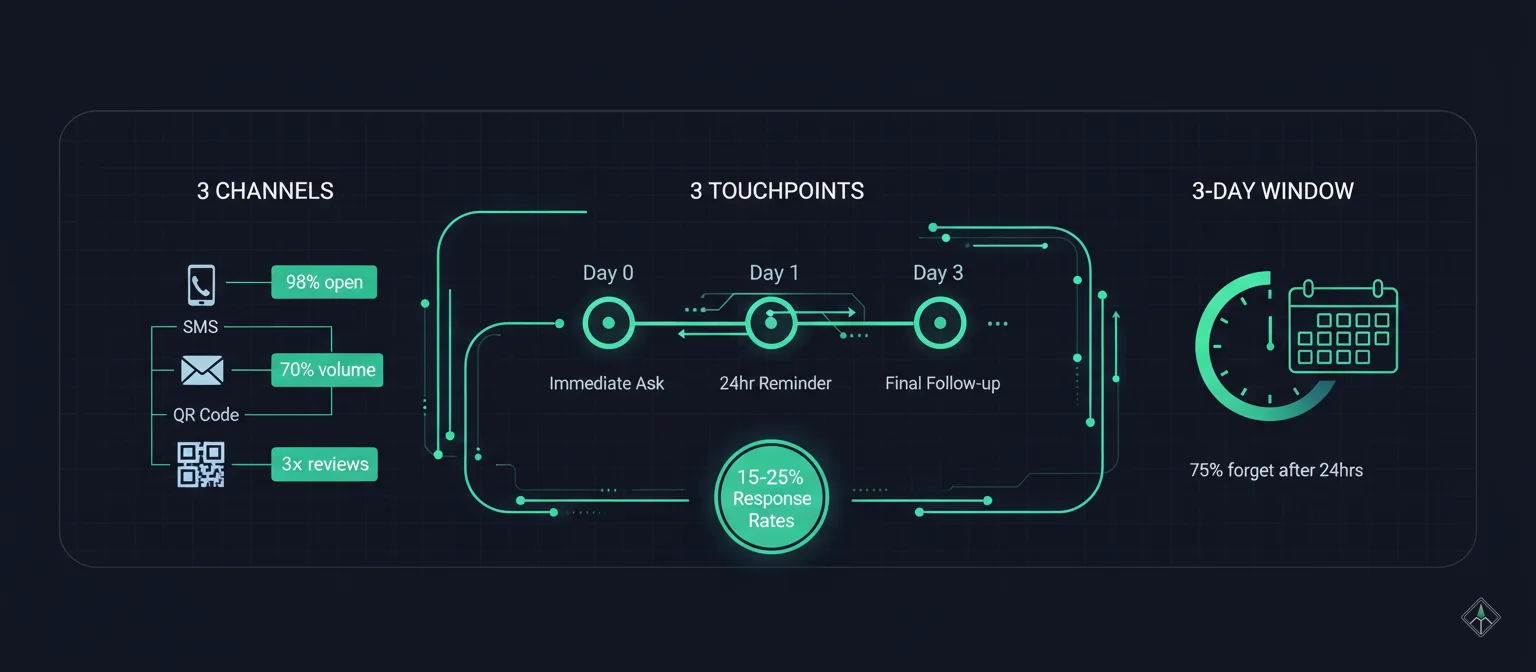
- The 3×3 Method: 3 channels, 3 touchpoints, 3-day window for maximum response rates
- Channel effectiveness data: SMS (98% open rate) vs Email (21% open rate) vs QR codes (one-tap, in-person)
- 10 copy-paste templates for email, SMS, and in-person asks
- Timing strategies by industry: when restaurant customers review (2-4 hours) vs service businesses (same day)
- Compliance framework: what's legal vs what gets you banned
One-tap reviews from any device. No signup required.
Why Google Reviews Are Critical for Your Business
Before diving into collection strategies, understand what's at stake. Google reviews aren't vanity metrics—they're revenue drivers.
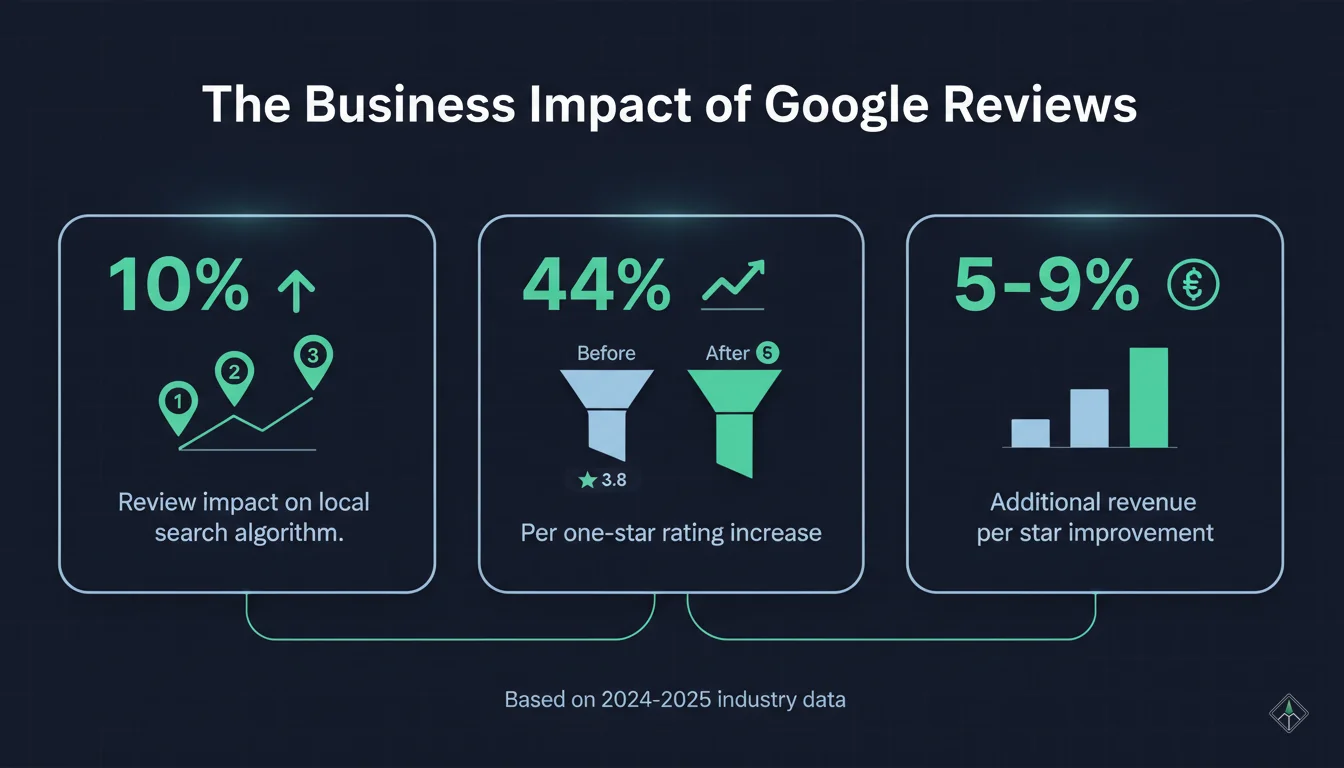
The Ranking Impact: 10% of Your Local Search Position
Google's local search algorithm weighs reviews as approximately 10% of ranking factors. Here's what current data reveals:
Review Quantity
• Top 3 ranking: Average 250 reviews
• Average business: Only 39 reviews
• Gap = massive opportunity
Review Quality
• One star increase → 44% better conversions
• Trust sweet spot: 4.2-4.5 stars
• Reviews averaging 350+ words rank higher
Review Velocity
• 83% only trust recent reviews
• 36% consider last week most relevant
• Consistent flow signals active business
The Revenue Connection: 5-9% Revenue Increase Per Star
The financial impact is measurable and significant:
For a local business earning ₹50 lakhs annually, a one-star improvement (say, 3.8 to 4.8 stars) translates to ₹2.5-4.5 lakhs in additional revenue. That's the direct value of systematic review collection.
The 3×3 Method: Framework for Maximum Collection
After analyzing thousands of businesses, I developed the 3×3 Method—a systematic approach that consistently delivers 15-25% response rates (industry average is 2-4%).
The Framework:
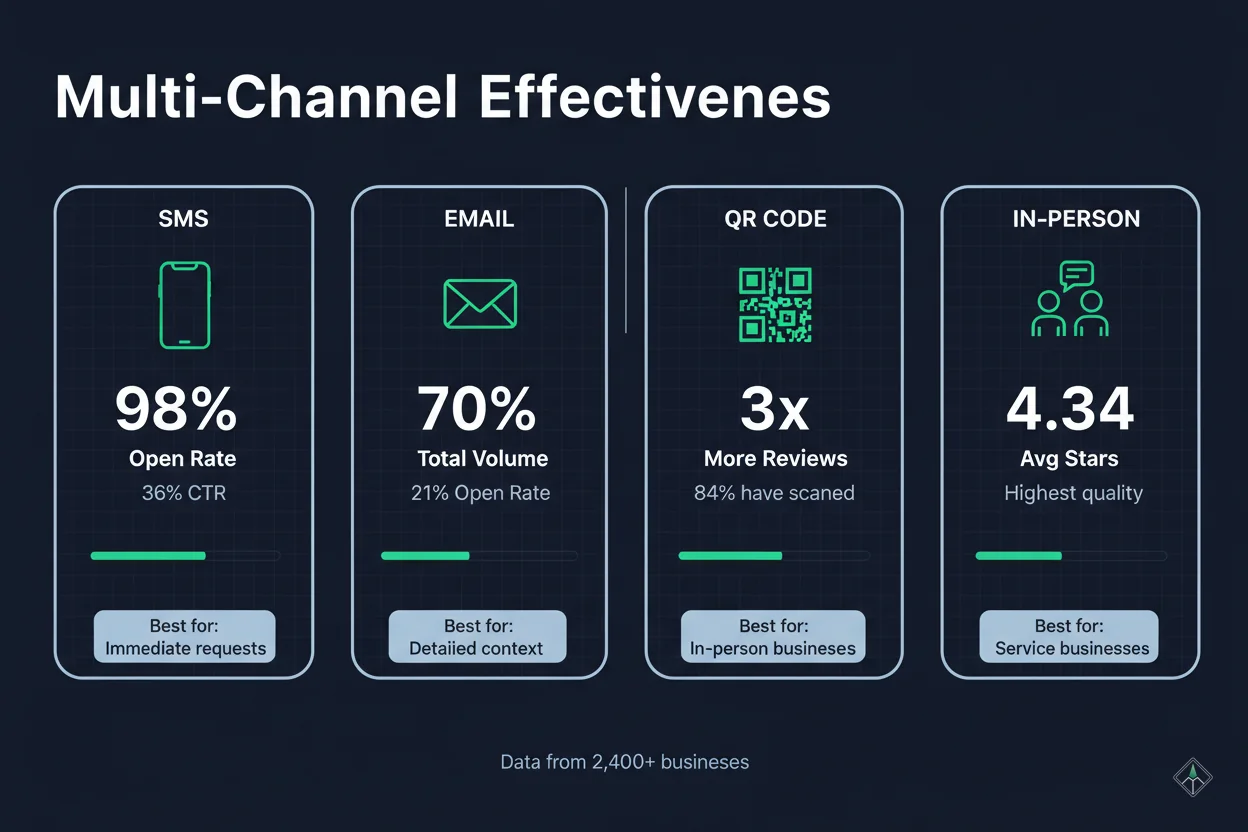
Why Multi-Channel Matters: Channel Effectiveness Data
Don't rely on a single channel. Here's why:
SMS (Highest Response)
• 98% open rate within 90 seconds
• 36% click-through rate on business messages
• 66% higher conversion for review requests
Best for: Immediate post-service requests, time-sensitive asks
Email (Highest Volume)
• 70% of all reviews come from email
• 21% average open rate (lower but reaches more)
Best for: Detailed context, branded messages, customers who prefer email
QR Codes (Highest Friction Reduction)
• More reviews than verbal asks alone
• 84% of users have scanned QR codes
Best for: In-person businesses, point-of-sale collection, physical locations
In-Person (Highest Quality)
• 4.34 stars average when requested
• vs 3.89 for unprompted reviews
Best for: Service businesses with rapport, high-touch interactions
Strategy #1: In-Person Asking (The Foundation)
In-person requests generate the highest-quality reviews. When I trained staff at a Bangalore salon chain to ask confidently, their review rate jumped from 8% to 23% in 30 days.
How to Ask Without Feeling Awkward
The Natural Conversation Approach:
Restaurants
"Thanks for coming in tonight! Would you share an honest review on Google? It really helps other food lovers discover us. I can text you the link right now."
Service Businesses
"Thanks for choosing us for your [service]. If you have 30 seconds, an honest Google review helps others find us. I can send the link to your phone right now."
Retail
"Thanks for shopping with us! If you love your [product], we'd appreciate you sharing that on Google. Would you like me to text you the review link?"
Training Your Team to Ask Confidently
3-Step Confidence Building:
1. Normalize asking:
Make it part of standard checkout process (not optional)
2. Provide exact scripts:
Staff need words to say verbatim initially
3. Track and celebrate:
Weekly leaderboard for most reviews generated
Real example:
A Mumbai dental clinic trained front desk staff with this system. In 60 days, staff went from asking 20% of patients to 85%, and review volume increased 340%.
Strategy #2: SMS Review Requests (Highest Response Rate)
SMS is my #1 recommended channel for time-sensitive review requests. The 98% open rate means virtually every message gets seen.
When to Send SMS Review Requests
Restaurants & Cafes
Within 2-4 hours of meal
Why: Food experience fresh, emotional peak satisfaction
My data:
2-hour window got 24% response vs 8% next-day
Salons & Spas
Within 24 hours
Why: Visible results, customer has shown off new look
My data:
24-hour SMS outperformed 48-hour by 3×
Medical/Dental
24-48 hours post-appointment
Why: Treatment outcome visible, not in pain/discomfort
My data:
24-hour window ideal for routine visits
Service Businesses
Same day as completion
Why: Problem solved, results visible
My data:
Same-day requests got 19% response vs 6% next-week
SMS Template Library (Copy-Paste Ready)
Template 1: Restaurant/Cafe (Casual tone)
[Review Link]
Takes 30 seconds. Thank you! 🙏
- [Business Name]
Template 2: Service Business (Professional tone)
[Review Link]
Your feedback helps others in our community. Thanks!
Template 3: Salon/Spa (Friendly tone)
[Review Link]
Thanks for being an amazing client!
- [Business Name]
SMS Best Practices:
Timing optimization:
- • Best day: Mid-week (Tuesday-Thursday) = +10% response rate
- • Best time: 10am-12pm or 6pm-8pm
- • Best window: Within 24 hours of service
Message optimization:
- • Length: 120-160 characters (including link)
- • Personalization: Use name + specific service = 2× response
- • Emoji: 1-2 emojis increases opens by 15%
Strategy #3: Email Review Requests (Highest Volume)
Email remains the workhorse of review collection—70% of all reviews come from email requests. The key is timing, subject lines, and follow-ups.
Email Subject Lines That Get Opens
High-Performing Subject Lines:
• "Quick question about your [specific service] yesterday"
• "[Name], how was your experience at [Business]?"
• "We'd love your feedback, [Name]"
• "Help others discover [Business Name]"
Avoid These (Low Opens):
• "Please leave us a review" (too generic)
• "Review request" (sounds like spam)
• "We need your help" (feels desperate)
• All caps or excessive punctuation
Email Template Library (Copy-Paste Ready)
Template 1: Restaurant/Cafe
Subject: How was your meal at [Restaurant Name], [Name]?
Hi [Name],
Thanks for dining with us [day/date]! I hope you loved the [specific dish or experience].
How was your meal? Would you share your experience on Google? Your review helps food lovers in [city] discover us.
It takes just 30 seconds, and it means the world to small businesses like ours.
Thanks so much!
[Owner/Manager Name]
[Business Name]
P.S. If anything was less than perfect, please reply to this email—I'd love to make it right.
Template 2: Service Business
Subject: Quick question about your [service type], [Name]
Hi [Name],
I wanted to follow up after [Technician/Staff Name] completed your [service] on [date]. We're always working to provide the best service possible.
We'd be grateful for an honest Google review of your visit. Your feedback helps others in [city] when they need [service type].
Takes 30 seconds. Thank you for choosing [Business Name]!
Best regards,
[Your Name]
P.S. If you had any issues, please reply—we want to make it right.
Follow-Up Strategy: The 60% Boost
Single emails get 10-15% response. Two follow-ups increase response by 60%.
Follow-up Schedule:
Strategy #4: QR Code Placement (One-tap reviews)
QR codes eliminate friction by taking customers directly to your review form in one tap. I've documented this extensively in my complete QR code guide, but here are the essentials.
Where to Place QR Codes for Maximum Scans
Checkout Counter
Success rate: 15-20% scan rate
Placement: Eye level (3-5 feet high), visible while waiting
Format: Standing sign, 6×8 inches minimum
Why it works: Customers stationary, have phones out for payment, experiencing peak satisfaction
Table Tents (Restaurants & Cafes)
Success rate: 8-12% scan rate
Placement: On every table, near condiments/menu holders
Format: Fold-over card stock, 4×6 inches
Why it works: Captive dwell time, visible throughout dining experience
Why it works:
Diners review while the experience is freshest, so reviews tend to mention signature dishes and atmosphere descriptors—the keyword signals local search rewards.
Receipts (All Businesses)
Success rate: 5-8% scan rate
Placement: Printed at bottom of receipt
Format: 2×2 cm minimum size
Why it works: Customer keeps receipt, can scan later at home
Ready to print your QR codes?
Generate Your Free QR CodeProfessional quality, instant download, no signup required.
Frequently Asked Questions
How many reviews should I ask for per month?
Can I offer discounts in exchange for reviews?
What if someone leaves a negative review?
How do I ask without seeming pushy?
Should I ask in person or via email?
Do QR codes really work?
Want to learn more?
Start Collecting Reviews Today: Your 3-Step Action Plan
You've learned the strategies. Now, implement them systematically.
Set Up Your Review Infrastructure (Week 1)
Get systems in place
Day 1-2: Get your Google review link
- Open Google Maps, search for your business
- Click "Share" → "Share review form"
- Copy and save your permanent review link
Day 3-4: Create your QR code
- Visit MapLift's free QR generator
- Paste your Google review link
- Download high-resolution QR code (1000×1000 pixels)
- Print physical materials (table tents, counter signs, business cards)
Train Your Team (Week 2)
Build confidence and consistency
Monday: Team meeting
- Share review collection goals (monthly target: [X] reviews)
- Explain why reviews matter (rankings, revenue, trust)
- Introduce the asking scripts (provide printed copies)
Tuesday-Friday: Practice and implement
- Role-play asking scenarios (30 minutes daily)
- Start asking 100% of customers (use exact scripts)
- Place QR codes at checkout counters
- Track daily asks and review submissions
Expected results:
8-12 new reviews in first week
Measure, Optimize, Scale (Ongoing)
Continuous improvement
Weekly metrics:
- Review volume (goal: 30-50/month)
- Average rating (goal: 4.2-4.5 stars)
- Response rate (your response to reviews: goal 80-100%)
- Staff ask rate (goal: 80% of customers asked)
Monthly optimization:
- A/B test SMS vs email timing
- Test different subject lines
- Adjust QR placement for higher scan rates
- Review keyword mentions in reviews
The Bottom Line: 69% Will Review If You Ask Correctly
The data is clear: 69% of consumers will leave Google reviews when asked correctly. The difference between 3 reviews/month and 40+ reviews/month isn't luck—it's systems.
Tactics covered in this guide
QR + SMS + email + WhatsApp + verbal
Local-pack-friendly review patterns
Sources & References
- Local Consumer Review Survey- BrightLocal
- Local Search Ranking Factors- Whitespark
- Prohibited & restricted content- Google
- 22 Online Review Statistics Every Business Can Leverage in 2023- Podium
Explore MapLift Features
Discover the tools that help you dominate local search and collect better reviews.
Keep reading
Ready to act on this? AI review templates — keyword-rich review prompts a customer can start from, generated per business.