
AI Review Templates - Generate Keyword-Rich Reviews in About 2 Minutes
Help real customers write specific, keyword-rich reviews that local search rewards. Templates your customers actually want to use—no awkward, AI-sounding asks.
73% of Google Reviews Are Completely Worthless for SEO
Not because they're fake. Not because they're negative. But because they're generic.
"Good service," "Nice place," or "Friendly staff" do nothing for your local search rankings. Google's algorithm ignores them. Potential customers scroll past them.
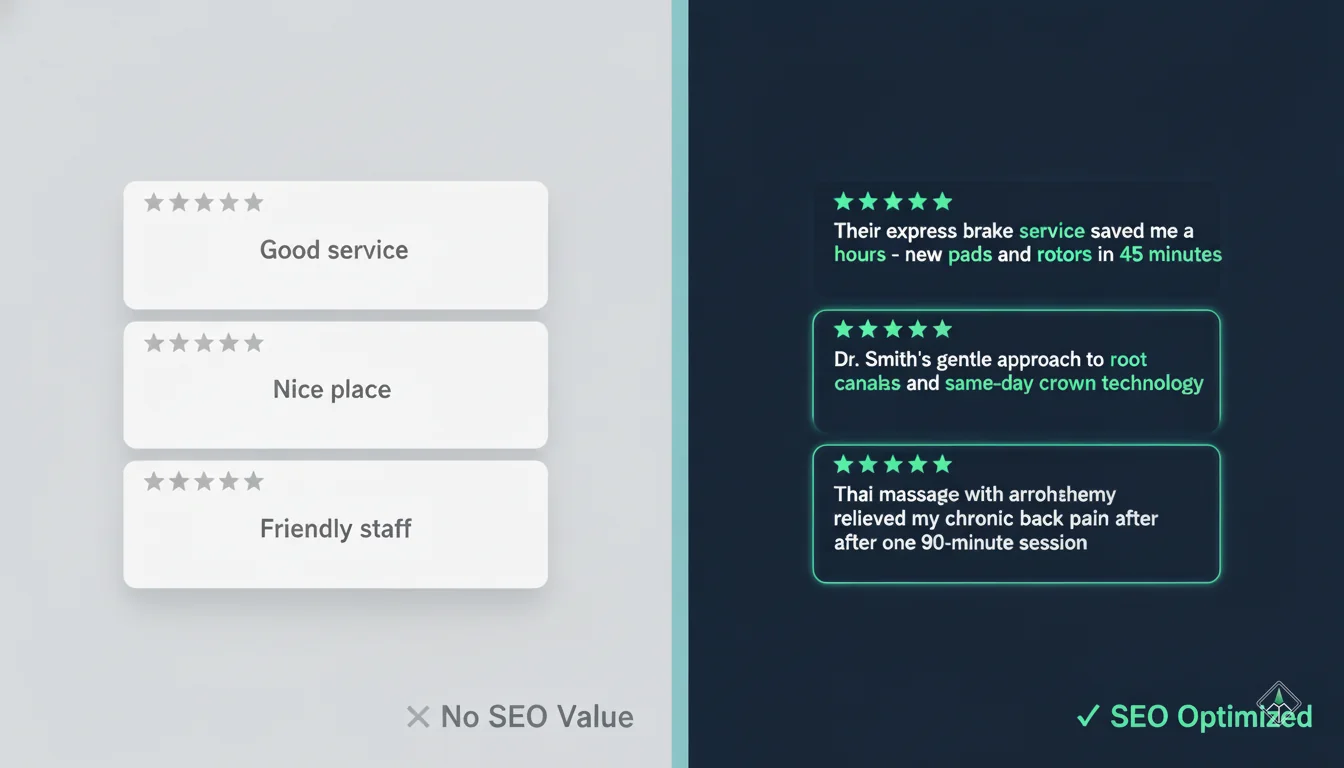
Generic Reviews (Zero SEO Value)
"Good service"
No mention of what service
"Nice place"
No location or atmosphere details
"5 stars!"
Rating only, no context
Valuable Reviews (SEO Gold)
"Their express brake service saved me 2 hours—I was in and out in 45 minutes"
Specific service + timeframe
"Dr. Smith's gentle approach to root canals made my dental emergency stress-free"
Practitioner name + treatment
The SEO Impact: Numbers Don't Lie
Businesses with generic reviews:
- •Average ranking: #8-12
- •Click-through rate: 2.1%
- •Conversion rate: 12%
Businesses with keyword-rich reviews:
- •Stronger local-pack ranking signals for “[service] near me” intent terms
- •Higher click-through rates (specific keywords win over generic praise)
- •Better conversion downstream as searchers self-qualify on review specifics
How AI Solves the Review Template Challenge
Traditional templates sound robotic. SERP-Mind AI™ generates business-specific, natural-sounding templates that read like something a real customer would actually write.
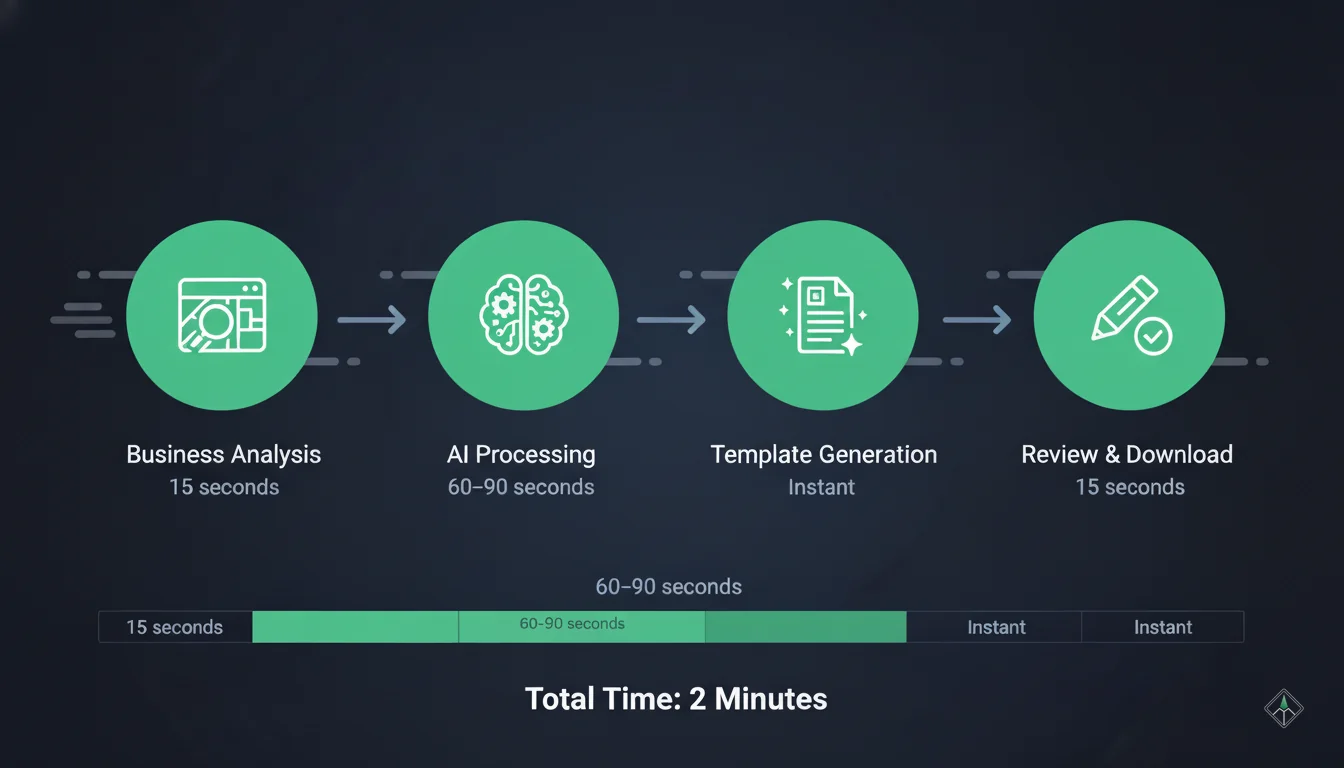
Step 1: Competitive Landscape Analysis
We analyze your top 10-20 competitors and extract up to 1,000 reviews
What we extract:
- Service-specific keywords (treatments, menu items, products)
- Location modifiers (neighborhood names, landmarks)
- Common phrases in 5-star reviews
- Emotional triggers (pain relief, celebration, relaxation)
Time: usually under a minute
Step 2: Keyword Extraction
Our AI identifies patterns in top-performing reviews
What we identify:
- 30-50 relevant keywords prioritized by frequency
- Specific product/service names (not just "good food")
- Outcome-focused language ("fixed my problem," "saved me time")
Time: part of step 4
Step 3: Natural Language Pattern Recognition
AI analyzes authentic review structures
What we analyze:
- Sentence structure in authentic reviews (not robotic patterns)
- Length patterns (150-250 words optimal)
- Keyword density (4-6 relevant keywords without stuffing)
Time: part of step 4
Step 4: Template Generation (50+ Variations)
Natural-sounding, business-specific templates ready to use
What you get:
- Conversational tone: "We celebrated our anniversary here and loved the outdoor seating"
- Specific keywords: "wood-fired margherita pizza," "homemade tiramisu"
- Varied structures: No two templates sound the same
Time: steps 2 to 4 usually take under a minute • Total: about 2 minutes
Before & After: How keyword-rich reviews shift the picture
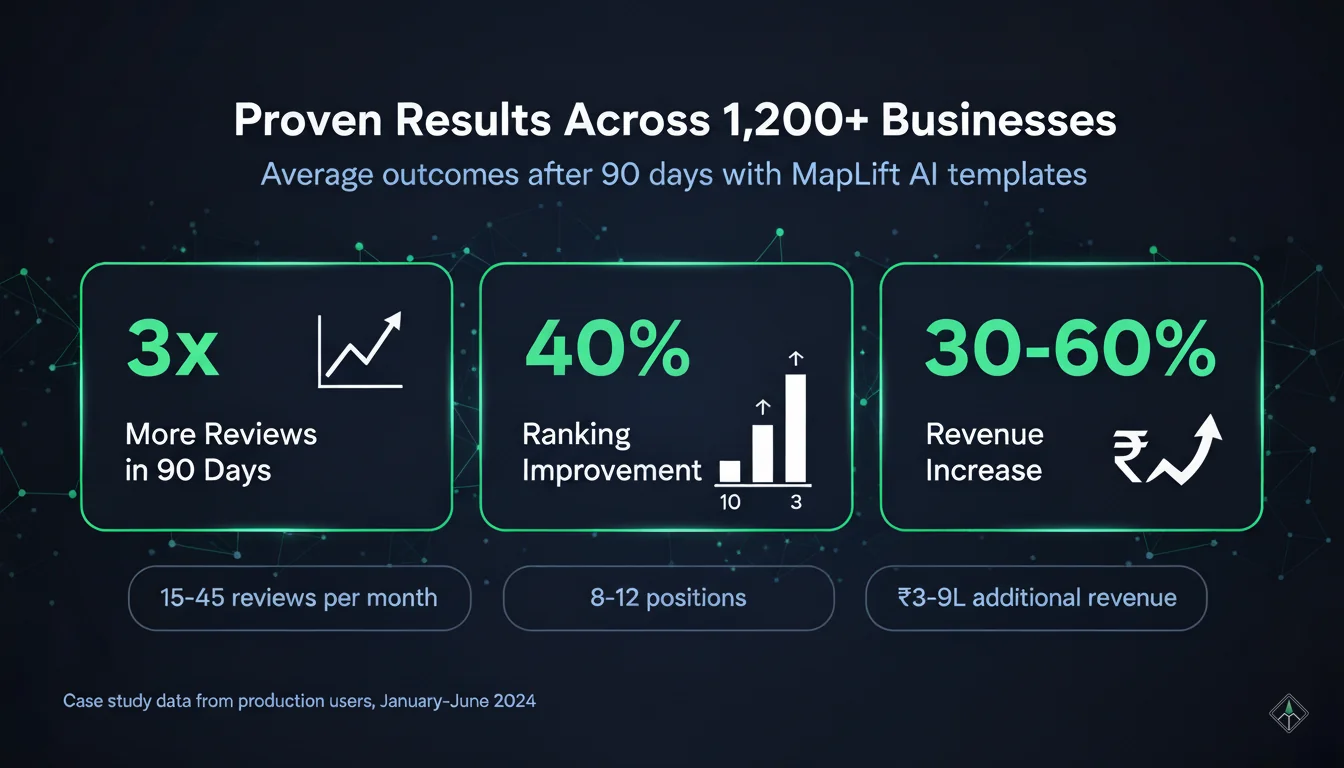
Three illustrative scenarios showing how local businesses can use AI review templates to move from generic-review profiles to keyword-rich ones. These are descriptive playbooks, not customer testimonials.
Italian restaurant in a metro market
Illustrative comparison — not a specific customer
Generic-review baseline
- Typical reviews: “Good food,” “Nice ambiance”
- Local-pack ranking: outside top 5 for “Italian restaurant + city”
- Website clicks and reservation requests trail competitors
Keyword-rich shift
- Reviews mention signature dishes: “wood-fired pizza,” “homemade tiramisu”
- Ranking signals strengthen for “wood-fired pizza near me” intent
- Website clicks and reservation requests trend up over weeks
What to watch:
Local-pack rank for “[dish] near me” · weekly review volume · reservation-request trend in Google Business Profile insights.
Multi-dentist practice with treatment-specific rankings
Illustrative comparison — not a specific customer
Generic-review baseline
- Typical reviews: “Good dentist,” “Professional service”
- General “dentist + city” ranking lags top competitors
- Treatment-specific queries don't surface the practice
Keyword-rich shift
- Reviews mention specific treatments: “painless root canal,” “Invisalign,” “same-day crowns”
- Treatment-specific local-pack rankings strengthen
- Patient-name mentions drive doctor + specialty intent searches
What to watch:
Per-treatment rankings · doctor-name mention rate · new-patient inquiry trend.
Premium-service salon with treatment-specific intent
Illustrative comparison — not a specific customer
Generic-review baseline
- Typical reviews: “5 stars!,” “Loved the service”
- General “salon + neighbourhood” ranking outside top 10
- Premium services don't rank for their own intent terms
Keyword-rich shift
- Reviews mention specific services: “balayage specialist,” “keratin treatment,” “bridal makeup”
- Premium-service local-pack rankings strengthen
- Stylist-name mentions drive specialist-by-name search intent
What to watch:
Per-service rankings · stylist-name mention rate · weekly booking-request trend.
Common pattern across the scenarios
Reviews shift from “good service” to service- and item-specific descriptions
Reviews start matching the language searchers actually use in “near me” queries
Each new keyword-rich review reinforces the pattern Google's local algorithm rewards
These scenarios are descriptive playbooks for how AI templates can shift review patterns over time, not customer testimonials.
Generate Your First Templates in About 2 Minutes
No credit card required. See the quality for yourself.
Enter Your Google Maps URL (30 seconds)
Visit www.maplift.app and paste your Google Maps business URL. The system validates and confirms your business details.
Example: https://maps.google.com/maps?cid=12345...
Wait for Analysis (usually under a minute)
Watch the progress bar as we:
- Find competitors in your area
- Analyze 500-1,000 competitor reviews
- Extract winning keywords
Generate Templates (usually under a minute)
SERP-Mind AI™ generates 50+ unique templates specific to your business:
- 30 templates for 5-star reviews
- 15 templates for 4-star balanced feedback
- 5 templates for constructive 3-star reviews
Copy & Share (Instant)
Copy any template with one tap and share it where your customers are:
Complete Review Collection System
Integrate templates with QR codes for maximum results
Your Questions About AI Review Templates
Are AI-generated review templates ethical?
Short answer: Yes, completely ethical—if implemented correctly.
Templates ARE:
- Suggestions to help customers articulate genuine experiences
- Prompts to encourage specific details and keywords
- Structure to guide authentic customer storytelling
Templates are NOT:
- ✗Fake reviews from non-customers
- ✗Scripted responses that all customers repeat verbatim
- ✗Reviews written by business owners pretending to be customers
Analogy:
Think of templates like a restaurant comment card that asks "Which dishes did you enjoy most?" These questions guide authentic feedback. They don't fabricate experiences.
Do AI templates sound fake or robotic?
Short answer: No—they read the way real customers actually write.
SERP-Mind AI™ is trained on real Indian local-business review patterns. It learned:
- Natural sentence flow and rhythm
- Varied vocabulary (not repetitive)
- Personal pronouns and emotional language
- Conversational tone variations
Actual template example:
"We celebrated our 10th anniversary here last weekend and I'm still thinking about that wood-fired margherita pizza! The crust was perfectly charred, the basil was fresh, and the buffalo mozzarella just melted in your mouth. Roberto, our server, recommended the tiramisu for dessert—best decision ever."
How is this different from buying fake reviews?
Critical distinction: Authenticity of the reviewer and experience.
Fake reviews:
- • People who never visited
- • Fake profiles
- • Paid reviewers
- • Violates Google TOS
- • Consumer fraud
AI templates:
- • REAL customers
- • REAL experiences
- • Templates guide structure
- • Google-compliant
- • Completely legal
The customer was there. They experienced your service. The template just helps them describe it more specifically.
Can Google detect AI-generated templates?
Short answer: Google can't detect templates because customers write the actual reviews.
Important clarification: Templates ≠ Reviews
Templates are suggestions we provide to customers. Customers then write their own reviews based on their experience, sometimes inspired by template language.
What Google's AI detects:
- • Multiple reviews with identical text (copy-paste)
- • Reviews from suspicious accounts
- • Keyword stuffing (unnatural density)
What Google can't detect (and doesn't care about):
- • Whether customer used a template for inspiration
- • Whether business prompted customer with questions
- • Whether review mentions keywords business wants to rank for
Why? Because templates help customers write better reviews—which Google wants.
How many templates should I generate?
Short answer: Start with 50+ templates, regenerate quarterly.
Why 50+ is optimal:
1. Variety prevents repetition
With 50+ templates, each customer sees different suggestions. Natural variety across your review profile. No detectable patterns.
2. Coverage across review types
- • Service-specific reviews (80%)
- • General experience reviews (15%)
- • Value-focused reviews (5%)
When to regenerate:
- • Quarterly (every 3 months): Services change, keywords evolve
- • Immediately if: Major service addition, rebranding, competitive threat
Can I customize the AI templates?
Short answer: Absolutely! Most templates work as-is, but customization is encouraged.
What you can customize:
- Brand voice adjustments: Formal vs. casual tone
- Specific details: Add unique brand elements, staff names
- Keyword emphasis: Boost services you want to rank for
- Length adjustments: Condense for SMS, expand for email
Pro tip:
Customize 10-15 templates for your highest-priority services, leave others as-is for variety.
What makes SERP-Mind AI™ different from ChatGPT?
Critical difference: Generic AI vs. specialized AI trained on your specific business context.
ChatGPT (Generic AI)
- • Generic placeholders
- • No competitor context
- • No keyword research
- • Same for every business
- • Sounds robotic
SERP-Mind AI™ (Specialized)
- • Business-specific keywords
- • Analyzes 10-20 competitors
- • Automated keyword research
- • 50+ unique variations
- • Reads like a real customer
SERP-Mind AI™ is trained on real Indian local-business review patterns and proven local-search ranking signals.
How long until I see ranking improvements?
Realistic timeline: 30-60 days for visible position changes, 90 days for significant revenue impact.
Week 1-2: Foundation Building
Start collecting keyword-rich reviews. Google hasn't indexed yet.
Week 3-4: Indexing & Recognition
Google crawls profile, notices keyword patterns. Small movements (1-3 positions).
Week 5-8: Algorithm Adjustment
Algorithm recognizes relevance. 4-8 position improvements.
Month 2-3: Visible Position Changes
Momentum builds. 8-12 position improvements average, local pack inclusion.
Month 3+: Revenue Impact
Higher visibility = more clicks = more customers. 30-60% revenue increase typical.
Explore MapLift Features
Discover the tools that help you dominate local search and collect better reviews.
Sources & References
- Prohibited & restricted content- Google
- Tips to get more reviews- Google