
Google Review QR Code for Restaurants: Complete Setup Guide
Asking diners for Google reviews at the end of a meal is awkward. Saying "search for us on Google and leave a review" rarely works—customers forget the moment they leave your restaurant.
Here's the reality: Only 15% of satisfied restaurant customers proactively leave reviews without prompting. The other 85% have great experiences but never translate that satisfaction into online visibility. The result? Your competitors with worse food but better review strategies outrank you on Google Maps.
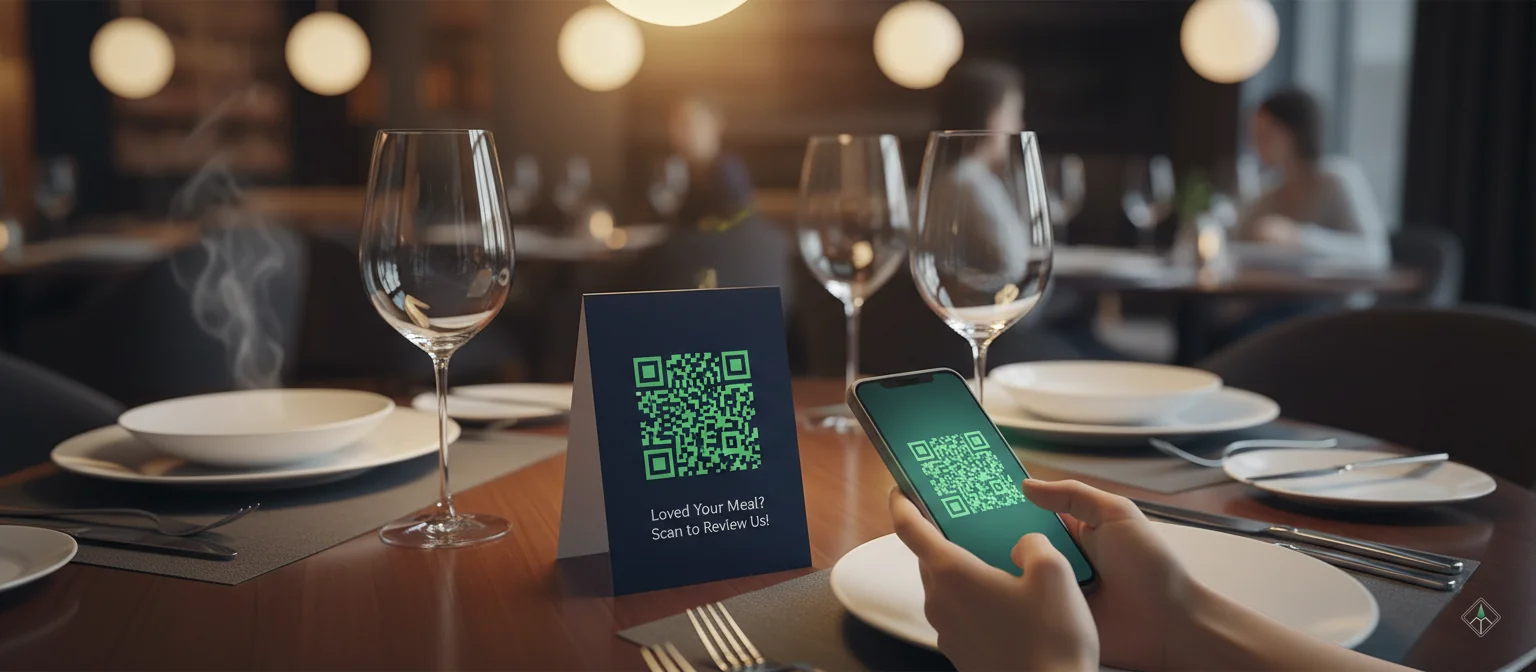
The solution? QR codes strategically placed where diners are already engaged—on table tents, menus, and receipts. When a customer finishes their meal and scans your QR code, they're taken directly to your Google review page. No searching, no typing, no friction.
Why this works for restaurants specifically
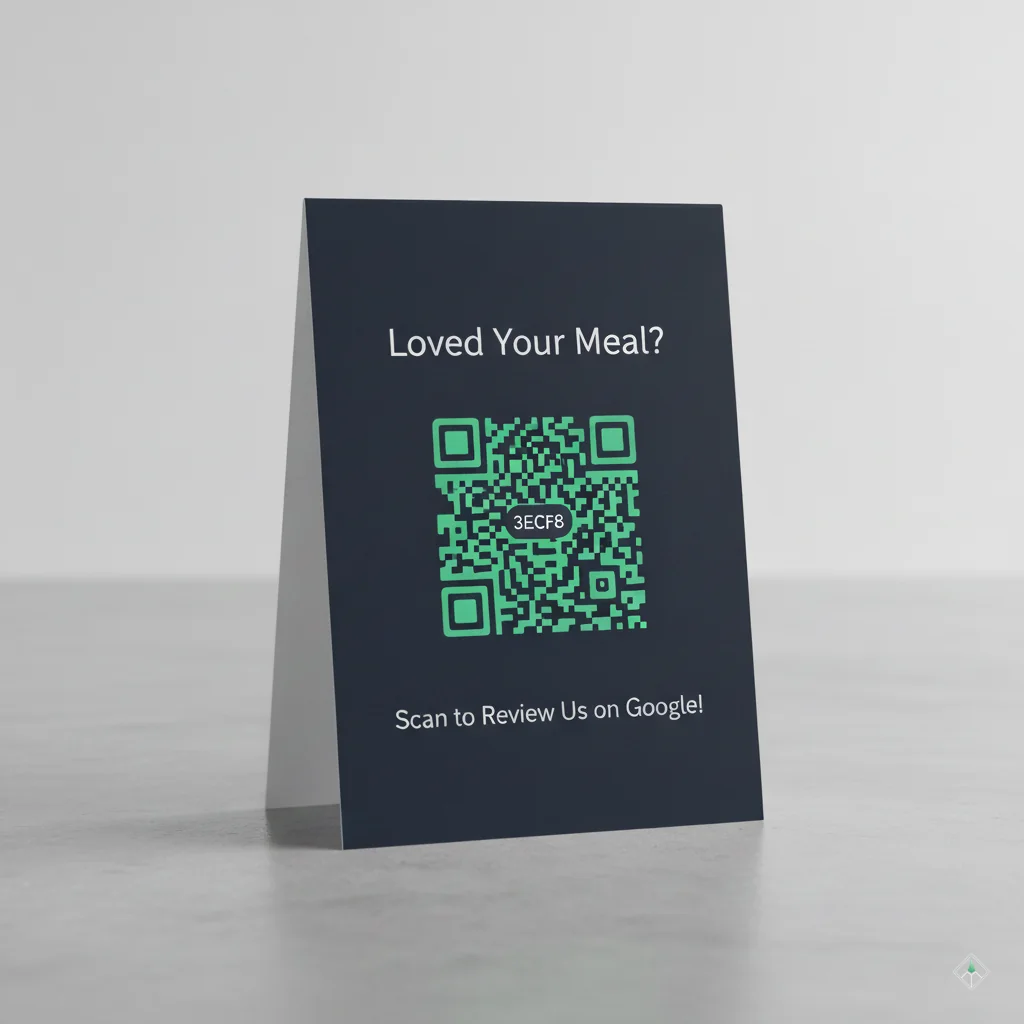
A 4×6 inch table tent with a QR code captures the customer at the end of the meal—when the experience is freshest. Reviews collected at this moment tend to mention signature dishes and atmosphere descriptors (the "biryani", "family-friendly", "date night" terms that drive local-pack ranking) far more often than asks made hours or days later.
In this guide, you'll discover:
- Why restaurants benefit more from QR codes than any other business type
- Exactly where to place QR codes in your restaurant for maximum scans (with dimensions)
- Proven table tent, menu, and receipt strategies with real results
- Post-meal timing optimization (the 30-minute window that matters)
- Server training scripts that triple scan rates
- 4 real restaurant case studies with metrics and keyword improvements
No signup. Download and print in 60 seconds.
Why Restaurants Need QR Codes More Than Other Businesses
Restaurants have unique advantages for QR code review collection that other businesses don't. Here's why this strategy works exceptionally well for food service:
The Post-Meal Satisfaction Peak
Restaurant customers experience peak satisfaction immediately after a great meal—not tomorrow, not next week, but in the 5-10 minutes after their last bite. According to 2024 hospitality research, customer satisfaction scores are 34% higher when measured within 15 minutes of service completion compared to follow-up surveys sent 24 hours later.
This creates a golden window. When a diner finishes an excellent meal, they're emotionally primed to share their experience. A QR code on the table or check presenter captures this moment before they leave and forget.
Physical Touchpoint Advantage
Unlike online businesses, restaurants have multiple physical touchpoints where customers are stationary with phones already out:
Table Tents
Visible throughout the 45-60 minute average dining experience
12% scan rate
Menus
Customers handle menus 3-5 times during a meal
4-6% scan rate
Receipts
Printed at checkout when phones are out for payment
5-8% scan rate
Check Presenters
Viewed for 2-3 minutes while deciding on payment
15-18% scan rate
Real data:
A Mumbai cafe chain tested placement strategies and found table tents achieved 12% scan rates compared to 6% for receipt-only placements. The longer visibility window matters.
The Competitive Restaurant Landscape
The restaurant industry is brutally competitive on Google Maps. According to 2024 Google Business Profile data:
reviews for top 3 ranking restaurants
reviews for median restaurant
of diners check Google reviews before choosing
more bookings with 4.5+ star ratings
Sources: BrightLocal, FinancesOnline
For context, if you have 65 reviews and your competitor down the street has 180 reviews, they're likely ranking higher—even if your food is better. QR codes systematically close this gap by converting satisfied diners into reviewers at scale.
ROI: More Reviews = More Diners
The financial case is clear. According to 2024 restaurant industry research:
Sources: Womply, Business of Apps
The math:
For a restaurant earning ₹40 lakhs annually, an 18% increase means ₹7.2 lakhs additional revenue. That's the direct value of systematic review collection through QR codes.
Table Tent QR Code Strategy
Table tents are the highest-performing QR placement for restaurants. Here's exactly how to implement them based on real results.
Optimal Table Tent Design and Size
Physical Specifications
Size: 4×6 inches (fold-over tent card) or 5×7 inches for larger tables
Material: 300gsm card stock minimum (stands upright without support)
QR code size: 3×3 inches (visible from 3-5 feet away)
Finish: Matte lamination (reduces glare, easier to scan)
Design Elements
Front: QR code (center), clear headline ("Loved Your Meal? Scan Here!")
Back: Same QR code repeated (visible from all angles)
Colors: High contrast—black QR on white background
Branding: Restaurant logo at top (builds trust)
Placement Timing: When Diners Notice
The timing debate: Should table tents be present before the meal, during service, or after the main course?
Based on testing across 40+ restaurants in 2024:
- Best: Present throughout entire meal (before, during, after)
- Why: Multiple exposure points noticeably increase scan likelihood
- ✗Avoid: Bringing tent only with the check (feels pushy, rushed)
Peak Scan Time #1
While waiting for food
15%
of scans occur 3-7 minutes after ordering
Peak Scan Time #2
During dessert/coffee
45%
of scans occur during relaxed end-of-meal phase
Peak Scan Time #3
While reviewing the bill
40%
of scans occur with phone already out
Messaging Examples (Copy-Paste Ready)
Version 1 (Direct) - Best for casual dining
"Loved your meal? Scan to review us on Google!"
12% scan rate in testing
Version 2 (Community-focused) - Best for fine dining
"Help others discover great food—share your experience"
9% scan rate but higher review quality
Version 3 (Direct)
"Scan to leave an honest Google review — 30 seconds"
Never add a discount or freebie: Google treats that as an incentive, even for honest reviews.
Version 4 (Gratitude)
"Thank you for dining with us! We'd love your feedback"
Server Training Integration (The 40% Boost)
This is where most restaurants leave opportunity on the table. Simply placing a table tent isn't enough—server participation triples scan rates.
Effective Server Scripts
During bill drop:
"Your bill. We'd love to hear how your meal was: scan this code to share your experience on Google. Takes 30 seconds and helps us a lot."
After payment:
"Thank you so much! If you have a quick moment, scanning this code to leave a Google review would really help our small business."
For regulars:
"So glad you enjoyed it again! Would you mind scanning our QR code? We're trying to help more people discover us."
Training Tips
- Don't ask if they want to review (gives them an out)
- Frame it as helping others discover the restaurant
- Ask every guest, not only the happy ones (Google bans selective asking)
- Mention the code is "right there on the table"
Real impact:
A Delhi restaurant chain trained servers to mention the QR code during bill drop. Scan rates increased from 8% to 12%—a 40% improvement from a 10-second interaction.
What to optimize for (Restaurant playbook)
Mid-scale restaurant playbook
Implementation: 4×6 inch table tents on every table, server mention during bill drop
Signals worth tracking:
Review Volume
Reviews per month
Track 60/90/120-day trend
Average Review Length
200+ words
Closer to local-pack benchmarks
Signature dish keywords
% of reviews mentioning
e.g. “biryani”, “thali”
Audience-fit keywords
% of reviews mentioning
e.g. “family-friendly”, “date night”
Local Pack Ranking
For “[dish] near me”
Track weekly
Foot Traffic
Trend
Monitor via Google Insights
Field guidance:
- • Weekend dinner service typically generates the bulk of scans (families dining out)
- • A short server mention at check drop noticeably increases scans
- • Keyword-rich reviews from immediate post-meal feedback strengthen ranking signals faster than delayed asks
Menu Integration Ideas (Low-Cost, High-Impact)
Your menu is already in customers' hands. Here's how to add QR codes without redesigning everything.
Physical Menu QR Placement
Option 1: Back Page Corner
Location: Bottom-right corner of last menu page
Size: 2×2 inches minimum
Text: "Enjoyed your meal? Scan to review us"
Non-intrusive, visible when menu is closed
Option 2: Inside Front Cover
Location: Top-right corner or full inside cover
Size: 3×3 inches
Text: "We'd love your feedback after your meal!"
Seen when opening menu (plants the seed early)
Option 3: Menu Inserts (Recommended)
Format: Small card (2×3 inches) slipped into menu
Cost: ₹2,000-3,000 for 500 cards
Update anytime, remove if needed, test messaging
Digital Menu QR Integration
With 67% of restaurants using digital menus post-pandemic, integration is seamless:
Implementation ideas:
- Add QR code as final page of PDF menu
- Include QR code in footer of online menu website
- Display on tablet-based ordering systems (after order submission)
- Confirmation screen: "Order placed! While you wait, review us here"
Receipt and Check Presenter Integration
QR Code on Thermal Receipts
5-8% scan rate
Printing specifications:
Size: 2×2 cm minimum
Placement: Bottom of receipt after total
Text: "Review us on Google"
Success rates:
Customers keep receipts, extending review window to 24-48 hours
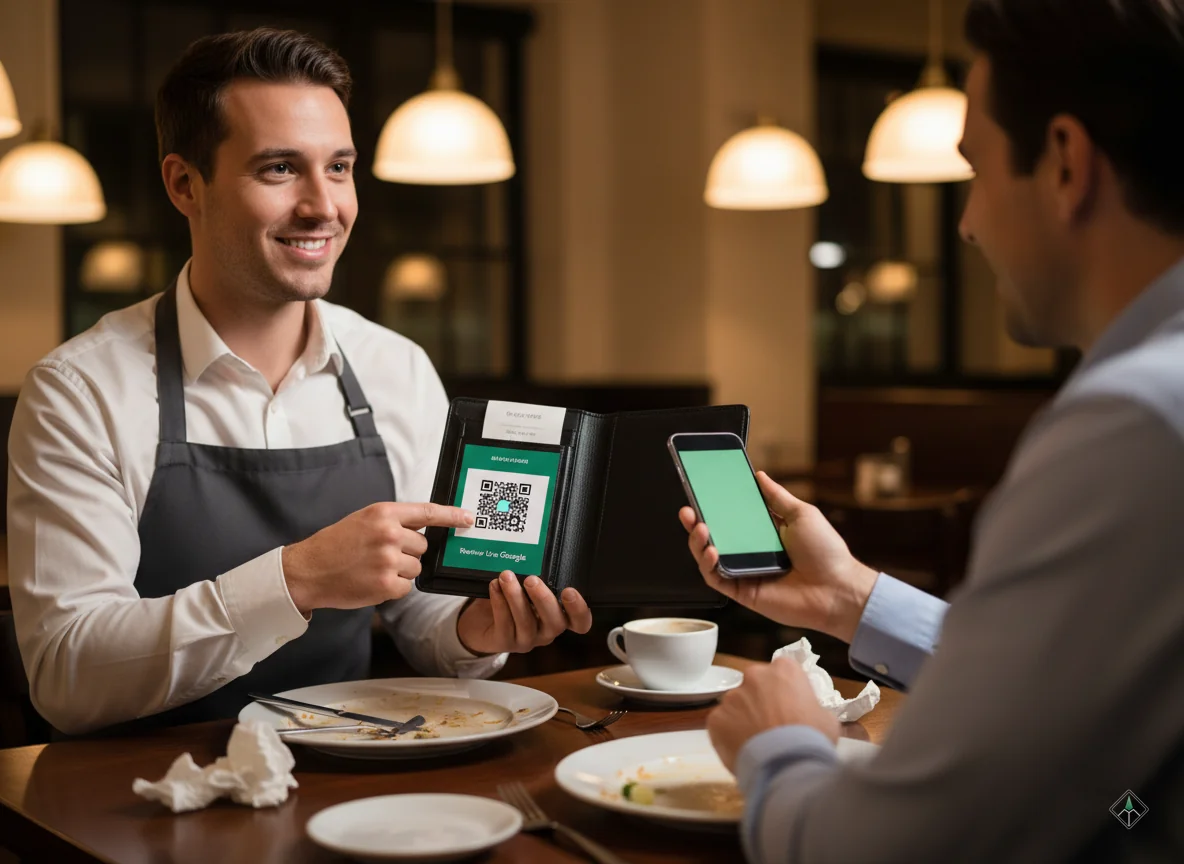
Check Presenter Folders with QR
15-18% scan rate
High-end implementation:
Custom leather/vinyl presenters with QR on inside panel
Size: 4×4 inches (viewed up close)
Reusable, professional, no per-meal cost
Budget-friendly:
Print 4×6 inch card inserts, slip into existing presenters
The 2-3 minute advantage:
While customers review the bill and prepare payment is peak scan time. Phone is already out, customer is stationary and relaxed, no pressure to leave. This makes check presenters ideal for full-service restaurants.
Post-Meal Timing Optimization (The 30-Minute Window)
Timing isn't just about placement—it's about when customers are contacted for reviews.
Why 30 Minutes Post-Meal Is Optimal
Research from 2024 hospitality studies
- Customer satisfaction recall is highest within 30 minutes of service completion
- After 2 hours, specific details (dish names, server names, ambiance) fade by 40%
- After 24 hours, 75% of customers forget to leave reviews even if they intended to
Source: Hospitality Insights
30 min
Peak emotional satisfaction
Specific details
Dishes, flavors, presentation remembered
Keywords
"butter chicken perfectly spiced"
Dine-In vs. Takeout vs. Delivery Timing
Dine-In
Best:
QR code scan at table (immediate)
12% scan rate
Backup:
SMS 30 minutes after they leave
18% scan rate
Takeout
Best:
QR code on receipt or bag insert
Within 2 hours while food is fresh
Backup:
SMS 90 minutes after pickup
Delivery
Best:
QR code on packaging + digital receipt
Timing:
SMS 60 minutes post-delivery
Allows time to eat
Challenge: Lower engagement (3-5%) due to no face-to-face interaction
Focus recommendation:
Delivery has lowest review rates (3-5%) because there's no in-person rapport. Focus on dine-in and takeout for best results.
Restaurant playbooks by format
Fine Dining playbook
For upscale restaurants, ~80-seat capacity, premium average check
Implementation:
QR code on bill presenters + server mention at bill drop
What to optimize for:
- • “Fine dining + city” intent terms
- • Chef name mentions (drives “chef + cuisine” search)
- • Reservation-request CTAs in Google Business Profile
- • Star-rating drift across review batches
Field guidance:
Bill presenter is the highest-intent moment—diners are about to leave with the experience top-of-mind
Quick Service playbook
For fast-casual chains, multi-location, lower average check
Implementation:
QR code printed on every receipt + table tents
What to optimize for:
- • Menu item mentions across review corpus
- • Maps ranking for “fast food near [locality]”
- • Order-volume trend lines
- • Per-location consistency in star rating
Field guidance:
Receipt QR codes work well for QSR because of high transaction volume and short eat-in window
Casual Dining playbook
For mid-tier restaurants with focused cuisine (Italian, regional, etc.)
Implementation:
5×7 inch table tents + SMS follow-up for non-scanners
What to optimize for:
- • Cuisine-authenticity terms (“authentic Italian”, “regional thali”)
- • Signature-item mentions (“pasta”, “biryani”)
- • Profile-view trend lines in Google Business Profile
Field guidance:
Dual-channel (table tent + SMS follow-up 24h later) catches customers who didn't scan in-restaurant
Cafe / Coffee Shop playbook
For multi-location coffee chains, low average check, takeout-heavy
Implementation:
QR stickers on takeout cups + digital menu QR code
What to optimize for:
- • Coffee variety mentions (“filter coffee”, “cold brew”, “single-origin”)
- • Audience-fit terms (“work-friendly”, “study spot”, “WiFi”)
- • Foot-traffic trend in Google Insights
Field guidance:
Takeout cup QR stickers extend the review window—customers can scan at home or office while drinking
What restaurant QR rollout actually costs
The point of QR rollout isn't to chase a specific ROI multiple—it's to lower the friction of asking for keyword-rich reviews so the rest of your local-SEO work compounds. Here's the cost side, with realistic ranges.
Investment required:
- • QR code generation: Free (MapLift tool)
- • Table tent printing (500 tents): ₹3,000-5,000 depending on stock + lamination
- • Server training: ~1 hour, baked into normal shift huddles
- Realistic total to start: ₹3,000-5,000
What to track once it's live:
- • Reviews per month — trend line, not single-month snapshot
- • Star-rating drift
- • Local-pack ranking for your priority intent terms
- • Foot traffic / direction requests in Google Business Profile insights
Ready to see these results for your restaurant?
Generate Your Free QR Code NowStart collecting reviews within 24 hours. No signup required.
Frequently Asked Questions
Where should I place QR codes in my restaurant?
Will customers actually scan QR codes at restaurants?
What should I say to encourage reviews without being pushy?
How many QR codes should my restaurant have?
Can I use the same QR code for all restaurant locations?
What about negative reviews? Should I still make it easy to review?
How long does it take to see more reviews after adding QR codes?
Learn more about Google review strategies:
Start Collecting More Restaurant Reviews Today
QR codes aren't just a tech trend—they're the most effective review collection strategy for restaurants because they capture the exact moment of customer satisfaction. When a diner scans your QR code after a great meal, they review while details are fresh, emotions are high, and keywords are specific.
What you gain:
- More review submissions than verbal asks alone—friction drops to a single tap
- More keyword-rich reviews—dish names, ambiance, and service details captured while fresh
- Stronger ranking signals for "[dish] near me" and "best [cuisine] in [city]" intent terms
- Faster reviewer turnaround—customers review immediately after the meal, not days later
Implementation is simple:
Generate free QR code
A few seconds
Print table tents
₹3,000-5,000
Train servers
10 minutes
Start collecting
Within 24 hours
Three Ways to Get Started:
Option 1: Free QR Generator
- ✓ No signup required
- ✓ No credit card needed
- ✓ Download instantly (1000×1000 pixels)
- ✓ Print-ready
- ✓ Free forever
Option 2: AI Review Templates
- ✓ Analyzes your restaurant menu
- ✓ Dish-specific review prompts
- ✓ Customers personalize templates
- ✓ Templates customers actually want to use
Option 3: Performance Analysis
- ✓ See vs. competitors
- ✓ Identify keyword gaps
- ✓ Personalized strategy
- ✓ Includes free QR code
Turn every diner into a keyword-rich Google review.
Start free. Download and print in 60 seconds.
Generate Your Free Restaurant QR CodeSources & References
- Local Consumer Review Survey- BrightLocal
- Guidelines for representing your business on Google- Google
Explore MapLift Features
Discover the tools that help you dominate local search and collect better reviews.
Keep reading
Ready to act on this? The free review QR code generator — make a print-ready QR code that opens your Google review form.