
Review Velocity: The #1 Ranking Factor You're Ignoring in 2026
Your competitor opened 14 months ago and has 62 reviews. You have 180 and you have been open 4 years. They hold position 2 in the local pack. You do not appear. This is review velocity at work.
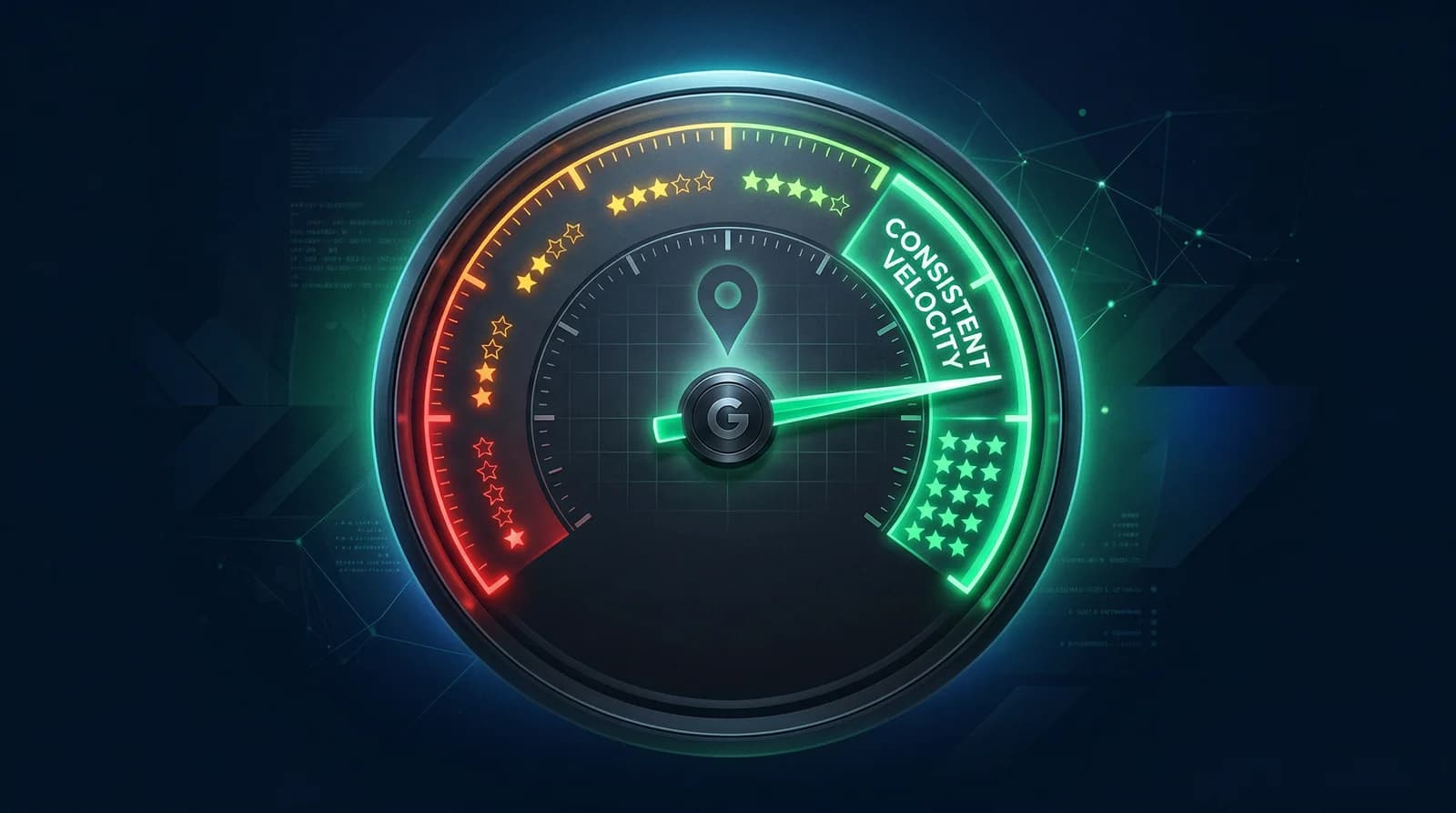
TL;DR — Key Takeaways
Review velocity now outweighs total count
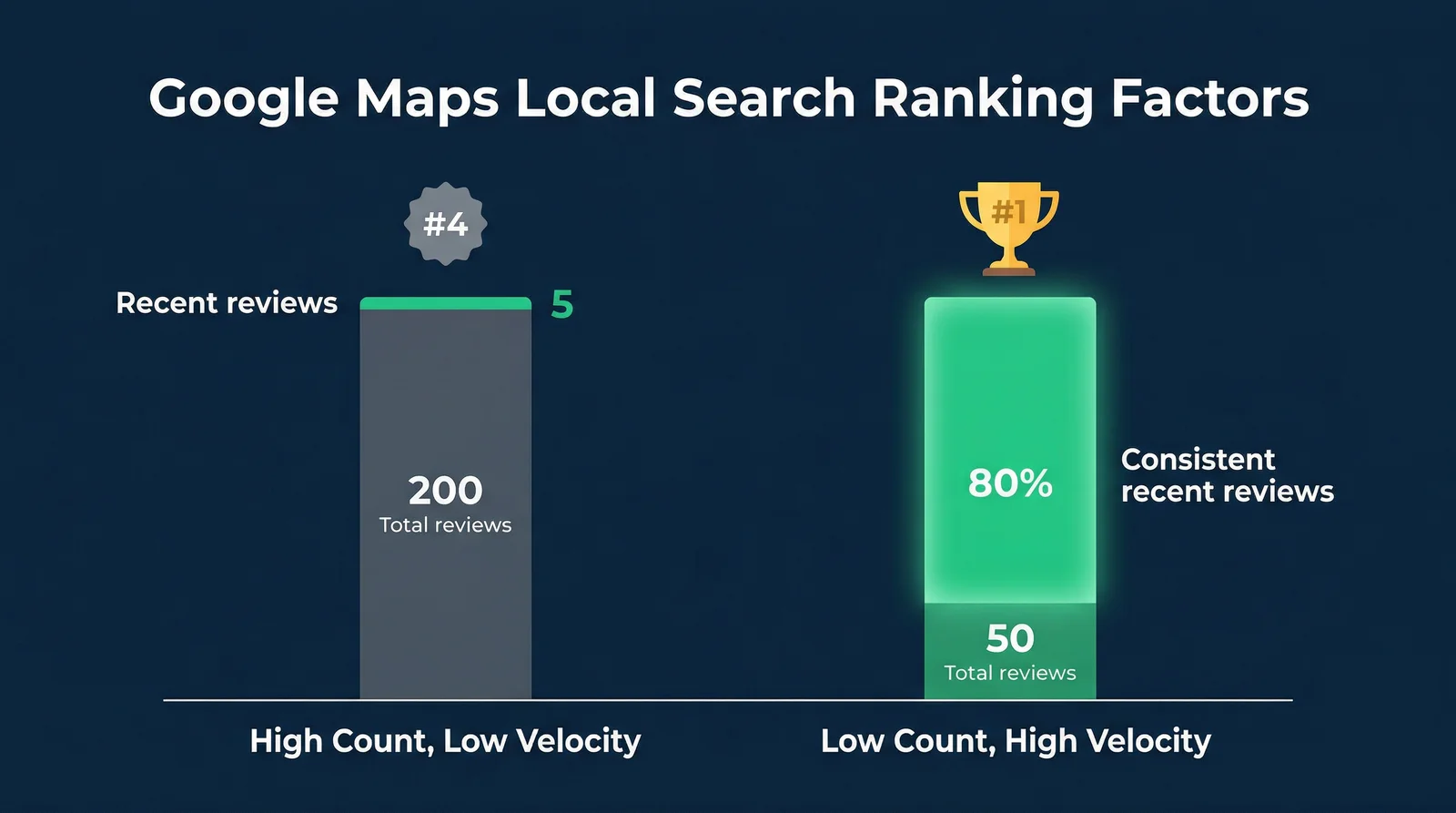
50 reviews with 5 per month typically outranks 200 stale reviews with 0 per month in 2026's local search algorithm.
Optimal cadence: 4–8 reviews per month for most Indian SMBs
Tier 1 cities need 8–15 per month to be competitive. Tier 2 cities: 4–8. Tier 3 towns: 2–4. Consistency matters more than the exact number.
Sudden bursts can trigger spam filters
Getting 40 reviews in two days — even from real customers — can cause Google to hide or remove them. Space requests evenly across the month.
Review velocity affects AI search results, not just Maps
Whitespark 2026 confirms that velocity signals now influence AI-generated local search answers — making this factor more important than ever.
A system beats willpower every time
MapLift generates keyword-rich review templates in 15 seconds. Send them at the right moment after each customer experience — velocity becomes automatic.
Most local business owners treat reviews like a savings account: accumulate as many as possible, check the balance occasionally, and assume more is always better.
Google does not think that way. Google thinks like a lender evaluating creditworthiness: it wants to see consistent, recent activity. A dormant account with a large balance does not signal a healthy business. A modest but active account does.
According to Whitespark's 2026 Local Search Ranking Factors report, review recency is consistently cited by local SEO experts as one of the most underrated ranking signals — and in competitive markets, businesses getting 1–2 new reviews per week are visibly separating from those that got all their reviews two years ago.
This guide explains exactly what review velocity is, why it now matters more than total count, what optimal cadence looks like for Indian businesses at different competitive levels, and how to build a sustainable system that keeps pace month after month without triggering spam filters.
What Is Review Velocity?
Review velocity is the rate at which a business collects new Google reviews over time — typically measured per week or per month.
It is distinct from review volume (total count) and review rating (star average). Velocity is purely about the freshness and frequency of incoming reviews. A business with 15 reviews collected in the last 60 days has stronger velocity than a business with 150 reviews where the last 10 arrived 18 months ago.
Review Volume
Total number of reviews on your listing. Important, but not the primary signal in 2026.
Secondary signal
Review Recency
How recently reviews were posted. Google weights fresh reviews significantly higher than old ones.
Strong signal
Review Velocity
The consistent monthly rate of new review acquisition. The signal Google reads as proof of ongoing relevance.
#1 signal in 2026
Why Google uses velocity as a ranking signal
Google uses velocity as a proxy for business activity and customer demand. A business seeing customers and delivering value will naturally accumulate new reviews at a steady pace. A business that collected reviews during a launch campaign and then stopped collecting sends the signal of a business that may have declined or lost relevance to the neighbourhood.
Why Review Velocity Beats Total Count in 2026
Three separate research findings converge on the same conclusion: recency and cadence now outweigh accumulation in Google's local ranking signals.
The Recency Algorithm
Whitespark's 2026 report confirms that review recency is among the top underrated factors in the local pack — and that freshness signals now carry weight across both Google Maps and AI-generated search results.
When Google evaluates two businesses for a local pack position, it considers how recently customers interacted with each one. A business with strong review velocity signals ongoing customer satisfaction. A business with a flat review curve signals stagnation.
Sterling Sky Case Study (2025)
Sterling Sky's 2025 research took three businesses each with 9 reviews and added 1 additional review. All three experienced measurable ranking improvement. The signal came not just from volume but from the recency of new activity on previously static profiles.
Implication: even one new review on a dormant profile can shift ranking position. Consistent monthly activity compounds this effect across all competitors.
The Staleness Effect
A business that collected 200 reviews three years ago and has received 5 since faces what local SEO practitioners call the staleness effect. Google reads that plateau as a declining business.
According to BrightLocal's research, 73% of consumers only trust reviews written in the last 30 days. Google's algorithm reflects this same preference for fresh signals over historical accumulation.
Business A — Strong Velocity
65 total reviews
5–6 new reviews per month for 12 months
Typically holds top-3 local pack position
Business B — Stale Profile
210 total reviews
Last 10 reviews arrived 18 months ago
Often ranked 4th–7th despite higher volume
The Velocity Impact Data
According to local SEO data from DNDSEOServices, businesses generating 3 or more monthly new reviews improve their near-me ranking position by 30–50% compared to businesses with stagnant review profiles.
30–50%
Ranking improvement from 3+ monthly reviews
DNDSEOServices, 2026
1–2/wk
Optimal review pace for most competitive markets
Whitespark, 2026
73%
Consumers only trust reviews from last 30 days
BrightLocal Research
The Velocity vs. Burst Problem: A Risk Most Businesses Create Accidentally
This is the section most guides skip — and it is the source of one of the most damaging mistakes local businesses make when they finally decide to take reviews seriously.
What a Burst Looks Like
A business decides to run a review drive. They send WhatsApp messages to every customer in their database on the same afternoon. By the next morning, 35 new reviews have appeared. The owner is satisfied. Then, over the following two weeks, 22 of those reviews disappear.
This is Google's spam filter at work. Reviews vanish from the listing without notification, leaving the business with fewer reviews than before — and a damaged trust signal.
What Google's Spam Filter Watches
Timing clusters
Multiple reviews posted within a few hours of each other, especially from the same network.
New reviewer accounts
Reviewers who created their Google account within days of posting — a classic fake review pattern.
Velocity vs. baseline mismatch
Going from 1 review per month to 40 in a single day. Pattern matching, not intent detection.
Geographic anomalies
Reviewers posting from unusual locations relative to a local business's customer base.
Safe Velocity Guidelines
Aim for 4–8 reviews per month for most Indian SMBs
Match your acquisition pace to your natural customer volume with a modest, believable uplift.
Space requests evenly across the month
Send 8–10 review requests per week rather than all at once. Drip campaigns beat bulk blasts.
Ten reviews spread across a month beats ten in one day
Google reads the pattern. Ten reviews across 30 days looks like real customers. Ten in one afternoon triggers filters.
Never use third-party review services with fake profiles
Policy violation and suspension risk. Only request reviews from real customers you have actually served.

India-Specific Velocity Benchmarks by City Tier
The right velocity target for a restaurant in Connaught Place is not the same as for a salon in Nashik. These benchmarks reflect competitive analysis across Indian markets — use them to set your monthly target.
Tier 1 Cities
Mumbai, Delhi, Bangalore, Hyderabad, Chennai, Kolkata
Local Pack Leaders
8–15
reviews per month
Minimum to Compete
6
reviews per month
Strategy Note
Below 4/month is unlikely to sustain top-3 position against active competitors.
Tier 2 Cities
Pune, Ahmedabad, Jaipur, Lucknow, Chandigarh, Surat, Kochi
Local Pack Leaders
4–10
reviews per month
Minimum to Compete
3–4
reviews per month
Strategy Note
Consistent velocity + keyword-rich review content creates a decisive advantage at this level.
Tier 3 Cities and Towns
Nashik, Mysore, Coimbatore, Jodhpur, Guwahati and similar
Local Pack Leaders
2–5
reviews per month
Minimum to Compete
2
reviews per month
Strategy Note
Most competitors do not actively manage velocity — even modest consistency produces outsized results.
Categories with naturally higher velocity potential
How to Build a Sustainable Review Velocity System
Consistency requires a system, not willpower. Here is the five-step framework we have seen work across 200+ Indian businesses.
1Establish your monthly target
Based on your city tier and category, define a specific monthly number. Write it down. This is your minimum operating standard — not a stretch goal, not an aspiration.
Example: A mid-tier restaurant in Pune sets a target of 6 reviews per month — that is 1–2 per week, achievable without a dedicated marketing person.
2Identify your review request moments
The highest-converting moments are when the customer's experience is still fresh. For most service businesses: immediately after a service is completed, the next morning for dining or event experiences, within 48 hours maximum — after that, conversion rates drop sharply.
Map your customer journey and identify the 2–3 moments where a review request feels natural and timely.
3Use templates that guide keyword-rich reviews
Velocity without quality is a missed opportunity. A review template does not dictate what customers write — that violates Google's policy. It gives customers a helpful prompt that guides them toward specifics: what service they received, what they ordered, where they are located.
MapLift generates AI-powered review templates for your specific business type, location, and services in 15 seconds — calibrated for both velocity and keyword relevance.
4Build a monthly review calendar
Assign a specific target number of requests per week, the channel for sending them (WhatsApp, QR code, email), and the day of the week for batch sending. Avoid Mondays — response rates are measurably lower.
A simple WhatsApp Business list and a MapLift-generated template, sent to 8–10 customers per week, is sufficient for most Indian SMBs.
5Monitor and adjust quarterly
Review your monthly average — is it trending up, flat, or down? Are reviews keyword-rich or generic? Have any reviews been removed? Are competitors accelerating? Check GBP Insights monthly for direction requests and search queries as proxy signals.
If profile views are increasing but reviews are flat, you have a conversion problem. If both are flat, you have a visibility problem — different solutions required.
Monthly Review Calendar Template
A simple structure that turns velocity from intention into habit:
| Week | Review Requests to Send | Target Reviews | Check |
|---|---|---|---|
| Week 1 | 8–10 | 2–3 reviews | Log sent requests |
| Week 2 | 8–10 | 2–3 reviews | Check conversion rate |
| Week 3 | 8–10 | 2–3 reviews | Review any removals |
| Week 4 | 8–10 | 2–3 reviews | Monthly count vs. target |
Assumes 30–40% conversion from request to posted review — a realistic rate for well-timed, personalised requests. Adjust request volume to hit your monthly target.
Review Velocity and AI Search: Why This Factor Just Doubled in Importance
This is the development that makes review velocity more important in 2026 than it was in 2024: Google's AI-generated search results for local queries.
When a user asks Google's AI "best dermatologist in Indiranagar" or "authentic South Indian breakfast near me," the AI draws from structured data and signals including review velocity, recency, and keyword content. Whitespark's 2026 report confirms that review signals now dictate discovery across Google Local Pack, organic search, and AI discovery results.
AI Local Pack Integration
When users ask AI-powered Google searches for local businesses, velocity and recency are factored into which businesses appear in AI-curated answers — not just the traditional local pack.
Review Content as AI Training Signal
AI models use review text to understand what a business offers. Keyword-rich reviews with strong velocity give AI systems more recent, relevant context to cite your business accurately.
Cross-Surface Discovery
Whitespark 2026 confirms review signals now influence discovery across Local Pack, organic search, and AI results simultaneously — one velocity system, three ranking surfaces.
Competitive Moat Building
Businesses that build 12+ months of consistent velocity history create a signal profile that is difficult for newer competitors to replicate quickly.
The compounding advantage
Businesses that start building review velocity now will have a 12–18 month head start over those that begin when AI search dominance is fully established. This is a structural advantage — not a one-time ranking boost — because it is built into every signal Google uses to evaluate local business authority.

What Happens When You Stop
According to research from ReviewScout AI, businesses that plateau on review collection after an initial push see measurable ranking decline within 3–6 months in competitive markets.
The plateau does not immediately penalise you — Google does not demote a listing the week after the last review. But as competitors continue collecting and your relative recency score falls, your position erodes steadily. A business that built 6 months of consistent velocity has a stronger baseline when it needs to take a month off. A business that got 80 reviews in one month and then nothing has a pattern that looks like a launch campaign that ended.
Consistent velocity builder
6 reviews/month for 12 months, then 1 quiet month
Minimal ranking impact. Historical pattern protects position.
Burst then nothing
80 reviews in one launch month, then 1–2/month for 12 months
Gradual ranking erosion over 3–6 months in competitive markets.
Frequently Asked Questions
What is review velocity in local SEO?
Review velocity is the rate at which a business collects new Google reviews over time, typically measured per month. It is distinct from total review count (volume) and star rating.
Google uses velocity as a proxy for ongoing business activity and customer demand. A business consistently receiving new reviews is more likely to be active, relevant, and worth surfacing to new searchers than one with a large but stagnant review history.
In 2026, review velocity affects ranking across the traditional local pack, organic search results, and AI-generated local answers.
How many reviews per month do I need to rank on Google Maps?
This depends on your city tier and category. For most Indian SMBs:
Tier 1 cities (Mumbai, Delhi, Bangalore): local pack leaders collect 8–15 per month. Minimum to be competitive: 6 per month.
Tier 2 cities (Pune, Ahmedabad, Jaipur): 4–8 per month is the competitive range.
Tier 3 cities and towns: 2–4 per month can dominate a local category because most competitors are not actively managing velocity at all.
Consistency matters more than hitting the top of the range. 4 reviews per month, every month, outperforms 20 in one month and 0 for the next five.
Can getting too many reviews at once hurt my Google Maps ranking?
Yes. A sudden spike in reviews can trigger Google's spam filters, causing reviews to be hidden or removed — even if they are completely genuine.
Google monitors timing clusters (multiple reviews in a short window), reviewer account age, velocity versus historical baseline, and geographic patterns. A business that normally receives 2 reviews per month and suddenly receives 40 in one day will trigger pattern-matching filters regardless of the reviews' authenticity.
The safe approach is steady, evenly-spaced acquisition. Ten reviews distributed across a month look like real customers. Ten reviews in one afternoon look like a campaign.
Does review recency matter more than total review count?
In 2026, yes — in competitive markets. Whitespark's 2026 Local Search Ranking Factors report confirms recency as one of the most underrated and increasingly influential signals.
Research consistently shows that a business with 50 reviews collecting 5 per month will typically outrank a competitor with 200 reviews collecting 0 per month. BrightLocal data shows 73% of consumers only trust reviews from the last 30 days — Google's algorithm reflects this same preference.
Total count still matters (a business with 5 total reviews faces a trust gap regardless of velocity), but beyond a reasonable threshold for your market, velocity becomes the differentiating factor.
How do I maintain review velocity without annoying customers?
The key is timing and relevance. Request reviews at the natural moment after a positive experience — immediately after a service, the next morning for a dining experience. The window closes fast: after 48 hours, conversion rates drop significantly.
Use a specific, helpful prompt rather than a generic "please leave a review" message. Customers leave better reviews when given a starting point — "tell us what you ordered and what you enjoyed most" produces a review that helps both the business and future customers.
MapLift generates these prompts automatically based on your business type and location. The templates feel personal, not automated, which improves both conversion rate and review quality.
Does review velocity affect AI search results?
Yes. Whitespark's 2026 report confirms that review signals — including velocity — now influence AI-generated search results for local queries, not just the traditional local pack.
When Google's AI answers "best clinic near me" or "top-rated restaurant in Koramangala," it draws from signals including review velocity, recency, and keyword content in reviews. Businesses with strong, consistent velocity are more likely to be cited in these AI-generated answers.
This makes review velocity more strategically important in 2026 than in previous years — the same signal now influences ranking across multiple search surfaces simultaneously.
How long does it take for review velocity to improve my ranking?
Most businesses see measurable movement within 60–90 days of implementing a consistent velocity strategy. The effect is not immediate — Google needs enough data points to confirm the pattern is consistent, not a one-time event.
The compounding effect over 6–12 months produces the most significant ranking improvements. A business that maintains 6 reviews per month for a year builds a signal profile that is genuinely difficult for competitors to displace quickly.
The fastest lever is combining velocity with keyword-rich review content. Fresh reviews that also mention your services and location create compound improvements in both the recency signal and relevance signal simultaneously.
The Ranking Advantage You Can Build Starting Today
Review velocity is not a hack or a workaround. It is what Google has always intended reviews to represent: ongoing evidence that a business is active, valued by customers, and worthy of being surfaced to the next person searching.
The strategic shift for Indian local businesses in 2026 is recognising that consistency beats accumulation. You do not need a thousand reviews. You need a system that generates 6 per month, month after month, in a way that feels natural to your customers and produces the keyword-rich content that feeds both your recency and relevance signals.
See how your current review velocity compares to competitors in your neighbourhood — and what your local pack position could look like with a consistent cadence.
MapLift generates AI-powered review templates in 15 seconds
Based on your business data — category, services, location — MapLift creates templates that guide customers toward the keyword-rich reviews that build velocity and relevance simultaneously. Free plan available. Paid plans from Rs.299/month.
Free
Rs.0
Essentials
Rs.299/mo
Pro
Rs.799/mo
Business
Rs.1,499/mo
Sources & References
- Local Search Ranking Factors- Whitespark
- Local Consumer Review Survey- BrightLocal
- Guidelines for representing your business on Google- Google
- Review Recency is the Most Underrated Local Ranking Factor in 2025- Whitespark
- Does the Number of Google Reviews Impact Ranking? (2025 Case Study)- Sterling Sky
- Google Review Velocity: Fast Reviews = Better Rank?- WiserReview
- What Is Google Review Velocity and Why Does It Matter?- LocalFalcon
- How Google Reviews Affect Map Pack Rankings — 2026 Data- DNDSEOServices
Keep reading
Ready to act on this? AI review templates — keyword-rich review prompts a customer can start from, generated per business.