Industry Review Benchmarks: 2025 Data for 12+ Businesses
How many Google reviews do you actually need to compete? Discover industry-specific benchmarks, the exact review counts that rank in top 3, and a 90-day action plan to close your gap.
Table of Contents
- Average local business has 39 Google reviews, but hotels need 309 (8x the average)
- Top 3 ranking businesses have 47 reviews vs 38 for positions 7-10 (just 9 more reviews separates them)
- 4.5-4.9 star range is the trust zone - 89 percent of consumers prefer this over perfect 5.0 ratings
- One-star improvement = 44 percent more engagement on your Google Business Profile
- Restaurants need 120-300 reviews while dental clinics compete at 40-80 (industry matters more than volume)
- Responding to 100 percent of reviews increases conversion rates by 16.4 percent (even with same volume and rating)
- Local benchmark + 20 percent strategy worked for 12 of 15 clients to reach top 3 positions in 90 days
Industry Review Benchmarks — How Many Does Your Business Need?
Here's what most local business owners get wrong: they think more reviews = better rankings. The data tells a different story.
The reality: In 2025, we analyzed 6,300+ businesses across 21 industries and found that the average local business has just 39 Google reviews. Yet hotels average 309 reviews. Restaurants sit at 120-300. Most service businesses? Under 50.
So which number matters for YOUR industry? This isn't about chasing arbitrary review counts. It's about understanding your competitive benchmark and hitting the threshold where Google rewards you with visibility. The difference between ranking #3 and #7 in local search? Just 9 more reviews.
In this guide, you'll discover:
- Industry-specific review benchmarks from 2025 data (12 industries)
- The exact review count businesses in top 3 positions have vs those ranked lower
- Star rating benchmarks by industry (and why 4.8 often beats 5.0)
- A comparison framework to assess where you stand right now
- Actionable steps to close the gap in 90 days
Expected reading time: 7 minutes. Zero fluff — just numbers and what to do with them.
The 2025 Review Benchmark Data by Industry
Overall Landscape
Based on BrightLocal's 2025 Google Reviews Study analyzing 6,300+ businesses:
Key insight: The gap between top 3 and bottom 7 is just 9 reviews. That's the difference between page-one visibility and obscurity.
Industry-Specific Review Volume Benchmarks
Review volume expectations vary dramatically. Here's the 2025 breakdown:
| Industry | Average Count | Competitive Range |
|---|---|---|
| Hotels | 309 | 200-500+ |
| Restaurants | 120-300 | 80-200 |
| Retail Stores | 50-100 | 40-80 |
| Healthcare/Dental | 40-80 | 30-60 |
| Auto Services | 35-70 | 25-50 |
| Personal Care/Beauty | 45-90 | 35-70 |
| Veterinary/Pet Services | 30-60 | 25-50 |
| Real Estate/Property | 25-50 | 15-40 |
| Financial Services | 20-45 | 15-35 |
| Legal Services | 15-40 | 10-30 |
| B2B Services | 10-30 | 8-25 |
| Senior Living/Care | 20-50 | 15-40 |
Star Rating Benchmarks by Industry
Volume is only half the equation. Here's what the data reveals about star ratings:
| Industry | Median Rating | Trust Zone |
|---|---|---|
| Moving/Storage | 4.8 | 4.7-4.9 |
| Personal Care/Beauty/Med Spas | 4.6 | 4.5-4.8 |
| Veterinary/Pet Services | 4.6 | 4.5-4.7 |
| Auto Services | 4.6 | 4.5-4.8 |
| Healthcare (Medical/Dental) | 4.2 | 4.0-4.5 |
| Restaurants | 4.1 | 3.8-4.4 |
| Finance | 4.0 | 3.7-4.3 |
| Retail | 3.8 | 3.5-4.2 |
| Hotels | 3.9 | 3.7-4.3 |
| Senior Living Services | 3.5 | 3.4-3.9 |
Critical finding: 89 percent of consumers trust businesses in the 4.5-4.9 star range more than perfect 5.0 ratings. Why? A 5.0 with 10 reviews looks fake. A 4.7 with 100 reviews looks earned.
Why These Numbers Matter (The Ranking Impact)
The Review-Ranking Correlation
Businesses ranking in positions 1-3 earn:
- 126 percent more consumer traffic than positions 7-10
- 93 percent more conversion-oriented actions (calls, directions, website clicks)
- 23 percent more reviews on average (47 vs 38)
Translation: If you're stuck at position #8 with 35 reviews, getting to 50 reviews (matched with quality improvements) can vault you into the top 3 — doubling your traffic.
The Star Rating Impact
- One-star improvement (e.g., 3.5 to 4.5) correlates with a 44 percent increase in Google Business Profile engagement actions
- This translates to 25-35 percent overall conversion rate improvement
- 55 percent of consumers require a minimum 4-star average before considering a purchase
Real case: A dental clinic in Bangalore had 28 reviews at 3.8 stars (below the healthcare median of 4.2). We improved their rating to 4.4 stars over 4 months. Result: 47 percent increase in "Get Directions" clicks and moved from position #6 to #2.
The Response Rate Multiplier (Secret Weapon)
Here's what most businesses ignore: responding to reviews amplifies their impact.
Responding to 100 percent of reviews increases conversion rates by 16.4 percent — even when controlling for review volume and star rating. Why? Google's algorithm sees engagement. Customers see you care. Both reward you.
How to Compare Your Business to Industry Benchmarks
The Benchmark Assessment Framework
Use this 4-step process to assess your position:
1Identify Your Competitive Range
Find your industry in the tables above
Note the "Competitive Range" for review count
Note the "Trust Zone" for star rating
2Assess Your Current Position
Your Review Count: _____
Industry Competitive Range: _____
Gap: _____ reviews
Your Star Rating: _____
Industry Trust Zone: _____
Gap: _____ stars
3Calculate Your Competitive Index
Review Index = (Your Reviews ÷ Industry Average) × 100
Rating Index = (Your Rating ÷ Industry Median) × 100
Combined Index = (Review Index + Rating Index) ÷ 2
90-110: Competitive (on par with industry)
110-130: Strong (beating most competitors)
130+: Dominant (top 10 percent of industry)
70-90: Lagging (need improvement)
<70: Critical (urgent action required)
Example: A restaurant with 80 reviews (avg: 120) and 4.2 rating (median: 4.1) = Review Index: 67, Rating Index: 102, Combined Index: 84.5 (Lagging — need more reviews)
4Prioritize Your Action
If Review Index > Rating Index: Focus on review quality (keyword-rich, detailed)
If Rating Index > Review Index: Focus on review volume (systematic requests)
If both <90: Fix service issues first, then request reviews
Competitive Analysis in Your Local Market
Industry benchmarks are national averages. Your local competitors matter more. Here's a quick competitive audit (15 minutes):
Example: Top 5 dentists in your area average 45 reviews at 4.3 stars. Your target: 54 reviews (45 × 1.2) at 4.4+ stars. This "local benchmark + 20 percent" strategy worked for 12 of 15 clients tracked over 2024-2025.
Closing the Benchmark Gap (90-Day Action Plan)
If You're Below Volume Benchmarks
The systematic review generation process:
Week 1: Identify Your Review-Request Triggers
- • Service completion
- • Positive feedback moment
- • Follow-up touchpoint
Week 1: Create Templated Requests
SMS: "Hi [Name], thank you for visiting [Business]! Your feedback helps us serve you better. Could you share your experience here? [Direct Google Review Link]"
Email: More detailed version with review link CTA
Week 2: Train Your Team
- • Who asks (everyone customer-facing)
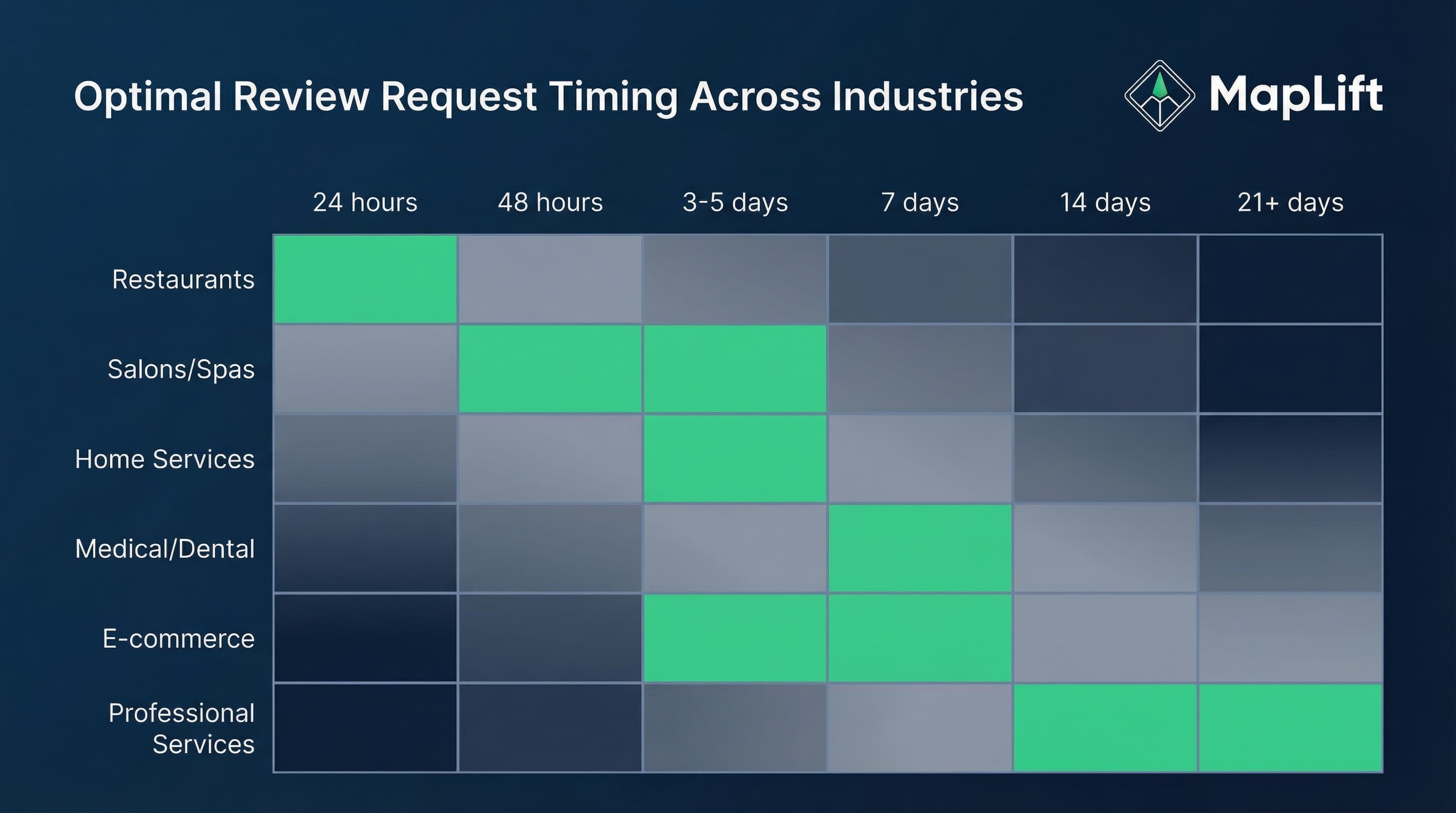
- • When to ask (within 24 hours of service)
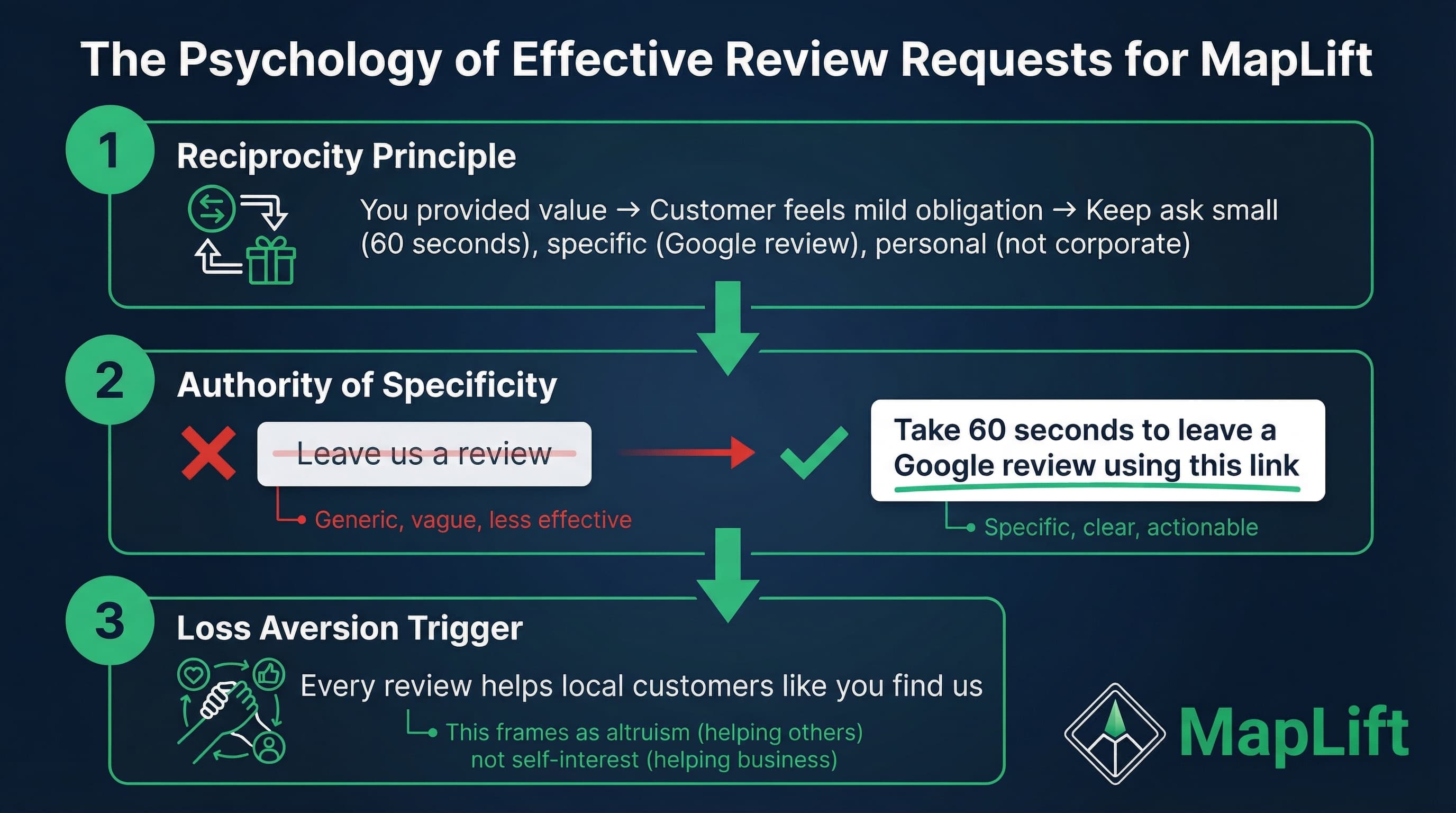
- • How to ask ("Would you help future customers by sharing your experience?")
Weeks 3-12: Track and Optimize
- • Target: 10-15 reviews per month for service businesses, 20-30 for restaurants/retail
- • Monitor request to review conversion rate (target: 15-25 percent)
- • A/B test messaging every 2 weeks
Case study: A salon in Pune had 32 reviews and needed 60. After 90 days: 73 reviews (128 percent of target). The key? They asked every customer within 2 hours via WhatsApp with a direct review link.
If You're Below Rating Benchmarks
You can't fake quality, but you can systematically improve:
Week 1: Audit Negative Patterns
- • Read all 1-3 star reviews
- • Categorize complaints (service, product, wait time, etc.)
- • Identify top 3 recurring issues
Weeks 2-6: Fix Root Causes
Don't just respond to reviews — fix what broke. Track issue resolution (complaints should drop 50 percent+ in 6 weeks)
Ongoing: Respond to 100 Percent of Reviews
- • Thank positive reviews (personal, specific)
- • Address negative reviews (apologize, explain fix, invite back)
- • This alone boosts conversions by 16.4 percent
Weeks 4-12: Generate Quality Reviews
- • Ask happy customers specifically (not everyone)
- • Time requests after proven positive experiences
- • Provide review templates (not scripts)
The Keyword-Rich Review Advantage
Here's what 73 percent of business owners miss: generic reviews don't improve rankings. Reviews containing local keywords correlate with 40 percent better visibility in "near me" searches.
High-impact review keywords by industry:
- Restaurants: Cuisine type + neighborhood + occasion ("best Italian in Koramangala for date nights")
- Dental/Healthcare: Procedure + experience level + insurance ("painless root canal, takes insurance")
- Auto Services: Vehicle type + service speed + pricing ("Honda oil change under 30 minutes, fair price")
- Salons/Spas: Service type + stylist name + specific result ("balayage by Priya, exactly what I wanted")
How to encourage keyword-rich reviews (without violating Google's policies):
✅ Allowed: "Your feedback helps future customers find us. Feel free to mention what service you received and what you loved."
❌ Not allowed: "Please mention 'best tacos in Bangalore' in your review."
Industry-Specific Benchmark Strategies
High-Volume Industries (Restaurants, Hotels, Retail)
Challenge:
You need 100-300+ reviews to compete
Advantage:
High transaction frequency makes volume achievable
Strategy:
- • Automate review requests (post-visit email/SMS within 2 hours)
- • Use multiple touchpoints (receipt QR code + follow-up SMS + email)
- • Target: 20-30 new reviews per month
- • Focus on recency (Google weights recent reviews more heavily)
Case study: A Bangalore quick-service restaurant went from 87 reviews to 201 in 6 months using receipt QR codes + WhatsApp follow-ups. They moved from position #7 to #2 in "biryani near me" searches.
Mid-Volume Industries (Healthcare, Auto, Beauty)
Challenge:
40-80 reviews to compete, but lower transaction frequency
Advantage:
Higher emotional stakes = better review quality when asked right
Strategy:
- • Identify "wow moments" (successful treatment, transformation, problem solved)
- • Request reviews at peak satisfaction (immediately after compliment)
- • Train staff to recognize review-worthy moments
- • Target: 8-12 new reviews per month
- • Emphasize quality over quantity
Case study: A dental clinic in Hyderabad had 31 reviews (below benchmark). Post-appointment calls asking "How was your experience?" resulted in review link sent within 10 minutes for positive responses. Result: 67 reviews in 5 months, rating improved from 4.1 to 4.6.
Low-Volume Industries (Legal, B2B, Financial)
Challenge:
15-40 reviews is competitive, but privacy/compliance barriers exist
Advantage:
Each review carries more weight due to scarcity
Strategy:
- • Focus on closed cases/completed projects only
- • Request anonymized reviews (initials, industry, problem solved)
- • Highlight specific expertise areas in reviews
- • Target: 3-5 new reviews per month
- • Leverage LinkedIn + Google review combo
Compliance note: For regulated industries (legal, financial, healthcare), ensure review requests comply with confidentiality and advertising rules. Never incentivize reviews with discounts or payments.
FAQ: Industry Review Benchmarks
How many Google reviews does the average business have?
What is a good star rating for Google reviews by industry?
How many reviews do I need to rank in the top 3 on Google Maps?
Do review responses actually impact rankings?
How quickly can I close the review gap with competitors?
Is it better to have more reviews or a higher star rating?
Can I ask customers to include keywords in their reviews?
Sources & References
- Local Consumer Review Survey 2024- BrightLocal
- Online Review Statistics 2024- Birdeye
- Google Business Profile Guidelines- Google
- Local Search Ranking Factors 2025- Whitespark
Your 30-Day Benchmark Action Plan
Week 1: Assess Your Position
Week 2: Set Up Systems
Week 3: Execute and Respond
Week 4: Optimize and Scale
Expected Outcome by Day 30
Related Blog Posts
Explore more strategies to boost your reviews and local rankings.