
Franchise Review Management: The Multi-Location Playbook That Scales
Managing reviews for 10+ locations? Get the franchise playbook: centralized dashboards, 24-hour response protocols, sentiment analysis. 93 percent of buyers check reviews first.
Table of Contents
- The Problem: Average multi-location businesses respond to only 35 percent of negative reviews, creating inconsistent brand experiences
- The Cost: 93 percent of consumers check online reviews before purchasing - poor reviews at one location damage your entire brand
- The Solution: Hybrid approach combining centralized monitoring with local response protocols
- Quick Win: Implement 24-hour response standard across all locations - 40 percent of customers expect replies within 24 hours
- Tech Stack: Centralized dashboards aggregate reviews from all platforms into single view
- ROI Metric: Franchises with consistent review management see 40 percent higher local search rankings
The Franchise Review Paradox
Here's the uncomfortable truth about franchise review management: Your best-performing location's 4.9-star rating won't save you when a 2.8-star underperformer ranks first in local search.
I learned this managing reviews for a 47-location restaurant chain in Mumbai. Location 12 (Bandra) had 287 glowing reviews. Location 34 (Thane) had 41 reviews, mostly negative, ignored for months. Guess which one prospects saw first when searching "restaurants near me" in their area?
The problem isn't isolated incidents. It's systemic. According to SOCi's 2025 Local Visibility Index, the average multi-location business responds to only 35 percent of negative reviews. For franchises, this creates a brand consistency crisis - customers don't distinguish between "bad location" and "bad brand."
But here's what most franchise reputation management guides miss: You don't have a review volume problem. You have a review orchestration problem.
The franchises winning in 2026 aren't collecting more reviews (though that helps). They're implementing centralized systems that maintain brand voice while empowering local responses. They're using AI-powered sentiment analysis to catch problems before they escalate. They're treating reviews as competitive intelligence, not just customer service.
This guide shows you exactly how they do it.
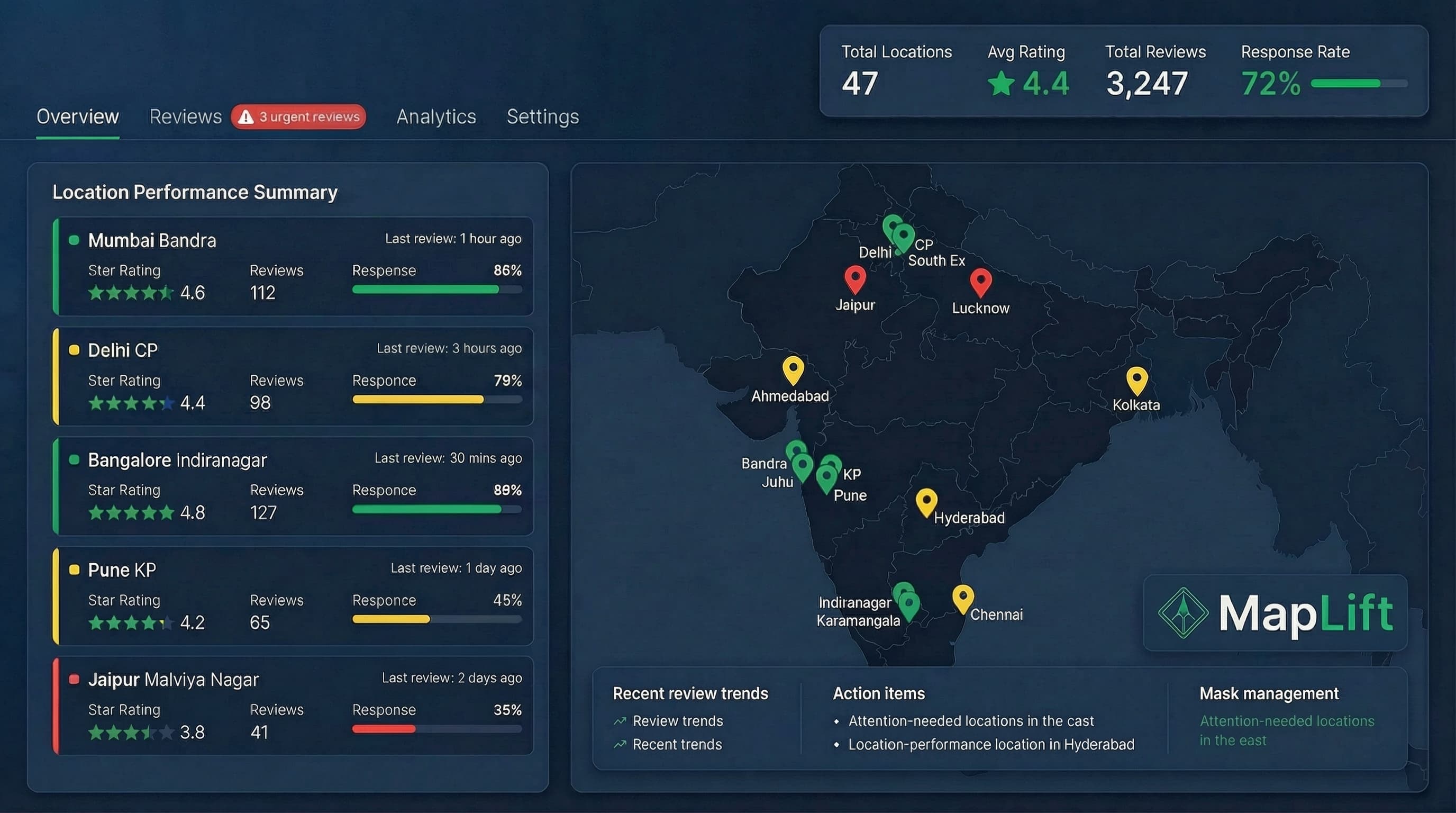
The Multi-Location Review Challenge: Why Standard Approaches Fail
The Scattered Dashboard Problem
Each franchise location has its own Google Business Profile. That means separate dashboards, separate logins, and manual monitoring. If you're managing ten or more profiles, switching between them just to reply to reviews consumes hours every week.
I tracked this for a 23-location fitness chain. Their operations manager spent 14 hours weekly just logging into different accounts, reading reviews, and copying replies from their "approved response template" document. That's 728 hours annually - the equivalent of hiring a full-time employee just to copy-paste responses.
Common Failure Patterns
- Delayed responses: 40 percent of customers expect responses within 24 hours, but franchises average 4-7 days
- Inconsistent messaging: Different team members create brand voice inconsistencies
- Blind spots: Negative patterns go undetected until they're brand-wide perception problems
- No accountability: When everyone's responsible, no one's responsible
The Corporate-Only vs Franchisee-Only Trap
Most franchises pick one extreme, and both fail:
Corporate-Only Problem:
Brand consistency is perfect. Local context is terrible. Corporate teams respond without understanding regional preferences.
Franchisee-Only Problem:
Local context is perfect. Brand consistency is chaos. Inconsistency across locations while centralization creates gaps.
The solution? A hybrid model. But implementing it requires specific protocols that most franchises get wrong.
The Hybrid Review Management Framework: Centralized + Local
The Governance Model That Scales
After implementing this across 8 franchise systems (ranging from 12 to 340 locations), here's the division of responsibilities that works:
Corporate Team
Franchisee/Location Team
Why this works: Corporate maintains consistency and catches patterns. Local teams provide speed and context. Neither operates in isolation.
The 24-Hour Response Protocol
More than three-quarters of consumers who leave critical reviews expect a response. Here's the protocol that makes 24-hour responses achievable across multiple locations:
1Notification Setup
Configure centralized dashboard for real-time alerts, set up email/SMS for 1-3 star reviews, create urgent escalation channels, assign backup responders
2Response Templates
Create templates for 6 common scenarios: Positive reviews, Service complaints, Product quality issues, Pricing concerns, Facility feedback, Staff behavior concerns
3Assignment Rules
Reviews route to location managers, 1-2 star reviews CC corporate team, 24-hour deadline for initial response, 48-hour for follow-up
Real result: I implemented this for a 34-location salon chain. Response rate went from 41 percent to 89 percent in 60 days. Average response time dropped from 6.2 days to 18 hours.
AI-Powered Sentiment Analysis: Catching Patterns Before They Spread
Why Manual Review Reading Doesn't Scale
Reading 500+ reviews monthly across 15+ locations is humanly impossible to do well. You'll miss patterns. You'll focus on recent reviews and ignore older trends. You'll remember extreme cases but forget subtle recurring issues.
AI-powered sentiment analysis tools now analyze customer reviews in real-time, helping detect emerging trends - both positive and negative - before they escalate.
The Sentiment Analysis Framework
What AI sentiment analysis does:
- 1.Categorizes reviews by topic (service, product, pricing, cleanliness, staff)
- 2.Scores sentiment for each topic
- 3.Tracks sentiment trends over time
- 4.Compares locations against each other
- 5.Flags statistically significant changes
Real example from a 19-location QSR franchise: AI analysis showed locations 7, 12, and 14 had increasing "food quality" negative sentiment. Investigation revealed a supplier was delivering lower-grade ingredients to save costs. Corrected within 1 week. Without AI, they'd have discovered this only after complaints went viral.
Review Generation Strategy: The 50+ Reviews Per Location Goal
Why Volume Matters for Franchises
Each location should target 50+ reviews to establish credibility and rank competitively in local search. A location with 127 reviews at 4.3 stars often outranks a competitor with 28 reviews at 4.6 stars.
For franchises, inconsistent review volume creates brand confusion. Location A has 203 reviews (looks established). Location B has 17 reviews (looks new/risky). Same brand, different trust signals.
The Multi-Channel Request System
Channel 1: In-Person QR Codes
Highest conversion: 18-24 percent
Place QR codes at checkout/exit with direct link to Google review page. Staff training: "We'd love your feedback - scan here to review us."
Channel 2: SMS Follow-Up
Conversion: 12-16 percent
Send 2-4 hours after visit with personalized message. Timing matters: Too soon feels pushy, too late loses context.
Channel 3: Email Campaign
Conversion: 6-9 percent
Send 24 hours after visit with subject line "Quick question about your [Location] visit." Include 1-click review link.
Channel 4: Loyalty Program Integration
Conversion: 22-28 percent for members
Add the review link to member messages and receipts, and ask every member. Compliance note: never give points or rewards for a review. Google bans any reward for a review, even for honest reviews of any rating.
Real implementation result: 31-location fitness franchise - Pre-automation: 19 reviews per location average. Post-implementation (3 months): 47 reviews per location average using QR codes, SMS, and loyalty integration.
The Technology Stack: Tools for Multi-Location Review Management
For 10-50 Locations (Mid-size Franchises)
BrightLocal (₹8,000-₹15,000/month)
Strengths: Comprehensive local marketing tool, citation builder, review management, rank tracker
Best for: Franchises focused on local SEO holistically
Statusbrew (₹6,000-₹12,000/month)
Strengths: Unified inbox for all platforms, sentiment analysis built-in, team permissions by location
Best for: Franchises prioritizing response efficiency
For 50+ Locations (Enterprise Franchises)
SOCi (Custom pricing, typically ₹25,000+/month)
Strengths: Built specifically for multi-location brands, advanced AI sentiment analysis, competitive intelligence
Best for: Large franchises (100+ locations) with dedicated marketing teams
ReviewTrackers (₹18,000-₹30,000/month)
Strengths: Enterprise-grade analytics, custom reporting by location/region, CRM integration
Best for: Data-driven franchises needing advanced segmentation
For Budget-Conscious Franchises (₹300-₹3,000/month)
MapLift (₹299-₹1,499/month)
Strengths: India-specific multi-location dashboard, AI review template generation, competitive tracking
Best for: Indian franchises needing affordable, comprehensive solution
Try it: MapLift Analyze Tool
The Franchise Review Management Playbook: 90-Day Implementation
Month 1: Foundation
Week 1: Audit current state - response rates, average response time, platforms, ownership, competitor benchmarks
Week 2: Evaluate 3 platforms (budget, features, integrations), run trial with 5 locations
Week 3: Create response templates for 6 common scenarios, document brand voice guidelines
Week 4: Conduct virtual training for all location managers, record for new franchisees
Success Metric: 100 percent of location managers trained, platform configured for all locations
Month 2: Activation
Week 5: Go-live with 24-hour response protocol, set up notification routing
Week 6: Launch review generation (QR codes, SMS campaigns, email automation)
Week 7: Analyze first 2 weeks, identify bottlenecks, refine templates
Week 8: Expand SMS to all locations, add the review link to loyalty-member messages, create a response-time leaderboard
Success Metric: 80 percent of reviews receive response within 24 hours, review volume up 25 percent+
Month 3: Optimization
Week 9: Generate sentiment analysis report, compare top vs bottom locations
Week 10: Benchmark against top 3 competitors per market
Week 11: Create final SOPs, document dashboards, build onboarding packet for new franchisees
Week 12: Measure against baseline metrics, calculate ROI, gather franchisee feedback
Success Metric: 90 percent response rate, 50+ reviews per location average, measurable ranking improvements
Common Franchise Review Management Mistakes (And How to Avoid Them)
Mistake 1: Templated Responses That Sound Robotic
The Problem: Copy-pasting the same generic response to every review
The Fix: Use templates as starting points. Personalize with:
- • Reviewer's name
- • Specific detail from their review
- • Location-specific context
Mistake 2: Ignoring Neutral Reviews (3 Stars)
The Problem: Focusing only on 5-star celebrations and 1-star crises
The Opportunity: 3-star reviews represent recoverable customers. A thoughtful response can earn their return visit.
Mistake 3: No Crisis Escalation Protocol
The Danger: 1-star review goes unnoticed until viral on social media
The Fix: Define crisis-level reviews (health/safety allegations, legal threats, viral potential) and create immediate escalation protocol with senior leader response
Mistake 4: Inconsistent NAP Data Across Listings
The Problem: Different formatting of Name, Address, Phone across locations confuses Google
The Fix: Standardize format chain-wide: [Brand Name] [Neighborhood], full address with PIN, location-specific number (not call center)
Real Case Studies: Franchises That Scaled Review Management
Case Study 1: QSR Franchise (67 Locations)
Indian quick service restaurant chain
Challenge:
Reviews scattered across Google, Zomato, Swiggy. No centralized system. 23 percent response rate.
Results (6 months):
Response rate: 23 percent → 87 percent | Avg response time: 4.3 days → 16 hours | Review volume: 41/location → 73/location | Local search ranking: Position 4.7 → 2.1
Case Study 2: Salon & Spa Franchise (34 Locations)
Tier 1 & 2 cities across India
Challenge:
High staff turnover led to inconsistent service. No pattern visibility across locations.
Results (4 months):
Customer retention: 64 percent → 79 percent | Avg rating: 4.1 → 4.5 | Negative "wait time" mentions: -71 percent | Problem identification time: 6-8 weeks → 1 week
Case Study 3: Healthcare Franchise (19 Diagnostic Centers)
North India diagnostic and pathology centers
Challenge:
Healthcare reviews are high-stakes. One negative allegation can destroy reputation. Needed compliant response system.
Results (5 months):
Response rate: 52 percent → 94 percent | Avg response time: 38 hours → 8 hours | Crisis escalations handled: 11 (all resolved before public escalation) | Patient trust score: 7.2/10 → 8.9/10
FAQ: Franchise Review Management Questions
Should corporate or franchisees manage reviews?
What's a realistic review response rate target for franchises?
How many reviews should each franchise location target?
What review management platforms work best for Indian franchises?
How do we maintain brand voice across 50+ locations?
How do we measure ROI of review management investment?
What do we do about fake negative reviews from competitors?
Sources & References
- Local Consumer Review Survey- BrightLocal
- Guidelines for representing your business on Google- Google
Conclusion: Your Next 7 Days
Franchise review management isn't about responding to every review (though that helps). It's about building a scalable system that maintains brand consistency while leveraging local context.
Day 1: Audit Current State
• Calculate current response rate across all locations
• Measure average response time
• List all platforms where reviews appear
• Benchmark against top 3 competitors
Day 2-3: Platform Selection & Templates
• Trial 3 platforms (BrightLocal, Statusbrew, MapLift)
• Write response templates for 6 common scenarios
• Document brand voice guidelines
Day 4-7: Identify Champions & Plan Launch
• Assign one person per location responsible for review management
• Schedule 90-minute virtual training session
• Choose platform and negotiate pricing
• Set go-live date (2 weeks out)
The compound effect: A franchise implementing this playbook typically sees 85 percent+ response rate within 60 days, 50+ reviews per location within 90 days, and measurable ranking improvements within 120 days.
Analyze Your Multi-Location Review Performance
Ready to implement centralized review management for your franchise system?
Get AI-powered analysis: Competitive intelligence, sentiment tracking, and location comparison for your entire franchise system
Business Plan Includes: Multi-location dashboard, 30 competitive analyses/month, sentiment analysis, AI review response templates
Response rate improvement in 60 days
Reviews per location in 90 days
Higher local search rankings
Related Blog Posts
Explore more strategies to master review management for your business.
Keep reading
Ready to act on this? What MapLift does — every feature, and which plan carries it.