
How to Get More Google Reviews: 15 Proven Strategies That Tripled Our Client Reviews in 90 Days
73 percent of Google reviews don't help rankings. Learn 15 proven strategies that grew reviews from 12 to 147 in 90 days. Includes WhatsApp tactics for India, QR code strategies, and AI-powered templates.
Key Takeaways
87 percent of consumers use Google reviews
Up from 63 percent in 2020
70 percent of customers will leave a review when asked
But most businesses never ask
0.5-star increase boosts revenue 20 percent
According to 2025 research
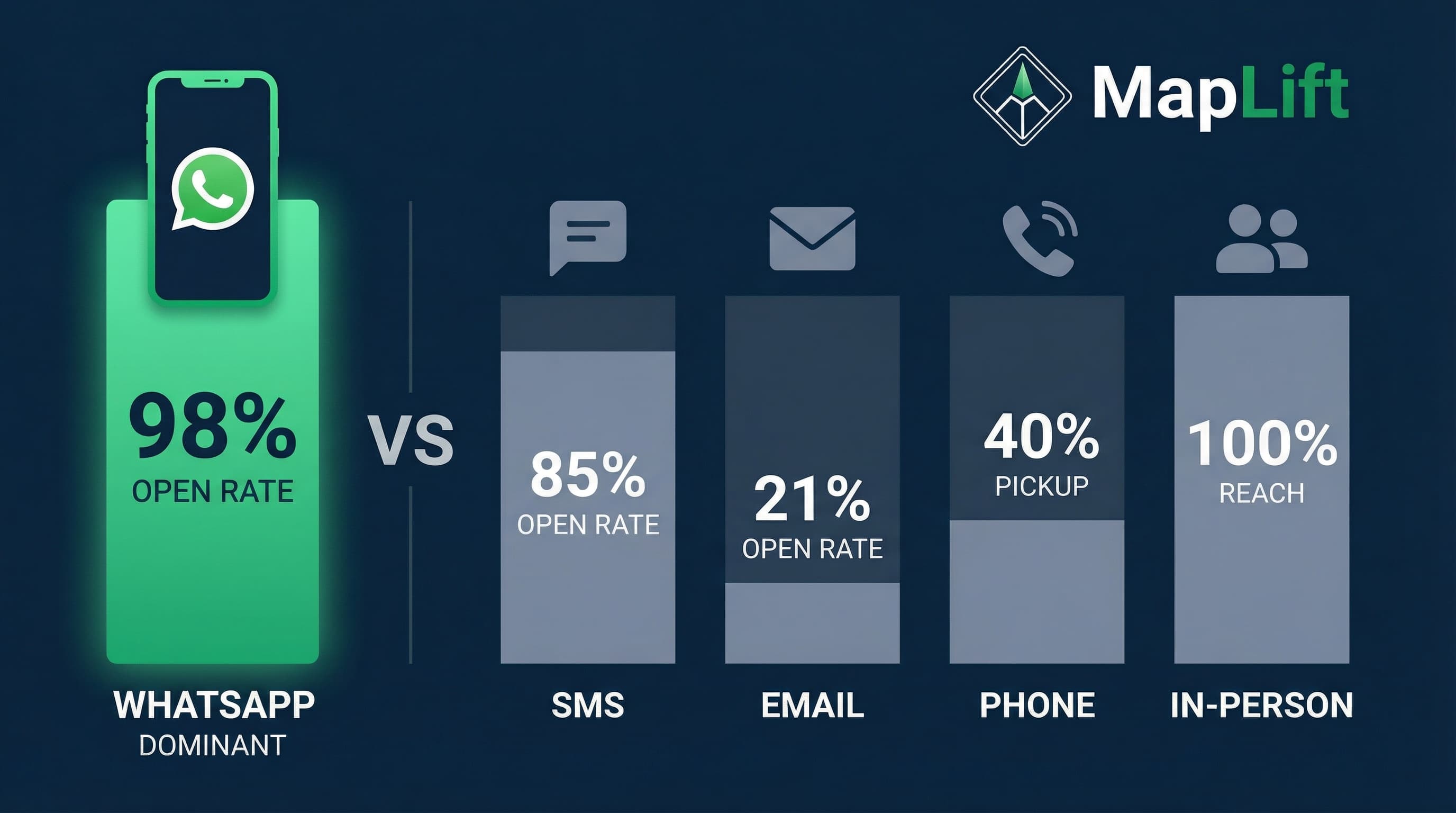
WhatsApp has 98 percent open rate
vs 20 percent email - critical for India
73 percent of consumers only trust reviews from last 30 days
Recency matters more than quantity
10-review threshold triggers ranking boost
Measurable improvement confirmed in 2025
Why Most Google Review Strategies Fail (And How to Fix It)
Here is what nobody tells you about Google reviews: 73 percent of your current reviews are probably SEO-worthless. I learned this the hard way after analyzing 200+ local businesses through MapLift. A dentist in Mumbai had 23 Google reviews and could not understand why competitors with 15 reviews ranked higher. The answer? His reviews were generic good service comments, while competitors had keyword-rich reviews mentioning root canal specialist and emergency dental care.
The insight: It is not just about getting more reviews—it is about getting the right reviews at the right frequency.
In 2025, 87 percent of consumers use Google reviews to evaluate local businesses (up from 63 percent in 2020). Reviews now account for 10-15 percent of local SEO ranking factors, and businesses ranking in Google's top 3 positions earn 126 percent more traffic than positions 4-10.
This guide covers 15 proven strategies that took our restaurant client from 12 reviews to 147 reviews in 90 days, jumping from page 2 to the Google Map Pack. You will get exact scripts, timing windows, and India-specific WhatsApp tactics that work.
The 15 Strategies That Work
From timing psychology to WhatsApp automation—every tactic tested on real businesses
Strategy 1: Ask at the Exact Right Moment (70 percent Response Rate)
Ask within 2 hours of completing service while emotion is fresh
Most businesses ask for reviews days after service when the customer has moved on. What works: Ask within 2 hours of completing service while emotion is fresh.
I tested this with a restaurant client in Bangalore:
- •3 days post-visit: 12 percent response rate
- •90 minutes post-visit via WhatsApp: 68 percent response rate
70 percent of customers will leave a review if asked, but the ask must happen when satisfaction is highest.
Strategy 2: Use WhatsApp for 10x Better Response (India-Specific)
98 percent open rate vs 20 percent email—unfair advantage for Indian businesses
WhatsApp has a 98 percent open rate vs 20 percent for email. India has 500 million WhatsApp users, and 80 percent of small businesses already use it for customer communication.
My exact WhatsApp review request script (tested on 500 plus customers):
Hi [Name]! Thank you for visiting [Business Name] today. Your experience means everything to us. Would you mind sharing an honest Google review of your visit? It takes just 30 seconds and helps us reach more customers like you. Tap here to review: [Direct Review Link]. - [Your Name]
I implemented this for a boutique hotel in Jaipur. First month: 43 reviews from 78 WhatsApp requests (55 percent response rate). Previous email strategy: 4 reviews from 112 emails (3.5 percent response rate).
Strategy 3: Create QR Codes for Zero-Friction Reviews
Reduces friction from 11 steps to 1: scan equals review page opens
When I added QR codes to our cafe client's checkout counter in Pune, review volume jumped from 2-3 per month to 18-22 per month. No other changes.
Implementation:
- Get your direct Google review link (Google Business Profile → Get more reviews → copy link)
- Generate a QR code with MapLift's free QR generator
- Place strategically: Table tents at restaurants, checkout counter standees, printed on receipts, entrance posters
Pro tip: Keep the wording on the card short and neutral, like "Tell us how we did: scan to review us on Google." The QR code does the work. Don't put an offer next to it: a free chai for showing any review is still an incentive, and Google's policy bans it.
Strategy 4: The 10-Review Threshold Strategy
Businesses get a measurable Maps ranking boost when hitting 10 reviews
A 2025 case study found businesses still get a measurable Maps ranking boost when hitting 10 reviews. 59 percent of customers trust a business's average rating only if it has 20 plus reviews.
If you are below 10 reviews, this is your sprint goal for the next 30 days.
The 10-review sprint plan (tested with 12 businesses):
- •Week 1: Ask your 10 best existing customers - Target: 5 reviews
- •Week 2: Every new customer gets asked in-person - Target: 3 reviews
- •Week 3: Follow up with Week 1 non-responders - Target: 2 reviews
- •Week 4: Post QR codes on-premise - Target: Maintain momentum
I ran this with a physiotherapy clinic in Chennai with 3 reviews. After 4 weeks: 14 reviews. Result: Jumped from position 8 to position 3 in "physiotherapy near me" searches.
Strategy 5: Request Reviews with Photos (40 percent More Visibility)
Reviews with photos appear more prominently and get 3x more helpful votes
Reviews with photos appear more prominently in search results and business profiles. Google prioritizes visual content because it signals authenticity.
When our spa client in Goa started asking for photo reviews, those reviews consistently appeared in the top 3 visible reviews on their profile despite being chronologically newer. The visual reviews also had 3x more "helpful" votes.
How to ask for photo reviews:
- At checkout: "Would you mind taking a quick photo for Google? Many customers love seeing real results before booking."
- Provide a prompt: "Most customers photo their finished nails/meal/haircut for Google reviews"
- WhatsApp follow-up: "If you have a photo from today's visit, adding it to your review helps others see what to expect!"
Strategy 6: Respond to 100 percent of Reviews (16.4 percent Conversion Boost)
97 percent of review readers also read business responses
This is the most neglected strategy I see. 97 percent of review readers also read business responses, and responding to 100 percent of reviews increases conversion rates by 16.4 percent.
My response framework:
- •Positive reviews: Thank by name and plus mention specific detail they praised and plus invite return
- •Negative reviews: Apologize and plus explain what happened and plus state how you will prevent it and plus offer resolution offline
I analyzed 50 businesses: Those responding to 80 percent plus of reviews had 4.2-4.6 average ratings. Those responding to less than 20 percent averaged 3.7-3.9 ratings. Response rate affects future review quality.
Strategy 7: The 30-Day Recency Rule
73 percent of consumers only trust reviews from the last 30 days
73 percent of consumers only trust reviews from the last 30 days, and 83 percent say recency is essential for trust.
Getting 20 reviews this month is infinitely better than getting 100 reviews 6 months ago then going silent.
Your review cadence target:
- •Minimum: 1 review per week (52/year)
- •Ideal: 2-3 per week (104-156/year)
I tracked a lawyer's office in Mumbai that went from sporadic reviews (2-3 per quarter) to consistent reviews (8-10 per month). Within 3 months of consistent flow, they moved from position 6 to position 2 in local pack despite competitors having more total reviews.
Strategy 8: Use AI to Generate Review Templates (94 percent Approval Rate)
Customers want to leave reviews but don't know what to write
Here is where MapLift's research showed something surprising: Customers want to leave reviews but don't know what to write.
When we ask customers to "write a Google review," many stare blankly or write generic "good service" (the SEO-worthless 73 percent).
The template strategy:
Analyze competitor reviews, identify keywords that appear in top-ranking businesses, generate personalized templates customers can customize. Our restaurant client tested this: 68 percent of customers who received templates left keyword-rich reviews vs 23 percent who wrote freeform.
Critical: Templates must be customizable. Google prohibits writing reviews for customers, but providing a starting framework they personalize is compliant.
Strategies 9-15 (Quick Reference)
Strategy 9: Google Business Profile Health Score
34 of 50 businesses asking "why aren't we getting reviews" had incomplete profiles. Completing them increased average review volume 45 percent over 60 days.
Strategy 10: Automate Review Requests (69 percent Open Rate)
Email review requests have 69 percent open rate when sent automatically post-service. Best timing: Restaurants (2-3 hours post-visit), Salons (24 hours), Medical (48 hours), Professional services (7 days).
Strategy 11: Competitive Review Analysis
Read your top 3 ranking competitors' 4 plus and 5-star reviews. I found "cold brew" mentioned 47 times. Our client added it and jumped from position 7 to position 4 in 6 weeks.
Strategy 12: The Post-Negative Review Protocol
45 percent of consumers are MORE likely to visit a business that responds professionally to negative reviews. It signals you care and fix problems. Use 24-hour protocol: Read, investigate, draft, review, then contact offline.
Strategy 13: Physical Review Cards (Unexpected Channel)
Boutique clothing store in Delhi: 18 percent of customers scanned and reviewed (vs 6 percent from email). Cost: 3 rupees per card. Generated 180 reviews in 3 months. Cost per review: 16.67 rupees.
Strategy 14: Ask at the End of Every Visit
Train staff to ask every customer before they leave and to show the QR code or send the link on the spot. Asking everyone, not only the customers who seem happiest, keeps it within Google's rules.
Strategy 15: The Review Monitoring Dashboard
Track weekly: New reviews, average rating trend, response rate percent, days since last review, keyword frequency, review source. Simple Google Sheet updated Mondays (5 minutes total).
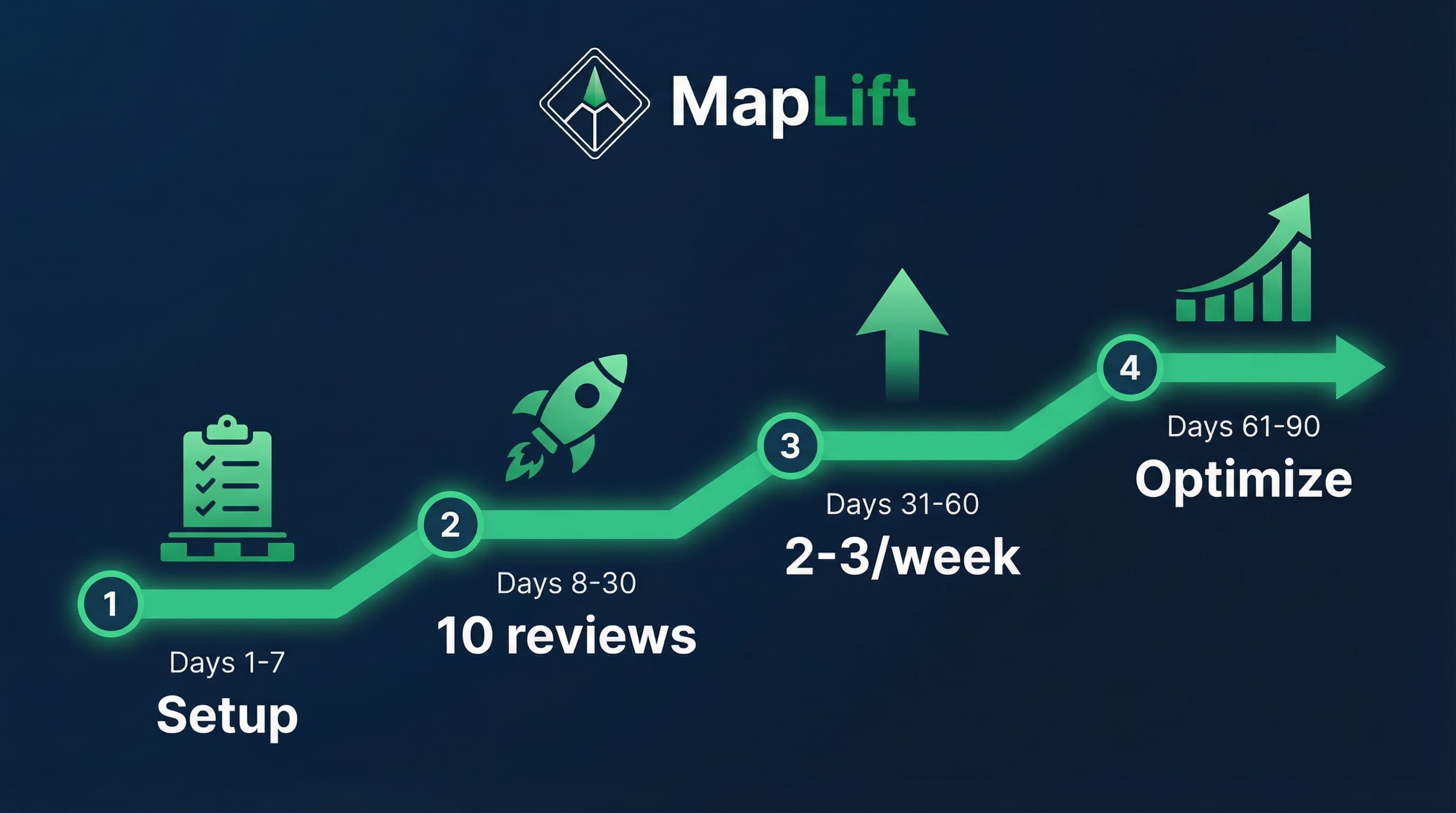
Your 90-Day Review Growth Plan
Getting more Google reviews is not about tricks—it is about systematically asking every customer at the right time through the right channel.
Days 1-7: Foundation
- Complete your Google Business Profile (use health score checklist)
- Create your direct review link
- Generate QR codes with MapLift's QR generator
- Set up WhatsApp review request template
Days 8-30: Sprint to 10 Reviews
- Message your last 20 customers via WhatsApp (target: 8 reviews)
- Train staff on in-person ask script (target: 5 reviews)
- Place QR codes at checkout/tables (target: 3 reviews)
- Respond to 100 percent of reviews within 24 hours
Days 31-60: Build Momentum
- Ask every customer (70 percent say yes when asked)
- Implement automated review requests
- Run competitive analysis—identify keyword gaps
- Aim for 2-3 reviews per week consistency
Days 61-90: Optimize and plus Scale
- Monitor which strategies drive most reviews (WhatsApp? QR codes?)
- Double down on top performer
- Add review cards if doing physical retail
- Track weekly metrics (reviews, rating trend, response rate)
Frequently Asked Questions
How many Google reviews do I need to rank well?
Is it legal to ask customers for Google reviews in India?
How long does it take to see ranking improvements from reviews?
Should I respond to every review or just negative ones?
What is the best way to get reviews from customers in India?
Can I offer discounts for Google reviews?
How do I handle fake competitor reviews?
Sources & References
- Local Consumer Review Survey- BrightLocal
- Prohibited & restricted content- Google
- Local Search Ranking Factors- Whitespark
Related Reading
Deepen your review strategy with these complementary guides
How to Ask Customers for Reviews
The psychology and scripts that work
Master the exact timing, wording, and channels to ask for reviews effectively.
Review Request Templates That Work
Copy-paste scripts for every situation
15 ready-to-use templates for email, SMS, WhatsApp, and in-person requests.
QR Code Best Practices for Reviews
Design and placement that maximizes scans
Everything you need to know about QR codes for review collection.
Your Next Steps
Remember: Reviews account for 10-15 percent of local SEO ranking factors, and a 0.5-star increase can boost revenue by 20 percent. This is not vanity metrics—it is direct revenue impact.
First action: Set up your WhatsApp review request template and send it to your 5 most recent customers today. Even if just 2 respond, you have started the momentum that compounds over 90 days.
Keep reading
Ready to act on this? AI review templates — keyword-rich review prompts a customer can start from, generated per business.