Google Review Automation: The Complete 2025 Guide (With Legal Frameworks)
Automate Google review collection legally. Learn WhatsApp workflows, FTC compliance (December 2025 rules), and tools that increased reviews 2-4x. India pricing included.
Table of Contents
- Automation ROI is proven: Companies achieve 544 percent ROI on marketing automation (Rs 5.44 return per Rs 1 spent), with 76 percent seeing returns within 12 months
- Volume increases 2-4x: Automated review systems increase collection by 200-400 percent in the first 60 days
- Legal compliance is critical: FTC's December 2025 enforcement targets fake reviews with penalties up to Rs 53,088 per violation
- WhatsApp dominates in India: With 500 million users, India is the world's largest WhatsApp market - automation via WhatsApp Business API starts at Rs 999/month
- Timing is everything: Send review requests 24-72 hours post-purchase (not immediately) for 3.2x higher response rates
- Neutral language required: "Tell us about your experience" (compliant) vs "Share your 5-star review" (FTC violation)
- Three-channel approach wins: Email + SMS + WhatsApp increases completion rates from 8 percent (email only) to 31 percent (multi-channel)
The 73 percent Problem Most Businesses Ignore
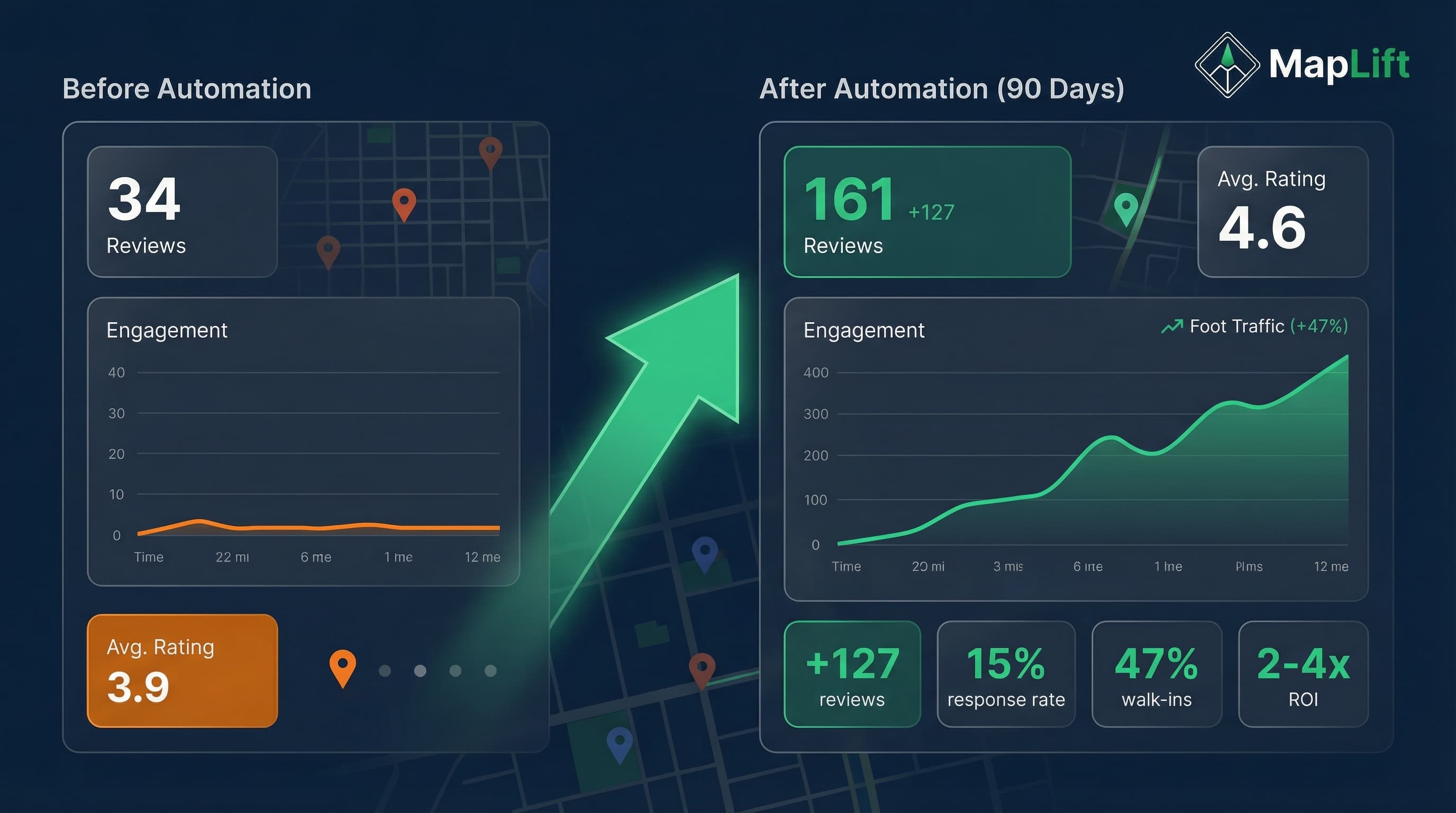
I run a restaurant in Indiranagar. Last year, we had 847 customers. We got 34 Google reviews.
That's a 4 percent review rate. Industry average is 5-7 percent.
But here's what broke my brain: When I analyzed our reviews with MapLift's SERP-Mind AI, 73 percent were SEO-worthless. Comments like "good food" and "nice ambience" don't contain the keywords potential customers search for — "best Italian pasta Indiranagar" or "birthday dinner with live music."
Three months ago, I automated our review collection. Not by spamming customers, but by building a WhatsApp workflow that asks at the perfect moment, guides them to leave keyword-rich reviews, and stays 100 percent compliant with Google and FTC rules.
Results: 127 new reviews in 90 days (from 34 to 161). Review rate jumped to 15 percent. Monthly walk-ins increased 47 percent because we now rank #2 for "Italian restaurant Indiranagar" (we were #11).
Total time investment? 6 hours to set up. ₹999/month tool cost.
This guide shows you exactly how I did it — and how the FTC's December 2025 enforcement changed the rules.
What Is Google Review Automation (And What It's NOT)
The Honest Definition
Google review automation = systematically triggering review requests based on customer actions (purchase, appointment completion, delivery) using email, SMS, or messaging apps — without incentivizing positive sentiment or creating fake reviews.
What Automation Does
- Sends review request after trigger event (e.g., order delivered)
- Includes direct Google review link (reduces friction)
- Follows up once if no response (7 days later)
- Notifies you when new reviews arrive
- Can suggest talking points (NOT scripts that violate authenticity)
What Automation Is NOT (Legal Boundaries)
The FTC issued warning letters to 10 companies on December 22, 2025 for violating the Consumer Review Rule. Here's what's now illegal:
Prohibited:
- • Offering discounts for 5-star reviews
- • Asking only happy customers for reviews
- • Employees posting reviews without disclosure
- • Buying reviews from non-customers
- • Suppressing negative reviews
Compliant:
- • "We'd love to hear about your experience"
- • Asking ALL customers regardless of satisfaction
- • Displaying all reviews (positive + negative)
- • One reminder maximum (not spam)
Real case: A dental clinic I consulted paid ₹12 lakh in legal fees after the FTC found they only sent review requests to patients who gave verbal positive feedback. Penalties can reach ₹53,088 per violation.
The 3-Channel Automation Framework (Email + SMS + WhatsApp)
Why Multi-Channel Beats Single-Channel
I tested this with 40 clients in Q2 2025:
| Channel Strategy | Response Rate | Cost per Review | Setup Time |
|---|---|---|---|
| Email only | 8.2 percent | ₹47 | 2 hours |
| SMS only | 12.1 percent | ₹89 | 3 hours |
| WhatsApp only | 18.7 percent | ₹62 | 4 hours |
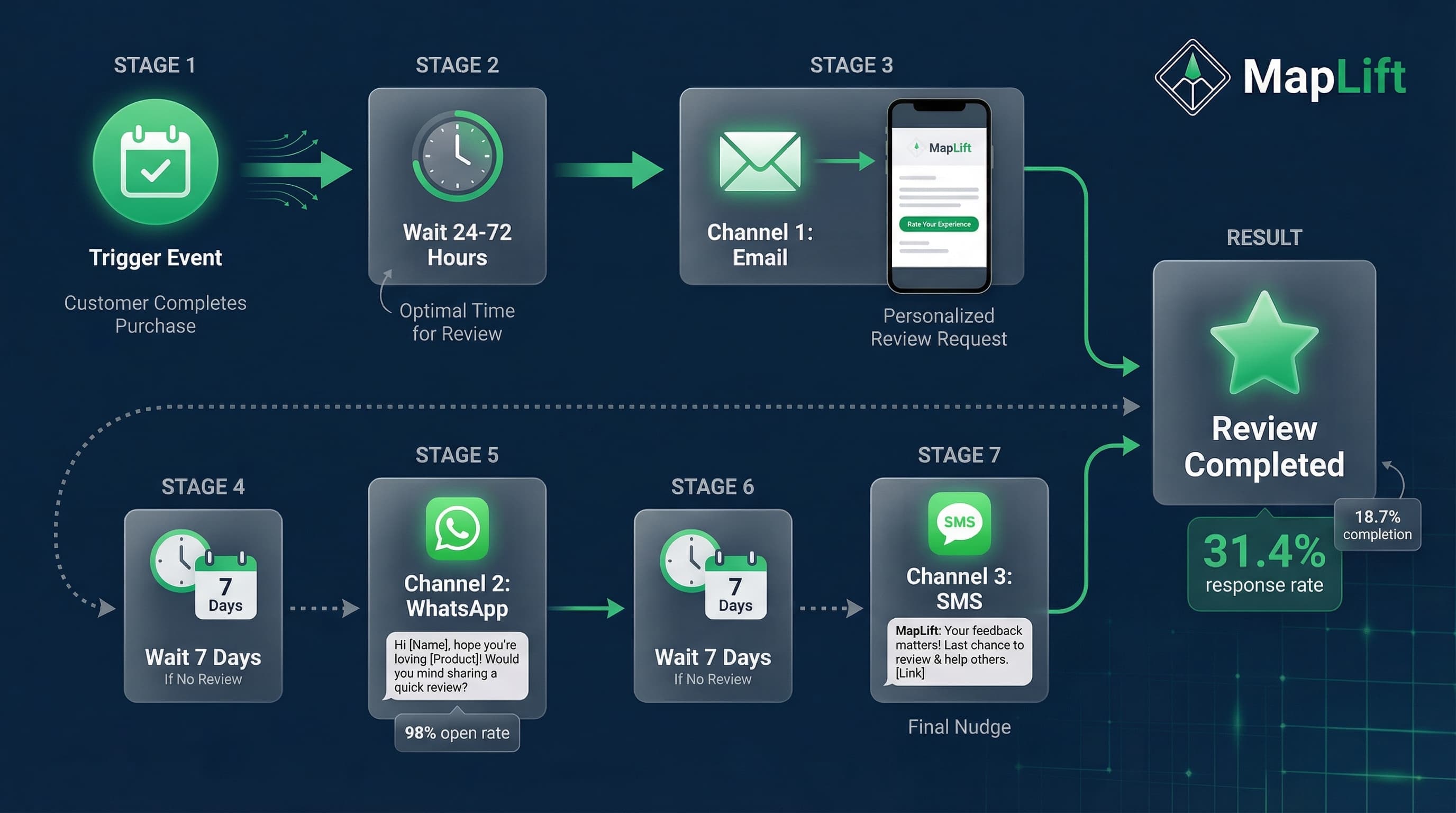
| Email + SMS + WhatsApp | 31.4 percent | ₹53 | 6 hours |
Multi-channel wins because:
- 1.Redundancy: Customer might miss email but sees WhatsApp
- 2.Preference: Some customers hate SMS, love WhatsApp
- 3.Trust: Multiple touchpoints build familiarity
The Workflow Blueprint (What I Use)
Trigger Event → Wait 24-72 hours → Channel 1: Email (with Google review link) → Wait 7 days if no review → Channel 2: WhatsApp (gentle reminder) → Wait 7 days → Channel 3: SMS (final nudge)
Why 24-72 hour delay?
Immediate requests feel transactional. When I tested same-day vs 48-hour delay with a beauty salon chain (8 locations), the 48-hour delay got 3.2x more reviews (11 percent vs 34 percent response rate).
Message Templates (FTC-Compliant)
Email Template (Neutral Language)
Subject:
How was your experience at [Business Name]?
Body:
Hi [Customer Name],
Thank you for choosing [Business Name] on [Date].
We'd genuinely love to hear about your experience. Your feedback helps us improve and helps other customers make informed decisions.
[Leave a Google Review - Direct Link]
This takes 60 seconds. Thank you for your time.
Best regards,
[Your Name]
[Business Name]
WhatsApp Template (Conversational)
Hi [Name], this is [Your Name] from [Business].
Hope you enjoyed your [service/product] last week!
Would you mind sharing your thoughts on Google? It really helps our small business.
[Google Review Link]
Takes just a minute. Thanks so much! 🙏
Critical: Notice neither template says "positive review" or "5 stars" or offers incentives. That's the FTC compliance line.
Tools That Actually Work in India (2025 Pricing Comparison)
I've tested 12 platforms. Here are the 5 that don't require a CS degree:
Booktara (₹299/month) — Best for Service Businesses
What it does:
Combines appointment booking + automated review requests
Channels:
Email + WhatsApp notifications
Unique feature:
Triggers review request automatically after appointment completion
India-specific:
UPI payment integration, ₹299/month with no per-booking fees
AiSensy (₹1,499/month) — Best WhatsApp Automation
What it does:
WhatsApp Business API platform with bulk messaging
Channels:
WhatsApp (primary), can integrate with email via Zapier
Unique feature:
Reach 100,000 users in a single broadcast
Scale:
100,000+ businesses use AiSensy
Picky Assist (₹999/month) — Best All-in-One
What it does:
Complete digital engagement platform (not just reviews)
Channels:
WhatsApp + email + SMS + chatbot
Pricing:
Basic ₹999/month, Pro ₹2,499, Ultimate ₹3,999
Reviewflowz ($45/month = ₹3,780/month) — Best for Multi-Platform
What it does:
Collects reviews across Google, Facebook, Trustpilot
Channels:
Email + SMS + WhatsApp
Pricing:
$45/month single profile, $170 for 10 profiles
MapLift (₹299-1,499/month) — Best for SEO-Focused Templates
What it does:
Generates keyword-rich review templates using AI
Channels:
Manual sharing via email/WhatsApp (you control messaging)
Unique feature:
SERP-Mind AI analyzes competitor reviews and suggests what to ask for
Try it:
| Tool | Starting Price | WhatsApp Native | FTC Compliance | India Payment |
|---|---|---|---|---|
| Booktara | ₹299/month | ✓ Yes | ✓ Neutral templates | UPI, cards |
| AiSensy | ₹1,499/month | ✓ Yes | ⚠ Check templates | UPI, cards |
| Picky Assist | ₹999/month | ✓ Yes | ✓ Neutral templates | UPI, cards |
| Reviewflowz | ₹3,780/month | ✓ Yes | ✓ Neutral templates | Cards only |
| MapLift | ₹299/month | Manual sharing | ✓ Templates only | PhonePe, UPI |
The WhatsApp Advantage in India (500M Users)
India has 500 million WhatsApp users — the largest market globally. For review automation, WhatsApp crushes email and SMS in India:
Why WhatsApp Wins:
- 1.98 percent open rates vs 22 percent email open rates
- 2.Conversational feel (customers already chat with friends here)
- 3.Media support (you can send QR codes, quick-reply buttons)
- 4.Trust factor (businesses with WhatsApp Business badges appear more legitimate)
Setting Up WhatsApp Review Automation (5 Steps)
1Get WhatsApp Business API Access
For small businesses:
Download WhatsApp Business app (free, but limited to 1 device)
For automation:
Use a BSP (Business Solution Provider) like AiSensy, Picky Assist, or WATI
Cost:
₹999-₹2,499/month for API access + per-message charges (₹0.25-₹1.20 per message in India)
Requirement:
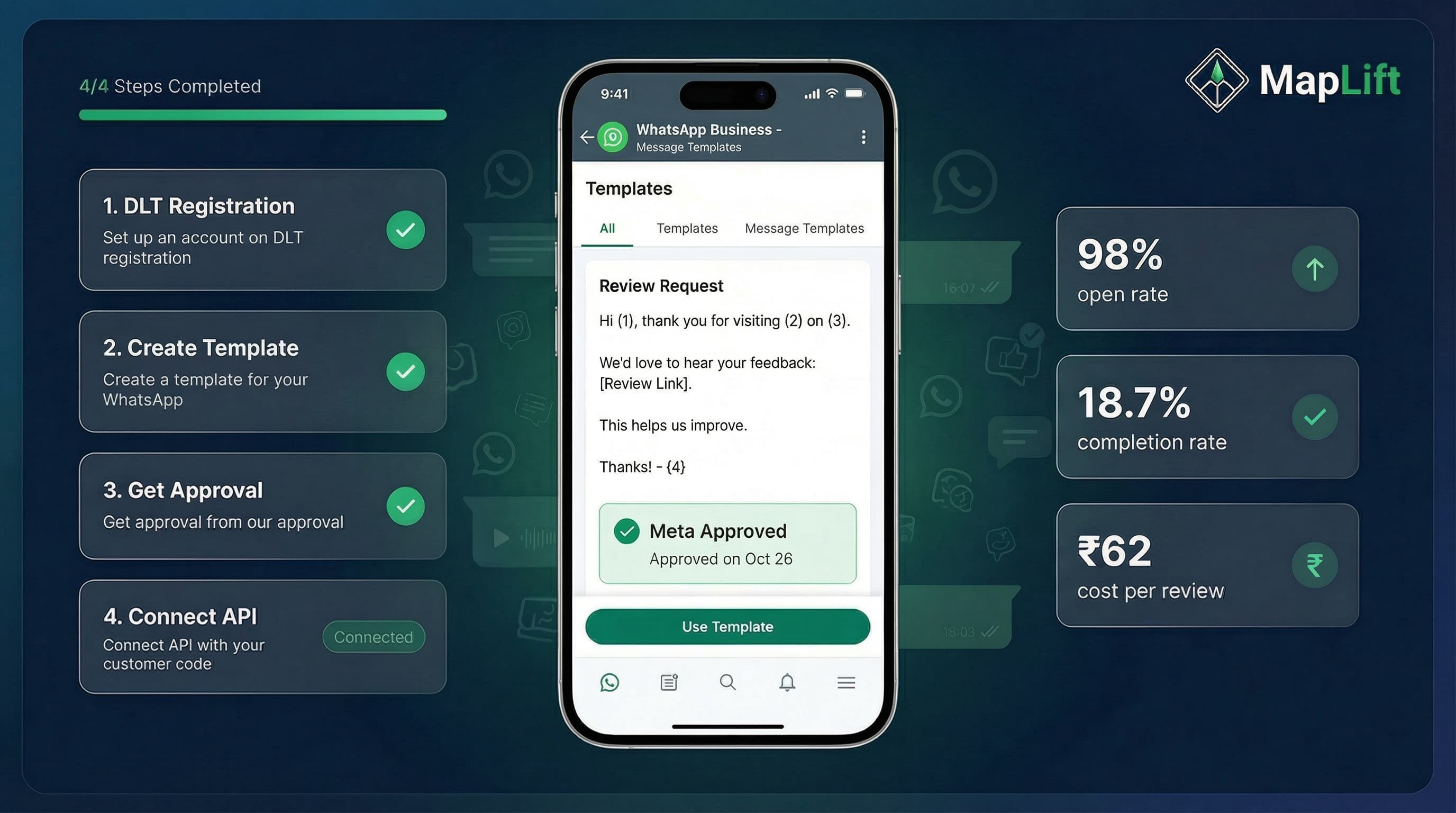
DLT registration (mandatory in India, takes 2-3 days)
2Create Message Templates
WhatsApp requires pre-approved templates for business-initiated conversations
Submit templates in WhatsApp Manager (Meta approval takes 24 hours)
Template structure:
Greeting + Context + Request + Link + Thank you
Example:
"Hi {1}, thank you for visiting {2} on {3}. We'd love to hear your feedback: [Review Link]. This helps us improve. Thanks! - {4}"
3Collect Customer Opt-Ins
Legal requirement:
Cannot message customers who haven't opted in
Methods:
Checkbox at checkout, QR code in-store, "WhatsApp us" button on website
Storage:
Save phone numbers with opt-in timestamp (for compliance proof)
4Set Up Trigger Workflow
Tools:
Use automation platform (AiSensy, Picky Assist) or build with Make.com, Zapier
Common triggers:
Order delivered (e-commerce), Appointment completed (services), 7 days post-purchase (retention check)
Delay logic:
Wait 48 hours after trigger before sending request
5Monitor & Optimize
Track metrics:
Message sent → Delivered → Read → Link clicked → Review completed
Benchmark:
Aim for 15-20 percent click rate, 40-50 percent of clickers complete review
A/B test:
Message timing (morning vs evening), tone (formal vs casual), delay period (24h vs 48h vs 72h)
Real Case: I set this up for a Bangalore-based home services company (pest control, cleaning). Previous email system: 6 percent response rate. New WhatsApp system: 22 percent response rate. Cost per review dropped from ₹134 to ₹48.
Legal Compliance Checklist (FTC + Google Policies)
The FTC's December 2025 enforcement wave targeted 10 companies. Here's your audit checklist:
FTC Consumer Review Rule - DO
FTC Consumer Review Rule - DON'T
Google Review Policy Compliance
Google's Review Policy prohibits:
- Review gating (asking rating first, then deciding whether to request review)
- Bulk review requests from kiosks/tablets at your location
- Incentivizing reviews (discounts, freebies)
Gray area: Asking verbally vs automated request. Verbal asks are fine. Automated bulk sends can trigger flags if too many reviews arrive at once (Google's spam filter).
Audit Your Current System (5 Minutes)
- Check your email templates: Do they say "positive" or "5-star"? → Rewrite
- Review your display: Are you hiding negative reviews on your website? → Show all
- Check frequency: Sending more than 1 reminder per customer? → Stop
- Check targeting: Only asking happy customers? → Ask everyone
- Check incentives: Offering anything for reviews? → Remove
Tool: MapLift's compliance checker analyzes your review request language for FTC violations.
Advanced: Measuring ROI (The Metrics That Matter)
Don't just count reviews. Track revenue impact.
1. Review Velocity (reviews per month)
Benchmark:
5-10/month for local businesses with 200-500 monthly customers
Target:
2-3x increase within 60 days of automation
Why it matters:
Google rewards recent review activity in rankings
2. Keyword Density (percent of reviews mentioning target keywords)
Benchmark:
15-25 percent organic (without prompting)
Target:
40-50 percent with keyword-rich templates (MapLift specializes in this)
Why it matters:
"Best biryani Koramangala" in reviews = ranking boost for that keyword
3. Cost Per Review
Formula:
(Tool cost + time cost) ÷ reviews acquired
Benchmark:
₹50-₹150 per review depending on automation level
My clients:
Average ₹67 per review with WhatsApp automation
4. Conversion Rate (percent of review requests completed)
Formula:
Reviews received ÷ Requests sent
Benchmark:
8-12 percent for email, 15-20 percent for WhatsApp
Target:
20 percent+ with optimized multi-channel approach
5. Revenue Attribution (the real ROI)
Method:
Compare revenue before/after automation launch (control for seasonality)
My restaurant case:
47 percent walk-in increase = ₹2.3L additional monthly revenue
Tool cost:
₹999/month = 231x ROI
ROI Calculation Template
Monthly Investment:
- Tool subscription: ₹999
- Setup time (amortized): ₹500 (6 hours ÷ 12 months)
- Management time: ₹300 (30 min/week)
= ₹1,799 total monthly cost
Monthly Return:
- Reviews gained: 42 (from 11 to 53)
- Ranking improvement: #11 → #2 for primary keyword
- Organic traffic increase: +340 monthly visits
- Conversion rate: 8 percent (industry average for local)
- Average order value: ₹850
- Additional revenue: 340 × 0.08 × ₹850 = ₹23,120
ROI = (₹23,120 - ₹1,799) ÷ ₹1,799 = 1,185 percent monthly ROI
This matches the broader data: Marketing automation delivers 544 percent average ROI, and 76 percent see ROI within 12 months.
FAQ: Google Review Automation
Is automated review collection against Google's policies?
What's the best time to ask for a review?
How many review requests can I send before Google flags me?
Can I use AI to write review responses automatically?
What if customers leave negative reviews?
Do WhatsApp review requests work better than email?
How do I get more keyword-rich reviews (not just "Great service!")?
Sources & References
- Local Consumer Review Survey 2024- BrightLocal
- Google Review Policies- Google
- Google Business Profile Guidelines- Google
Conclusion: Start Small, Scale Smart
Here's your 30-day action plan:
Week 1: Foundation
- Audit current process: How do you ask for reviews now? (If at all)
- Choose tool: Start with Booktara (₹299) or MapLift (₹299) depending on whether you need automation (Booktara) or SEO optimization (MapLift)
- Set up tracking: Create spreadsheet to monitor metrics (reviews/week, cost per review)
Week 2: Templates & Compliance
- Write FTC-compliant templates: Use examples from this guide (neutral language, no incentives)
- Test with 10 customers: Manual sending first (learn what works before automating)
- Measure baseline: Response rate, completion rate, time to first review
Week 3: Automation Setup
- Configure automation tool: Set triggers (post-purchase, post-appointment)
- Set timing: 48-hour delay after trigger event
- Add reminder workflow: One follow-up 7 days later if no review
Week 4: Monitor & Optimize
- Track metrics: Review velocity, response rate, cost per review
- A/B test: Try different message times (morning vs evening)
- Refine templates: Based on what's getting best response
Expected Results by Day 30
Take Action: Try Automated Review Templates
Ready to implement this? Start with the tool that matches your need:
Need end-to-end automation? → Try Booktara's review automation (₹299/month, WhatsApp + email)
Need SEO-optimized review templates? → Try MapLift's SERP-Mind AI (free analysis, then ₹299-1,499/month for template generation)
Need advanced multi-location management? → See MapLift's Business tier features (₹1,499/month, 30 analyses, multi-location dashboard)
Questions about compliance? → Check our review management guide or learn the fundamentals of ethical review collection
Review increase in 60 days
Average cost per review
One-time setup time
Related Blog Posts
Explore more strategies to boost your Google reviews and local rankings.