
Multi-Location Review Management: How to Scale Reviews Across All Your Locations
Chains and franchises that scale past five locations without a review management system see their aggregate rating drift within 12 months. Not because service quality drops — because the informal approach that worked at two outlets cannot survive ten. Here is the systematic fix.
Table of Contents
TL;DR — Key Takeaways
Multi-location reviews is a systems problem, not a motivation problem
Chains that rely on individual branch managers to handle reviews informally see response rates collapse above five locations. The fix is a centralized monitoring system with defined SLAs and local accountability — not more reminders.
Industry response rate rose to 73% in 2024 — that is now your floor
Birdeye's 2024 data shows the average review response rate increased from 63% to 73% year-over-year. For competitive local search, target 85%+ — and 100% on all Tier 1 and Tier 2 reviews.
The hybrid model outperforms both fully centralized and fully decentralised
Corporate monitors and handles critical reviews. Branch managers own day-to-day responses with template guidance. Weekly performance benchmarking keeps accountability in place across every location.
Location-specific templates dramatically outperform generic ones
A review saying "best Chai Point in Indiranagar" helps that specific branch rank locally. A review saying "great Chai Point" helps almost nothing. Every branch needs its own template with geographic and service-specific prompts.
Here is the problem that nobody talks about when a business opens its fifth location.
Your first two outlets were easy to manage. You personally checked Google Maps reviews every morning. You responded to every comment. You knew your average rating at every branch. Then came outlets three, four, five — and suddenly reviews started slipping. A branch in Baner got a 3.2-star week. A new location in Whitefield did not receive a single review in its first month. The Koramangala store's response rate dropped to zero because the manager was too busy to check.
This is the multi-location review management problem. It is not a motivation problem. It is a systems problem.
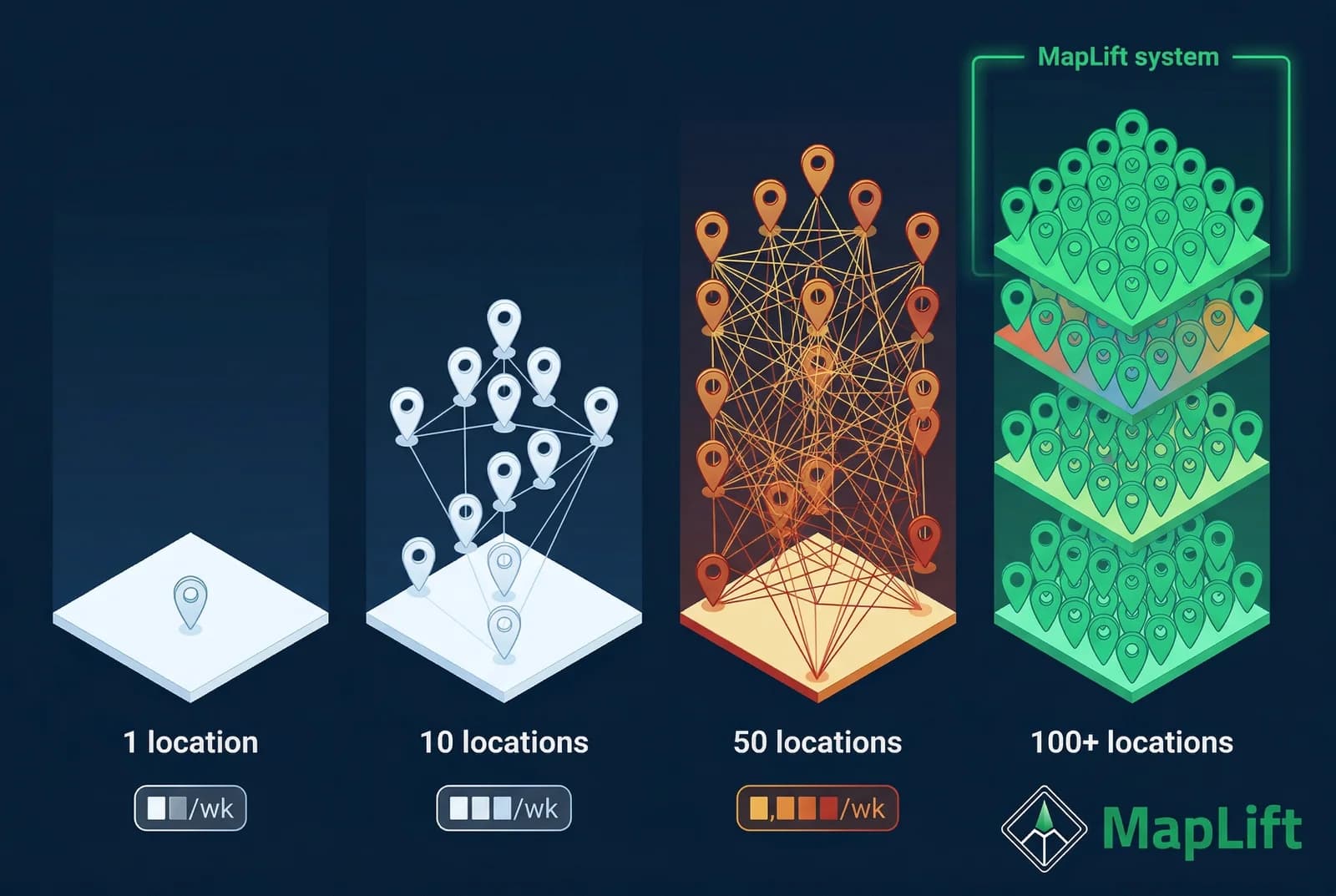
I have spent six years helping businesses optimize their Google Maps presence, and the pattern is consistent: chains and franchises that scale past five locations without a review management system see their aggregate rating drift downward within 12 months. Not because service quality drops, but because the informal, effort-based approach to reviews that worked at two locations cannot survive the operational complexity of ten. This guide covers how to build a system that works at any scale.
Why Multi-Location Review Management Fails Without a System
Most franchise operators approach multi-location reviews the way they approach other operational issues: by trying harder. More reminders to managers, more checklists, more follow-up. It rarely works.
The reason is structural. A single-location business has one Google Business Profile to watch, one review stream to respond to, and one manager responsible for the outcome. The incentive to maintain a strong rating is direct and personal.
A multi-location business has fragmented ownership of the problem. Branch managers prioritize food quality and staffing over review responses. Corporate teams lack visibility into individual location performance until ratings have already dropped. And because Google counts reviews at the location level, a chain with ten outlets that averages 4.1 stars has four locations dragging down the six that are at 4.5.
According to BrightLocal, review recency is as important as review volume — a business that receives two or three reviews per week over several months sends a stronger trust signal than one that collected forty reviews at launch and has gone quiet. For a multi-location brand, this means every branch needs a consistent, ongoing flow of reviews, not a burst campaign at opening.
Fragmented accountability
Branch managers prioritize operations over reviews. Corporate teams lack real-time visibility until ratings have already dropped.
Inconsistent review velocity
Without a system, some branches generate 20 reviews a month while others go 45 days without a single new review.
Missed response windows
Negative reviews that sit unanswered for 48+ hours do more reputational damage than the original complaint. Branch managers routinely miss the window.
Centralized vs. Decentralised vs. Hybrid: Choosing the Right Model
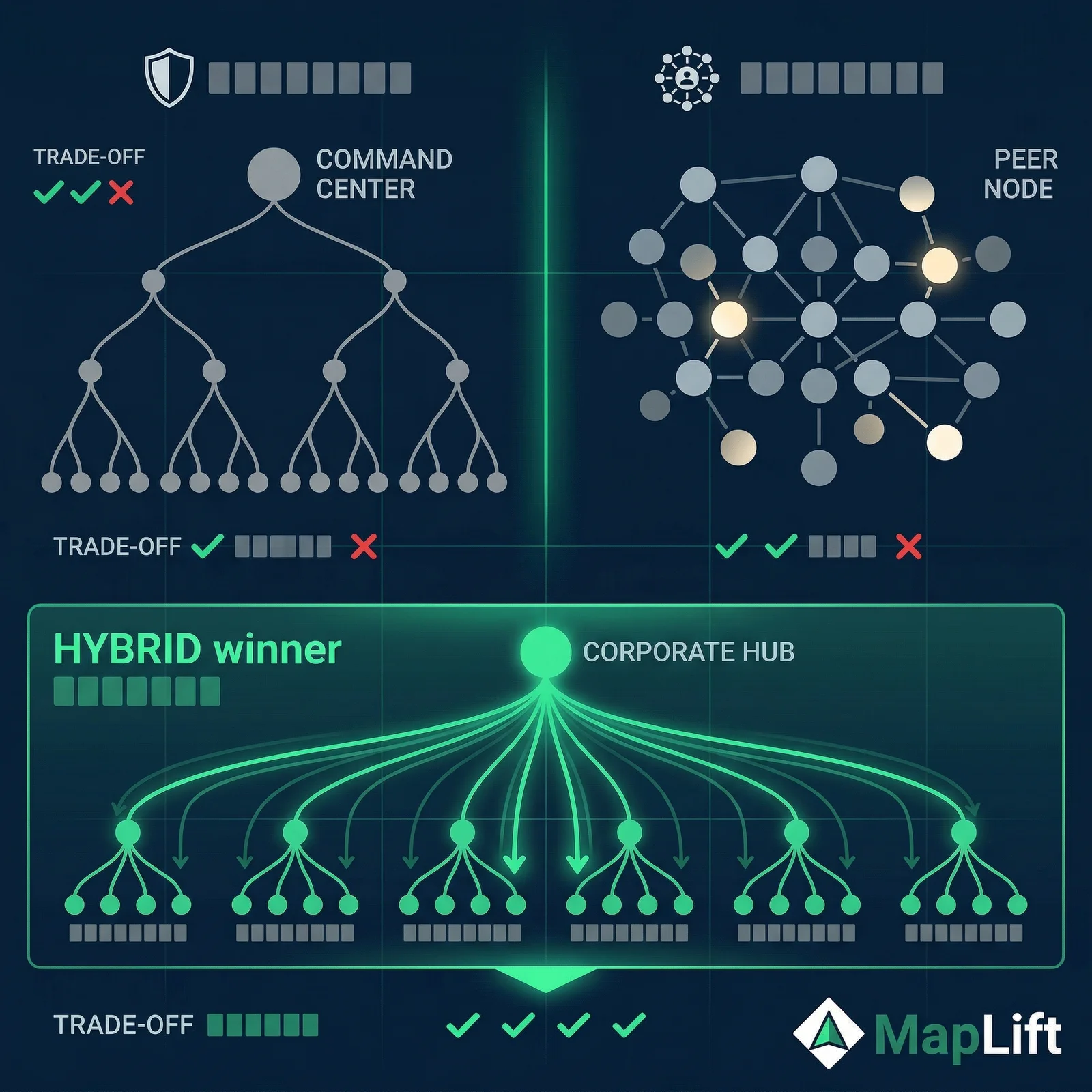
There is no single correct model for multi-location review management. The right choice depends on your brand structure, location count, and operational maturity.
Centralized
Best for: 2–15 locations, regulated industries
A corporate team monitors and responds to all reviews across all locations. Individual branches have no review management responsibility.
Works well when:
- Consistent brand voice across all responses
- No reviews fall through the cracks
- Ideal for highly regulated brands (healthcare, finance)
Breaks down when:
- Local context gets lost in corporate responses
- Volume becomes unmanageable above 20–30 locations
- Slow to respond to location-specific nuances
Decentralised
Best for: independent franchisees, boutique brands
Individual location managers own their reviews completely. Corporate sets guidelines but does not intervene unless there is a crisis.
Works well when:
- Hyper-local context in every response
- Owner-customer relationships remain personal
- No corporate bottleneck
Breaks down when:
- Response consistency collapses under operational pressure
- Negative reviews routinely miss 24-hour response window
- Corporate has no visibility until damage is done
Hybrid
Best for: 5–500 locations, franchise chains
Corporate monitors all locations and handles critical reviews. Standard reviews are assigned to branch managers with template guidance and defined SLAs. Weekly performance benchmarking keeps accountability in place.
Works well when:
- Critical reviews handled at speed by corporate
- Local managers retain contextual ownership
- Scalable from 5 to 500+ locations
Breaks down when:
- Requires a platform to coordinate review triage
- Needs clear SLA definitions to work consistently
What the research says about the hybrid model
FranConnect's 2025 research on franchise data management found that centralized review platforms improve response consistency by 10–15% across franchise networks compared to fully decentralised approaches. The efficiency gain comes from systematic triage, not from removing local ownership. The hybrid model captures the local context advantage while ensuring no review — especially no damaging one — falls through the cracks.
The Review Response SLA Framework
One of the clearest operational improvements a multi-location brand can make is establishing a formal Service Level Agreement for review responses. Without one, "respond promptly" is a guideline nobody enforces.
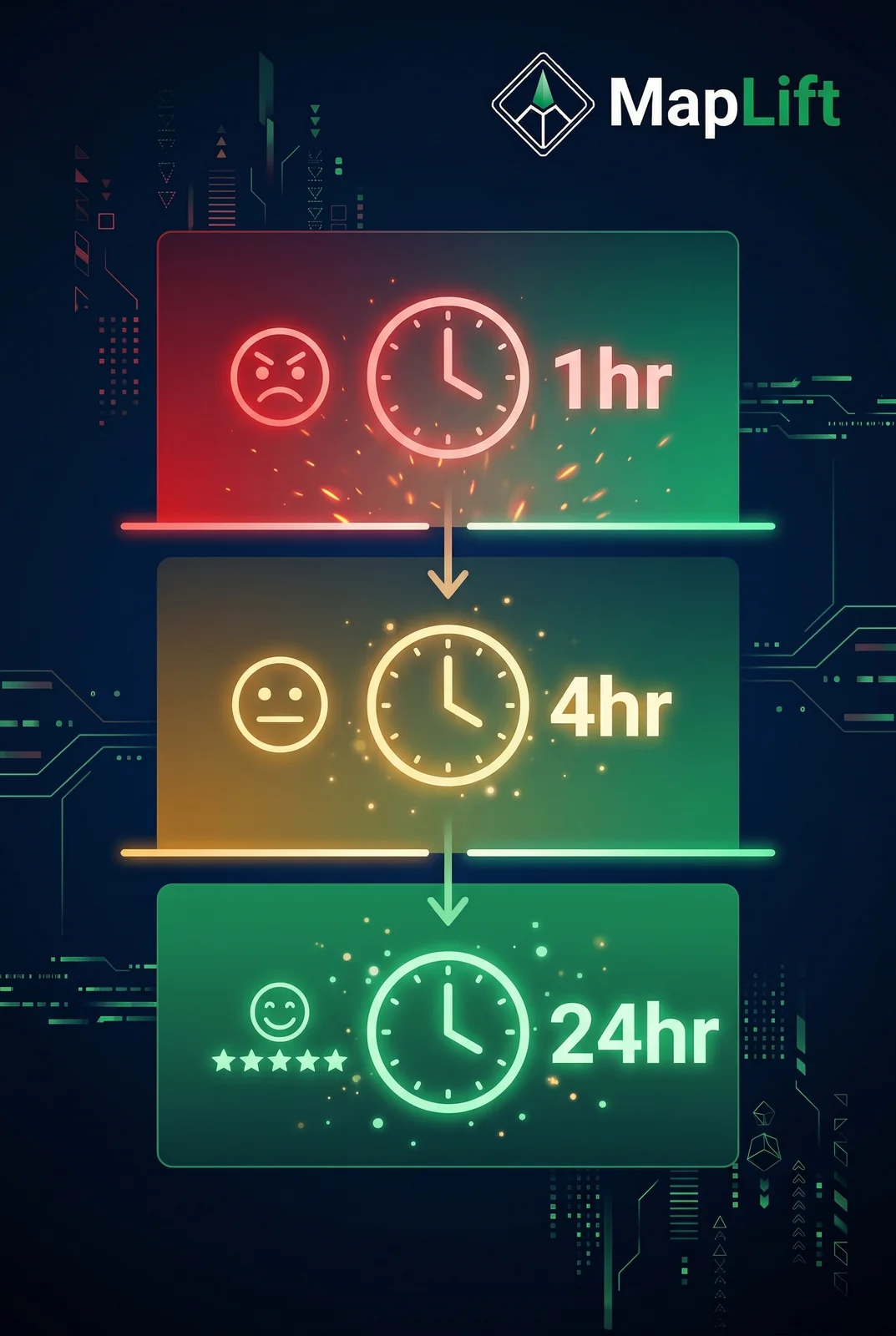
BrightLocal data shows that negative reviews responded to within 24 hours are 33% more likely to be updated or revised positively. That window closes fast — and in a multi-location operation, without a defined SLA, the window routinely stays shut.
Tier 1 — CriticalRespond within 4 hours
- Any 1-star review
- Review mentioning food safety, hygiene, or health issues
- Review containing allegations of staff misconduct
- Review with more than 50 upvotes
Tier 2 — High PriorityRespond within 24 hours
- Any 2-star review
- Review mentioning a specific staff member by name
- Review from a verified Local Guide
- Review mentioning a refund, complaint, or unresolved issue
Tier 3 — StandardRespond within 48 hours
- All 3-star reviews
- 4–5 star reviews with specific service feedback
- 4–5 star reviews with general positive comments
Tier 4 — AutomatedRespond within Template response
- 5-star reviews with no text
- Reviews in non-English languages requiring basic acknowledgment
The SLA only works with a monitoring platform
A defined SLA requires someone monitoring and triaging reviews across all locations in real time. For any brand with more than five locations, this is only operationally viable with a centralized review management platform that automatically classifies incoming reviews by tier and routes them to the appropriate responder. See how review management software handles this automatically.
Location Performance Benchmarking
Chains that do not benchmark review performance across locations have no way to identify which branches are underperforming — or why. Four metrics, tracked weekly per location, tell the entire story.
Average star rating (30-day rolling)
Current rolling average, not all-time. All-time ratings can mask recent deterioration. A branch with a 4.3 all-time rating and a 3.8 rating over the past 30 days has a service problem that the all-time number hides.
What low performance signals:
Recent service quality issues or a surge of unanswered negative reviews.
Review velocity (new reviews per 30 days)
How many new reviews arrived in the past 30 days. Review recency is a direct ranking signal. A branch receiving fewer than 4 reviews per month is invisible to the review generation process.
What low performance signals:
No review request process in place, or staff not asking for reviews.
Response rate (within SLA)
Percentage of reviews that received a response within the defined SLA timeframe. Industry average is now 73% — below this represents below-median performance.
What low performance signals:
No SLA enforcement, no monitoring platform, or branch manager overwhelmed.
Sentiment ratio (positive vs. negative)
Percentage of reviews containing positive vs. negative sentiment, independent of star rating. A 4-star review can contain significant negative sentiment about specific staff or menu items.
What low performance signals:
Recurring service issue that management is not addressing operationally.
Birdeye's 2024 State of Google Business Profile data shows the industry-wide review response rate rose from 63% in 2023 to 73% in 2024. For a brand competing in local search, this means your floor is now roughly 73% response rate — anything below that is below the industry median, and Google's algorithm notices.
I worked with a 12-location salon chain in Maharashtra last year that was losing local pack visibility at three of its branches. The branches had acceptable ratings (above 4.0) but review velocity of fewer than two reviews per month. When we ran the benchmark comparison against their highest-performing location — which consistently received 15–20 reviews per month — the pattern was obvious: those three branches had never implemented any review request process. The managers assumed customers would leave reviews unprompted. Most do not.
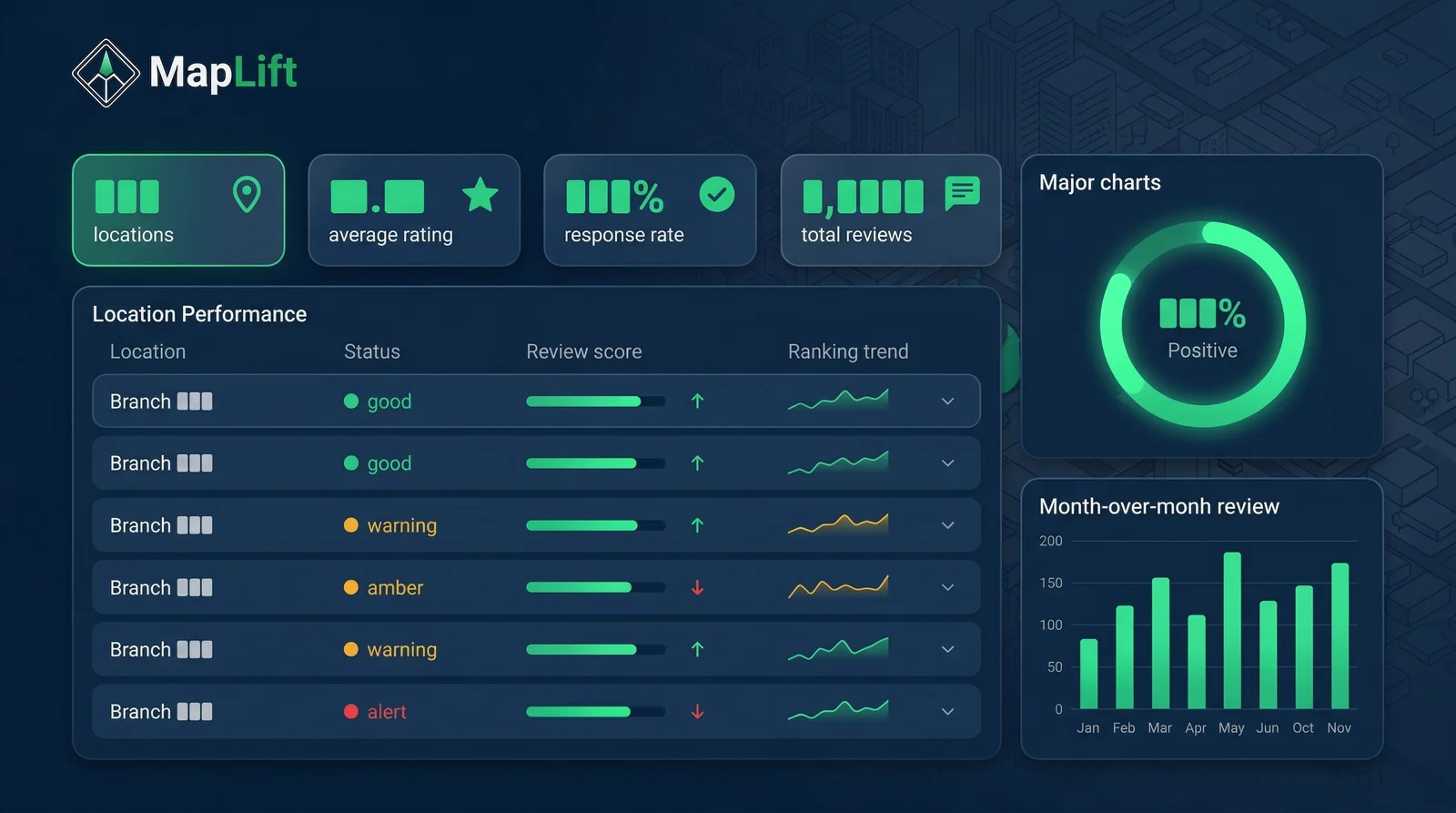
MapLift Business tier: one dashboard for all your locations
Monitor review performance across every branch, generate location-specific review templates, track response SLAs, and benchmark locations against each other — without switching between individual Google Business Profiles. Purpose-built for Indian franchise chains. Business tier from ₹1,499/month.
India Franchise Examples: What the Scale Challenge Looks Like
India's franchise sector gives us excellent real-world context for multi-location review management at scale. Three chains illustrate the challenge across different business models.
1Naturals Salon
800+ salons, 20 states, franchisee-owned model
Naturals Salon
800+ salons, 20 states, franchisee-owned model
With 800+ separate Google Business Profiles under a franchisee-owned model, Naturals faces the classic decentralised review management problem at scale. Each franchisee is an independent operator with competing operational priorities — and the brand's growth target of 3,000 salons by 2029 makes this challenge exponentially larger.
Review management implication:
A single franchisee who ignores reviews for a quarter can produce a 3.4-star branch in a high-visibility market. With 800+ locations, even a 5% non-compliance rate means 40 underperforming branches dragging down brand visibility in their local markets.
2Wow Momos
318+ outlets, 16+ cities, valued at ~₹860 crore
Wow Momos
318+ outlets, 16+ cities, valued at ~₹860 crore
Wow Momos operates in a mix of mall food courts and high-street locations with very different footfall patterns. Mall-adjacent outlets often receive lower review volumes than street-facing stores — customers in malls are less likely to complete their visit experience with a review, creating velocity gaps that affect local ranking.
Review management implication:
A consistent, outlet-type-specific review generation process is necessary to maintain ranking parity across the network. Mall outlets need QR codes on trays and packaging; street outlets need WhatsApp follow-ups or staff prompts.
3Chai Point
170+ outlets, hybrid company-owned (120+) and franchise (25+) model
Chai Point
170+ outlets, hybrid company-owned (120+) and franchise (25+) model
Company-owned outlets are easier to standardize for review management because the outlet manager reports directly to corporate. The 25+ franchise locations introduce the variability common to all franchise models — independent operators with different levels of engagement with brand standards.
Review management implication:
The franchise locations need the same review management tooling that company-owned outlets have, distributed in a way that franchisees can operate independently but corporate can monitor centrally.
The common thread across all three brands is that review management cannot be optional at scale. Each new location that opens with no review management process represents a dilution of the brand's aggregate local search visibility — and with India's QSR market projected to reach ₹43.5 billion by 2030, the brands that build review systems early will compound the advantage as they expand.
Building Location-Specific Review Templates
One of the highest-leverage activities in multi-location review management is creating location-specific review request templates — not a single generic template applied to all branches.
Generic template (helps nothing)
"We hope you enjoyed your visit! Please leave us a review on Google."
This produces reviews like "great Chai Point, recommend." No location, no specifics, no local search value.
Location-specific template (builds local ranking)
"Thanks for visiting us at Indiranagar! Tell them which tea you had, how the ambience was, and whether you'd recommend us for a quick break from work."
Produces reviews with location, product, and use-case context — all signals that boost that specific branch's local visibility.
The Location Signal Stack
When working with multi-location businesses, I use a framework I call the Location Signal Stack. Every location template should incorporate all three layers to produce reviews that build local search visibility — not just star ratings.
Layer 1 — Geographic anchor
Every template prompts the reviewer to mention the specific location by neighbourhood or landmark. This creates locally-anchored reviews that boost visibility for location-specific searches.
Example prompt: "Tell them you visited us at the Koramangala 80 Feet Road outlet..."
Layer 2 — Service specificity
Templates prompt reviewers to name the specific service or product they experienced. Generic reviews do not help local rankings — specific ones do.
Example prompt: "Tell them which tea you had today, or which treatment you came in for..."
Layer 3 — Experience context
Templates prompt reviewers to describe the context of their visit. Use-case context gives Google semantic signals about what type of experience your location offers.
Example prompt: "Was it a quick work break, a family visit, or a special occasion?"
For a chain with 50 locations, this means 50 distinct templates. That is not practical to write manually — but it is exactly the kind of work that AI-powered review management tools like MapLift handle at scale. The AI incorporates each location's neighbourhood, primary services, and typical customer profile to generate templates that are locally relevant from day one.
Automated Monitoring and Escalation Workflows
For chains above 20 locations, manual review monitoring becomes a bottleneck. The solution is automated monitoring with rule-based escalation.
Alert thresholds
Any new 1–2 star review triggers an immediate notification to both branch manager and corporate. Secondary threshold: three or more negative reviews in seven days escalates to a senior operations review, regardless of whether each individual review was responded to.
Sentiment keyword monitoring
Specific keywords (food poisoning, unclean, rude staff, wrong order, waited 45 minutes) automatically escalate regardless of star rating. A 3-star review containing "found something in my food" is more damaging than a generic 1-star. Smart escalation looks at content, not just rating.
Response drafting assistance
For large chains, drafting individual responses to hundreds of reviews per week requires AI assistance. Template-based responses for common review types, combined with AI-assisted drafting for complex cases, reduces response time while maintaining response quality.
Weekly performance reports
Every Monday, the multi-location dashboard auto-generates a report showing each location's review metrics for the previous week, ranked by performance. Locations below SLA response rates, lost rating points, or below minimum review velocity are automatically flagged for manager follow-up.
The market is catching up to the need
The enterprise review management software market reached $1.7 billion in 2024 and is projected to grow to $7 billion by 2033, according to Archive Market Research. This growth reflects how central systematic review management has become to franchise operations at scale — and how much of the Indian market is still under-served by tools priced for Western enterprise budgets.
How MapLift Business Tier Handles Multi-Location Review Management
MapLift's Business tier (₹1,499/month) is built specifically for multi-location businesses that have outgrown manual review management. Here is the end-to-end workflow.
1Location setup and onboarding
Location setup and onboarding
Add all your GBP locations to a single MapLift dashboard. Each location gets its own review profile, benchmark targets, and performance tracking configuration.
2Location-specific template generation
Location-specific template generation
MapLift's AI generates review request templates for each branch, incorporating the location's neighbourhood, primary services, and typical customer profile. A Naturals salon in Powai gets different templates than one in Anna Nagar.
3Centralized monitoring dashboard
Centralized monitoring dashboard
All incoming reviews across all locations appear in a single feed, sorted by SLA tier. Tier 1 reviews are flagged for immediate attention. The operations team sees every branch's review activity without visiting individual Google Business Profiles.
4Response workflow and SLA tracking
Response workflow and SLA tracking
Branch managers receive notifications for reviews assigned to their SLA tier via WhatsApp or email. They respond within the platform, and the response publishes to Google. Corporate can review responses before publishing for sensitive cases.
5Performance benchmarking
Performance benchmarking
The multi-location dashboard shows each branch's review velocity, response rate, average rating, and sentiment ratio in a single comparative view. Underperforming locations are highlighted automatically, with one-click escalation to branch managers.
| Feature | Manual / Spreadsheet | MapLift Business |
|---|---|---|
| Review monitoring | Check each GBP individually — misses reviews between checks | All locations in one feed, real-time, with SLA tier classification |
| Review templates | One generic template for all locations | AI-generated location-specific templates with geographic and service context |
| Response SLA tracking | No tracking — response rate unknown until it becomes a problem | Automated SLA timers per review, with manager notification on breach |
| Performance benchmarking | Manual spreadsheet, updated weekly at best | Automated weekly report with location ranking and underperformer flagging |
| Scalability | Breaks down above 5–7 locations | Designed for 5–500 locations |
Purpose-built for Indian franchise economics
Most enterprise review management tools are priced for Western markets at rates that make them cost-prohibitive for Indian franchise chains. MapLift's Business tier is designed around the economics of Indian franchise operations — managing up to 500 locations at a pricing model that scales with your growth.
Frequently Asked Questions
How many locations do you need before a multi-location review management system becomes necessary?
The inflection point is typically five locations. Below five, an informal process — a shared WhatsApp group, a weekly check-in — can work if the team is disciplined. Above five, the volume of reviews and the operational complexity of managing accountability across managers makes informal processes unreliable. If your brand is at three or four locations and growing, the right time to implement a system is now, before the informal habits from early scale become entrenched.
Should franchise owners manage their own Google reviews or should corporate handle it?
The answer depends on your franchise model. Fully independent franchisees — like many Indian salon or food chain operators — typically own their Google Business Profiles and are operationally responsible for their reviews. In this case, corporate's role is to provide templates, training, and monitoring tools, not to respond on franchisees' behalf. For company-owned outlets, centralized corporate management with local escalation is more appropriate. The hybrid model accommodates both ownership types simultaneously.
What is a realistic review response rate target for a multi-location business?
Birdeye's 2024 data shows the industry average response rate rose to 73%. For a brand competing in local search, target 85% or higher — meaning 85% of all reviews receive a response within the SLA timeframe. Aim for 100% response to all Tier 1 and Tier 2 reviews (1–3 star reviews or reviews with specific service feedback). The remaining 15% tolerance accommodates the practical reality that some reviews arrive during operationally difficult windows.
How do you handle a negative review about a specific location that could damage the entire brand?
Speed is the most important factor. A negative review that sits unanswered for 48 hours does more damage than one that receives an immediate, professional response. The response should: acknowledge the specific issue described, apologize appropriately without blanket admissions, provide a way for the customer to continue the conversation offline (phone number or email), and mention the steps being taken to address the issue. Do not argue with the reviewer in a public response, and do not post a generic corporate-sounding reply that ignores the specific complaint.
How do you build review velocity at a new location that has zero reviews?
New locations are at a competitive disadvantage because Google's algorithm treats review recency and velocity as prominence signals. In the first 30 days, every customer interaction should include a review request: a QR code on the receipt, a follow-up WhatsApp message, a verbal mention at checkout. The goal is to reach 10 reviews in the first 30 days. Sterling Sky's 2025 case study shows a measurable local ranking lift when a location crosses the 10-review threshold. Once at 10 reviews, focus on maintaining steady weekly velocity rather than volume bursts.
What is the difference between centralized and decentralised review management for franchises?
Centralized management means a corporate team handles all reviews across all locations. It ensures consistency but loses local context and breaks down operationally above 15–20 locations. Decentralised management means each branch manager handles their own reviews. It preserves local context but results in wildly inconsistent response rates — busy managers simply do not respond. The hybrid model resolves this: corporate handles critical reviews (1–2 star, sensitive content) while branch managers handle standard reviews with template guidance and defined SLAs. FranConnect research shows the hybrid approach improves response consistency by 10–15% versus fully decentralised operations.
Build the System Before You Need It
Multi-location review management is not a harder version of single-location review management. It is a different problem that requires a different approach — systems over effort, benchmarking over gut feel, and centralized visibility with localized execution.
India's franchise sector is growing faster than the operational infrastructure to support it. Chains like Naturals, Wow Momos, and Chai Point are expanding to hundreds of locations, and each new outlet that opens without a review management system is a new vulnerability to local search visibility drift.
The businesses that win at multi-location review management share three characteristics: they have a clear model (centralized, decentralised, or hybrid), they have defined SLAs with named accountability, and they use a platform that gives them a single view across every location. If you manage more than five locations today and do not have this system in place, the gap between your review performance and your best-performing competitor will widen with every new location you open.
MapLift Business tier: multi-location review management for Indian franchises
Centralized monitoring, location-specific AI review templates, SLA tracking, and performance benchmarking across up to 500 locations — in one dashboard. Purpose-built for Indian franchise economics. Business tier from ₹1,499/month.
Sources & References
- Multi-Location Review Management — BrightLocal- BrightLocal
- State of Google Business Profile 2025 — Birdeye- Birdeye
- Multi-Location Review Management Strategies — SocialPilot- SocialPilot
- Benefits of Centralized Data Management — FranConnect- FranConnect
- 2025 UPDATE: Does Number of Reviews Impact Ranking? — Sterling Sky- Sterling Sky
- Franchise Review Management Essentials — Uberall- Uberall
- About Naturals Salon — India's Best Beauty Salon Chain- Naturals Salon
- Wow! Momo — Wikipedia- Wikipedia
- Chai Point Franchise — FranTiger Consulting- FranTiger
- Quick Service Restaurant in India — Market Overview 2026- Restroworks
Keep reading
Ready to act on this? What MapLift does — every feature, and which plan carries it.