
Google Maps "Near Me" Optimization: Complete Guide to Ranking for Local Searches (2026)
1.5 billion "near me" searches happen every month. 76% of those searchers visit a business within 24 hours. This guide explains exactly how Google decides who ranks — and what you can do this week to be in those results.
Table of Contents
TL;DR — Key Takeaways
1.5 billion near-me searches every month — and growing
Mobile searches for "store open near me" have grown over 250% in two years. 76% of near-me searchers visit a business within 24 hours. This is the highest-converting traffic category in local search.
Proximity is less than 20% of your near-me ranking
Relevance and prominence now dominate. A business 2 km away with a complete, review-rich profile consistently outranks a business 500 m away with a sparse profile.
GBP completeness accounts for up to 32% of local ranking factors
Every attribute you check, every service you describe, every category you claim accurately — these are direct near-me relevance signals. Most businesses leave 60–70% of applicable attributes unchecked.
India's tier 2 cities are the biggest near-me opportunity in 2026
Internet penetration in tier 2 and tier 3 cities is growing at 30% annually. Local search volumes in cities like Jaipur, Indore, and Lucknow now rival metros — with far less optimized competition.
Schema markup and mobile speed are near-me ranking multipliers
72.6% of Google first-page results use schema. 58% of local searches happen on mobile. Both are controllable factors that most local businesses have not addressed.
Every day, more than 50 million people type or speak some version of the same two words into Google: "near me."
They are looking for a restaurant, a clinic, a salon, an auto repair shop, a pharmacy — and they want the closest, most trusted option right now. These are not casual browsers. Google's own research shows that 76% of people who perform a "near me" search on their smartphone visit a business within 24 hours, and 28% of those searches end in a purchase on the same day.
That intent makes "near me" searches among the most valuable traffic a local business can capture. A restaurant that appears in the Google Maps local pack for "restaurants near me" does not need a national advertising budget. It just needs to show Google, clearly and consistently, that it is the most relevant, trusted option in the area.
This guide explains exactly how Google decides which businesses to show for near-me queries, what you can do this week to improve your position, and why Indian businesses — especially those in tier 2 cities — have an extraordinary opportunity right now.
What "Near Me" Searches Mean for Google Maps
When someone searches "coffee shop near me," Google does not simply find the nearest business with "coffee" in the name. It runs a three-factor analysis to determine which results are most likely to satisfy the searcher's full intent.
Proximity
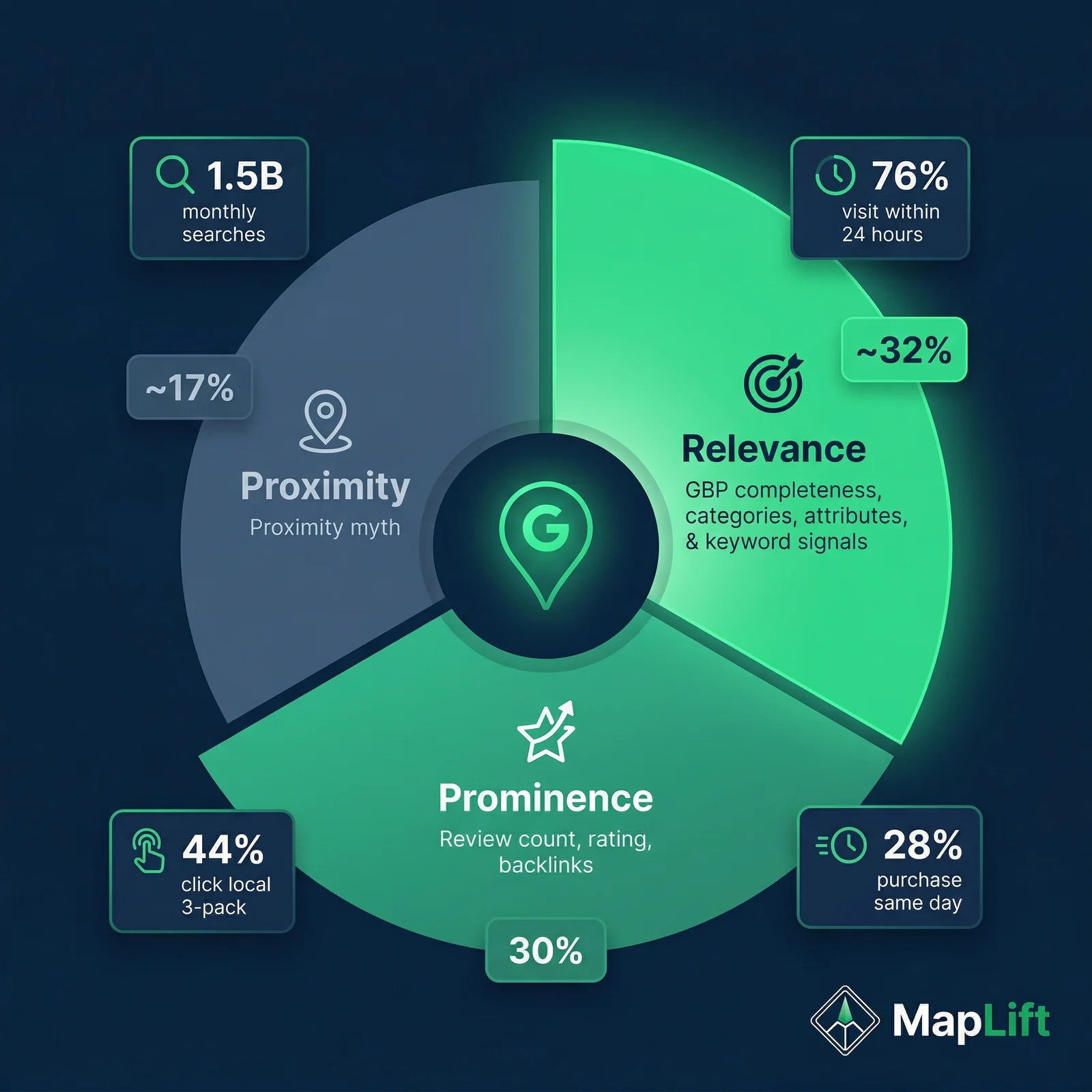
15–19% of ranking power (2025 data)
How far the business is from the searcher. Google uses GPS location for mobile and inferred location for desktop.
Proximity has declined from 25–30% five years ago. It still matters, but it is no longer decisive.
Relevance
Approximately 25% of ranking power
How well the business profile matches the full intent behind the query — category, description, services, review language, and attributes.
The highest-leverage factor. Almost entirely within your control through profile optimization.
Prominence
19–27% driven by reviews and citations
How well-known and trusted the business appears — through review volume and quality, links, citations, and behavioral signals.
Review signals alone can account for 15–27% of ranking factors for top local pack positions.
The proximity myth: distance is less than 20% of your near-me ranking
Research from Local Falcon and LocalDominator shows proximity now contributes approximately 15–19% of ranking power in most markets, down from 25–30% five years ago. A business 2 kilometres away with a complete, review-rich profile consistently outranks a business 500 metres away with a sparse profile. Relevance and prominence are where the battle is won.
The Near-Me Search Volume Reality
"Near me" search volume has more than doubled globally over the past three years. Globally, 1.5 billion "near me" queries occur every month — 50 million searches every single day. The conversion intent behind these queries is extraordinary: 44% of local searchers click on local 3-pack results, and 78% of local mobile searches lead to an offline purchase within a short time.
"Near me" searches happen globally every month — 50 million every single day
Of near-me searchers visit a business within 24 hours of their search
Of near-me searches result in a same-day purchase
Growth in mobile "store open near me" searches over the past two years
Of local searchers click on local 3-pack results (vs 29% for organic)
Of all local searches happen on mobile devices
Why Near-Me Searches Are Exploding in India
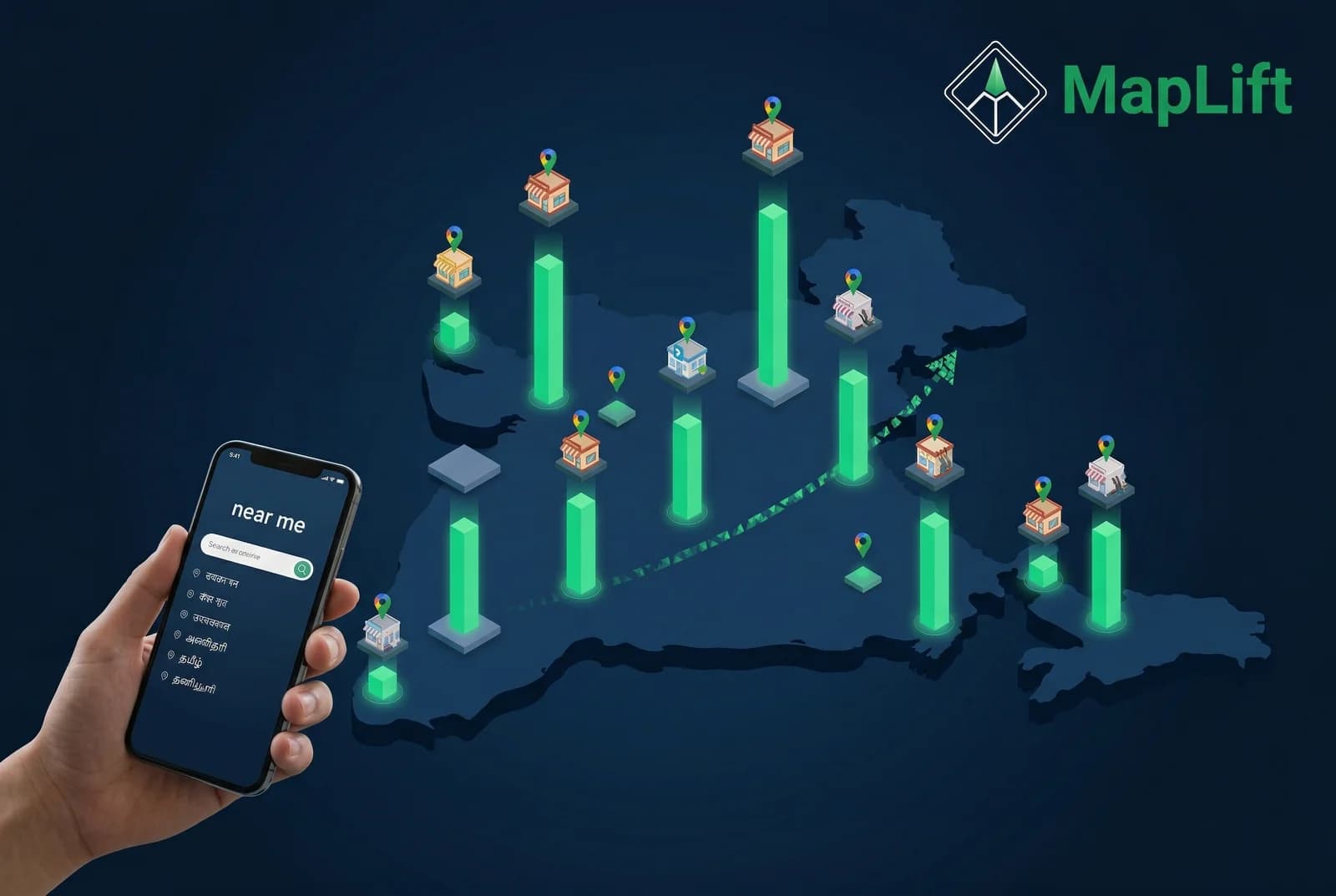
India's internet user base surpassed 950 million in 2025, and internet penetration in tier 2 and tier 3 cities is expanding at 30% annually — nearly double the rate of already-saturated metro markets.
Tier 2 Cities Are Leading, Not Following
A 2024 JustDial report found that tier 2 and tier 3 cities now lead India's local services search volume, with schools, restaurants, hospitals, beauty parlours, and home services topping the most-searched categories. Cities like Jaipur, Lucknow, Coimbatore, and Nagpur are seeing local search volumes that rival metros — but those markets have far fewer businesses that have properly optimized their Google Maps presence.
This creates a compounding opportunity: less competition, growing search volume, and a user base that is highly intent-driven. A clinic in Nashik or a salon in Indore that ranks in the top three for "near me" searches in their category can capture the majority of high-intent local traffic without competing against the optimization sophistication seen in Mumbai or Bengaluru.
Voice Search Is a Near-Me Accelerator
Voice search — particularly in Hindi, Marathi, Tamil, and Bengali — is the primary discovery method for many first-time internet users in non-metro India. Voice queries are almost always local: "Mujhe paas mein restaurant chahiye," "nearest chemist open now." Businesses that have optimized for near-me visibility also capture this voice search traffic, because Google's voice results draw from the same local pack signals.
Schema markup and complete GBP profiles are the two signals that most directly support voice search near-me results — both of which we cover in the sections below.
Over 60% of India's e-commerce transactions originate from tier 2 and tier 3 markets
UPI has become the default transaction method for 67% of consumers in non-metro markets. The digital maturity of these customers means near-me searches increasingly translate directly into visits and purchases — not just awareness. The opportunity for local businesses in these cities is not coming. It is here.
How to Optimize Your Google Business Profile for Near-Me Searches
Your Google Business Profile is the single most important asset for near-me ranking. Industry data shows GBP signals account for up to 32% of all local pack ranking factors. Here is what that means in practice.
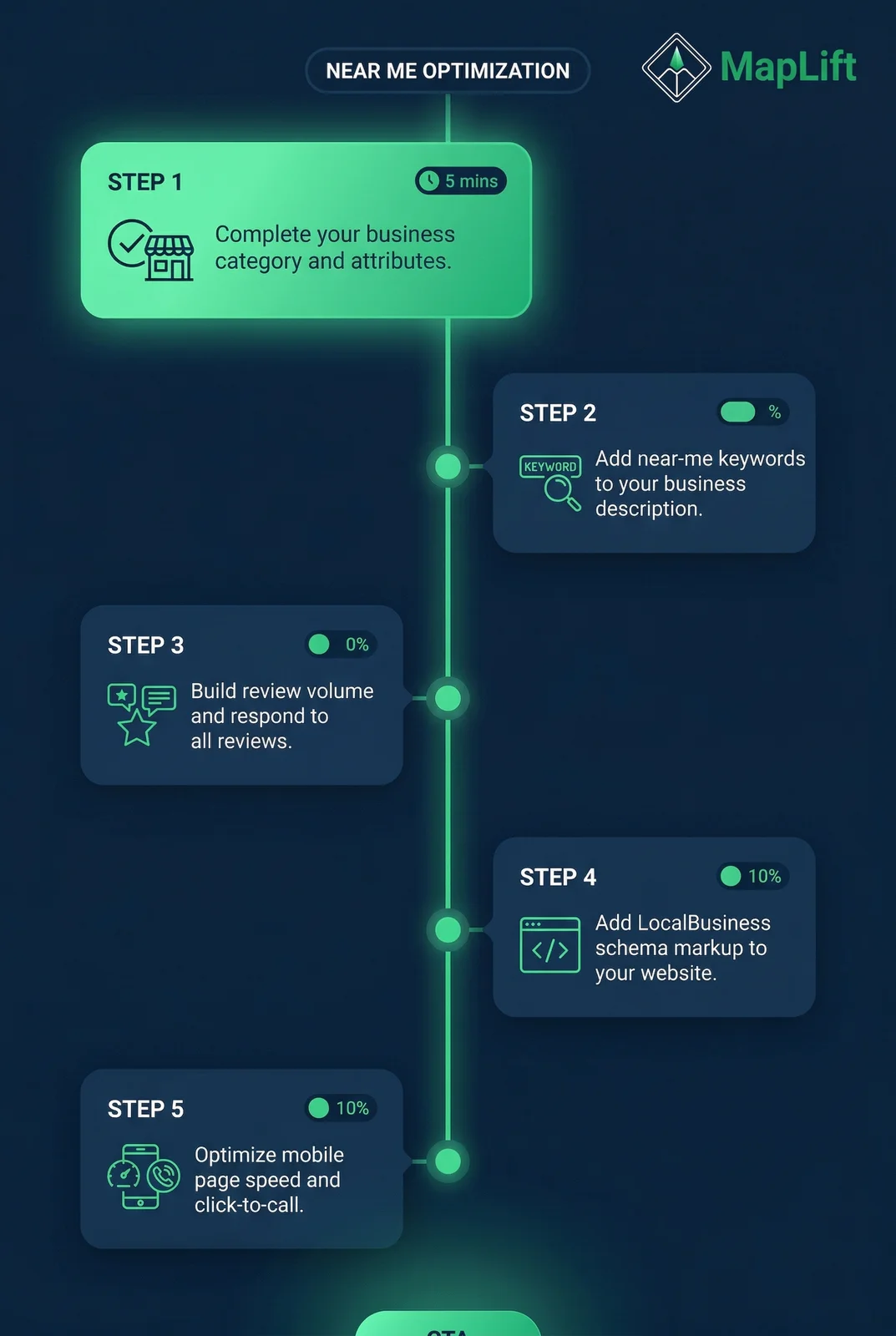
1Choose the Right Primary Category (and Add Secondary Categories)
Time: 15 minutes
Choose the Right Primary Category (and Add Secondary Categories)
Time: 15 minutes
Your primary category is the most powerful relevance signal Google has about your business. "Restaurant" is too broad. "South Indian Restaurant" or "Biryani Restaurant" — if accurate — targets more relevant near-me queries. Secondary categories extend your relevance footprint across multiple near-me query types.
- Use the most specific category that accurately describes your primary business
- Add secondary categories for every additional service type you offer
- Do not choose categories that do not honestly match your business — Google detects mismatches
- Review competitor categories using Google Maps search to benchmark your selections
2Write a Business Description That Uses Natural Language
Time: 30 minutes
Write a Business Description That Uses Natural Language
Time: 30 minutes
Your 750-character business description is indexed content. Write it the way a satisfied customer would describe your business to a friend. Include your primary service types, the neighborhoods or areas you serve, and what makes your business different. Natural, specific language outperforms keyword lists.
- Mention your primary service types in the first two sentences
- Include the neighborhood or area you serve — this is a direct near-me relevance signal
- Describe what makes your business distinct (established year, specialties, customer type)
- Avoid keyword stuffing — Google penalizes unnatural repetition
3Complete Every Applicable Attribute
Time: 45–60 minutes, one-time setup
Complete Every Applicable Attribute
Time: 45–60 minutes, one-time setup
Open your GBP dashboard, navigate to Edit Profile, and find the Attributes section. Check every attribute that honestly applies. Parking, outdoor seating, wifi, wheelchair access, women-led, vegetarian options, dine-in, delivery, takeaway — each checked attribute is a matchable data point for near-me queries. Most businesses leave 60–70% of applicable attributes unchecked.
- Check all attributes that honestly apply — completeness is a relevance multiplier
- Attributes like "free parking" and "outdoor seating" directly match common near-me modifiers
- Revisit the attributes section quarterly — Google adds new attribute options regularly
- Correct inaccurate attributes immediately — outdated data undermines trust signals
4Build Review Volume Consistently
Time: 15 minutes to set up, ongoing
Build Review Volume Consistently
Time: 15 minutes to set up, ongoing
Businesses with fewer than 10 reviews rarely appear in top-3 near-me results for competitive categories. A target of 50+ reviews with a 4.0+ rating is a baseline for consistent near-me visibility in most Indian markets. Use post-visit follow-up messages via WhatsApp to request reviews when experience is freshest.
- Send review requests within 24 hours of the customer visit for highest conversion
- WhatsApp review requests sent to every customer after a visit convert at 15–20%
- Respond to every review within 48 hours — owner responses are a prominence signal
- Use review templates that prompt customers to mention specific services and the neighborhood
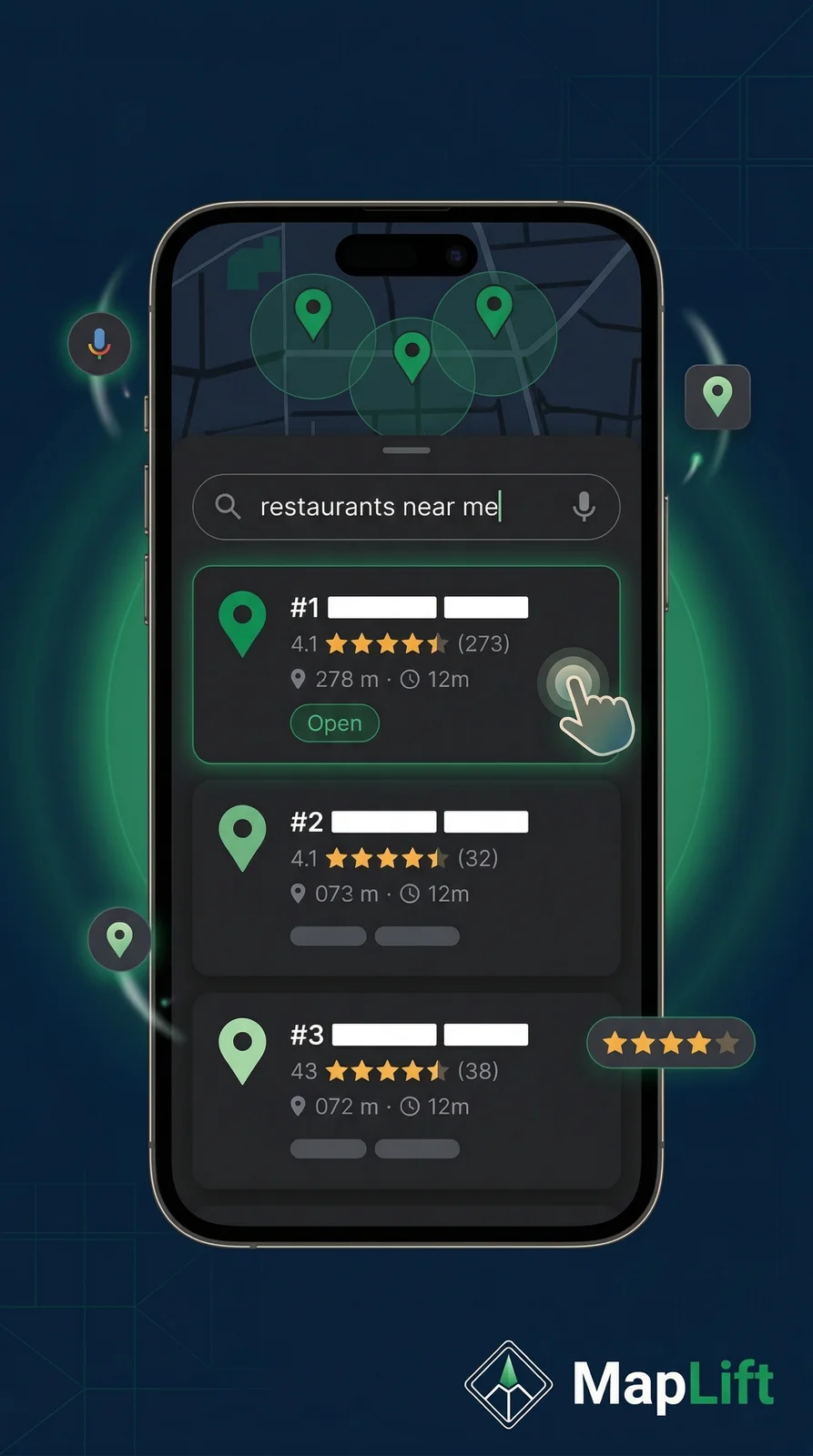
How Reviews Drive Near-Me Rankings
Industry studies show review signals account for 15–27% of Google Maps ranking factors for top positions. But volume alone is not the story — the language inside reviews matters just as much.
Keyword-Rich Reviews Are a Near-Me Multiplier
Reviews that mention specific services, dishes, or locations carry far more near-me ranking value than generic five-star reviews. A review saying "best biryani near Jayanagar" teaches Google that your restaurant is specifically associated with biryani and with Jayanagar — two signals that make you relevant when someone in that area searches for biryani near them.
Research shows that reviews with keyword relevance — customers mentioning specific services — provide up to 26% additional ranking power compared to reviews of equal length with no service keywords. Understanding the full picture of how Google Maps ranking works clarifies why review language and volume are both essential.
The Generic Review Problem
Low-value review (no near-me signal)
"Nice place. Good food. Will visit again."
Near-me relevance signals: none. Google cannot use this to match any specific query.
High-value review (multiple near-me signals)
"Best paneer butter masala near Koramangala — large portions, quick lunch service, and the parking is easy. Perfect for office groups."
Near-me signals: dish name, neighborhood, service quality, amenity, use case. Matches 5+ query types.
Response Rate and Recency Both Matter
Google interprets owner response activity as a prominence signal. A business that responds to every review within 48 hours signals active management and customer care. Review recency also matters: a business with 100 reviews where the last one was six months ago is deprioritized compared to a business with 60 reviews where 15 arrived in the last 30 days.
See our guide on Google Maps ranking factors for a complete breakdown of how review signals interact with other ranking elements.
Schema Markup: Helping Google Understand Your Business for Near-Me Queries
Schema markup is code you add to your website that tells search engines exactly what your business is, where it is, what it offers, and when it is open. For near-me searches — especially voice search and AI-driven discovery — LocalBusiness schema is increasingly important.
What LocalBusiness Schema Does
LocalBusiness JSON-LD tells Google your business name, address, phone number, coordinates, opening hours, price range, and service types in a machine-readable format. While schema does not directly boost rankings, research from Localo shows 72.6% of pages on Google's first page use schema markup — and for local businesses competing in near-me searches, the gap between schema-optimized and non-optimized profiles is increasingly visible.
- Improves Google's confidence in your business data — feeds into local ranking signals
- Enables rich results (opening hours, ratings, price range) directly in search results
- Supports voice search accuracy — voice near-me results draw heavily from schema data
- Supports AI-driven near-me discovery, which interprets structured data as high-quality signals
- 72.6% of Google first-page results use schema markup (Localo research)
Key Fields for Near-Me Optimization
Include these fields in your LocalBusiness schema:
@typeYour specific business type: Restaurant, HealthAndBeautyBusiness, etc.nameExact business name as it appears on your GBPaddressFull postal address with streetAddress, addressLocality, postalCodegeoLatitude/longitude coordinates for proximity matchingtelephonePrimary contact number with country codeopeningHoursSpecificationHours for each day of the weekpriceRangePrice range indicator (e.g., "Rs.200–Rs.500 per person")aggregateRatingCurrent rating and review count from GoogleUse Google's Rich Results Test to verify your schema implementation. Reference: developers.google.com/search/docs/appearance/structured-data/local-business
Mobile Optimization: The Near-Me Non-Negotiable
58% of all local searches happen on mobile devices. For near-me searches specifically, that percentage is even higher — near-me intent is inherently immediate and location-driven, which is almost always a mobile context.
Why Mobile Performance Affects Near-Me Rankings
If your website loads slowly or displays poorly on mobile, you are losing near-me traffic even when Google ranks you in the local pack. A user who clicks your result and encounters a slow, hard-to-navigate mobile site will hit the back button within three seconds — and that bounce signal affects your ranking over time.
Google's mobile-first indexing means the mobile version of your site is what Google primarily evaluates for ranking purposes. Mobile experience is a ranking signal for local search, not just a usability consideration.
Mobile Optimization Checklist for Near-Me Businesses
- Page speed under 3 seconds: Use Google PageSpeed Insights to identify load time issues. Compress images, enable caching, defer non-critical JavaScript.
- Click-to-call button above the fold: Near-me searchers want to act immediately. Your phone number must be tappable without scrolling.
- Tap-to-navigate address link: Link your address to Google Maps with a tap-to-navigate trigger. Use the Google Maps URL format with your coordinates.
- Minimum 16px font size: Google downgrades mobile usability scores for text below 16px. Readable text without zooming is a ranking signal.
- No intrusive interstitials on mobile: Pop-ups that cover content on mobile are a confirmed Google ranking penalty. Remove all full-screen overlays.
India-Specific Near-Me Strategy: Tier 1 vs Tier 2 Cities
Near-me optimization looks different depending on where your business operates. The competitive landscape, search volume, and optimization sophistication vary significantly between metros and tier 2 markets.
| Factor | Tier 1 (Metro) Markets | Tier 2 Markets |
|---|---|---|
| Competition level | High — many well-optimized businesses in each category | Low to medium — most businesses have incomplete profiles |
| Review counts needed | 100+ reviews for top-3 in competitive categories | 25–50 high-quality reviews often sufficient for category dominance |
| Search volume growth | Stable — market is maturing | Rapid — 30% annual internet penetration growth in these markets |
| Optimization effort needed | High — requires hyperlocal precision and multi-platform presence | Moderate — basic GBP optimization yields significant results |
| First-mover advantage | Limited — most categories already have strong incumbents | High — significant opportunity to establish category dominance now |
| Voice search relevance | Moderate — users skew toward typed search | High — voice in regional languages is primary discovery method for many users |
Metro Strategy: Hyperlocal Precision
In Bengaluru, Mumbai, Delhi, Hyderabad, and Chennai, near-me competition is intense for popular categories. The key lever is hyperlocal optimization: targeting specific neighborhoods (Koramangala, Bandra, Hauz Khas) rather than the full city. A restaurant that ranks for "restaurant near Koramangala" captures identically high-intent traffic as one ranking city-wide — but with lower competition.
- Target specific neighborhoods (Koramangala, Bandra, Hauz Khas) rather than full city
- Include neighborhood names in your GBP description and posts
- Build review counts of 100+ for competitive categories
- Maintain multi-platform presence (Google, Zomato, MagicPin, JustDial)
- Post on GBP at least twice per month with neighborhood-specific content
Tier 2 Strategy: First-Mover Advantage
Jaipur, Lucknow, Indore, Coimbatore, Vadodara, Nagpur — these cities are experiencing rapid local search growth with relatively unsophisticated competition. A business that invests in proper GBP optimization today can achieve near-me dominance with a fraction of the effort required in metros.
- Complete GBP optimization now — most competitors have not done this
- Target 25–50 reviews with specific service keywords to establish category dominance
- Add LocalBusiness schema to your website — few local competitors have done this
- Optimize for voice search by including common Hindi/regional language transliterations in your description
- Claim and optimize your listings on JustDial and Sulekha — high usage in tier 2 markets
MapLift gives you the near-me edge — wherever your business operates
MapLift analyzes your Google Maps presence and generates AI-powered review templates tailored to your services, location, and customer type. Reviews that contain specific service keywords, neighborhood mentions, and use-case context — exactly the language that drives near-me relevance. Essentials from Rs.299/month. Free analysis available.
Frequently Asked Questions
What is "near me" optimization for Google Maps?
"Near me" optimization is the process of improving your Google Maps presence so that your business appears prominently when users in your area search for your category with location intent — whether they type "restaurant near me," "salon near me," or speak a voice query. It involves optimizing your Google Business Profile, building strong review signals, completing LocalBusiness schema markup on your website, and ensuring your site loads fast on mobile.
How does Google decide which businesses to show for near-me searches?
Google uses three factors: proximity (how close the business is to the searcher), relevance (how well the profile matches the search query), and prominence (how trusted and well-known the business appears through reviews, links, and citations). Relevance and prominence are highly controllable through optimization — and in 2025, they outweigh proximity for most competitive categories. A business 2 km away with a complete, review-rich profile consistently outranks a business 500 m away with a sparse profile.
How many reviews do I need to rank for near-me searches?
There is no universal minimum, but industry data consistently shows businesses with fewer than 10 reviews rarely appear in top-3 local pack positions for competitive categories. For most Indian metros, 50+ reviews with a 4.0+ rating is a baseline for consistent near-me visibility. In tier 2 cities, 25–50 high-quality reviews with specific service keywords can be sufficient to rank in many categories. Review recency matters too — a steady flow of new reviews signals an active, trustworthy business.
Does schema markup help with near-me ranking?
Schema markup does not directly boost rankings, but it improves Google's confidence in your business data and enables rich search results (hours, ratings, price range) that increase click-through rates. It is especially important for voice search and AI-driven near-me discovery, both of which rely heavily on structured data signals. Research shows 72.6% of Google first-page results use schema markup — for local businesses, this is a significant gap that most competitors have not addressed.
Why do "near me" searches happen mostly on mobile?
Near-me intent is inherently immediate and location-dependent — people search for something near them when they are physically out and need it now. This is almost always a mobile context. 58% of all local searches happen on mobile, and for time-sensitive near-me queries, the percentage is higher still. Mobile optimization (page speed under 3 seconds, click-to-call, tap-to-navigate) directly affects near-me conversion rates and is also a ranking signal through Google's mobile-first indexing.
What is the best way for an Indian business to rank for near-me searches?
Start with a fully complete Google Business Profile — every attribute checked, detailed service descriptions, a keyword-rich business description that includes your neighborhood and service types. Build review volume with at least 50 high-quality reviews that contain specific service language. Add LocalBusiness schema to your website. Post on your GBP twice a month with neighborhood-specific language. Ensure your website loads in under 3 seconds on mobile. For tier 2 cities, this foundation is often enough to achieve top-3 near-me rankings within 60–90 days.
How long does it take to rank for near-me searches after optimizing?
GBP attribute and category improvements can start affecting rankings within days — Google re-indexes updated profiles quickly. Review volume improvements take longer because they depend on accumulating real customer reviews. Most businesses that systematically complete their GBP, add schema markup, and implement a review generation strategy see measurable near-me ranking improvements within 60–90 days. Tier 2 city businesses with less optimized competition often see results faster.
Near-Me Searches Are the Highest-Converting Traffic in Local Search — Claim Your Share
1.5 billion near-me searches happen every month. 76% of those searchers visit a business within 24 hours. 28% make a purchase on the same day. The intent behind these searches is unmatched in digital marketing — the user already knows what they want and exactly where they are.
The businesses that capture this traffic are not necessarily the closest or the largest. They are the ones that have given Google the clearest, most complete picture of who they are — through a fully optimized GBP, keyword-rich reviews, LocalBusiness schema, and a mobile-fast website.
For most Indian businesses, especially those in tier 2 cities, this optimization work is still largely undone by competitors. The first-mover advantage is available right now. The businesses that act in the next 60–90 days will lock in near-me rankings that compound over time.
Sources & References
- Tips to improve your local ranking on Google- Google Business Profile Help
- 24 Must-Know Local SEO Statistics- Backlinko
- Top 10 Local Search Ranking Factors: A 2026 Guide- LocalDominator
- What Are the Most Important Local Search Ranking Factors- Local Falcon
- LocalBusiness Structured Data- Google Search Central
- Tier-2, 3 cities lead India's local services search- Business Standard
- 75 Local SEO Statistics for 2026- SeoProfy
- Google Maps Statistics 2026- LoopEx Digital
- LocalBusiness Schema Markup: The Complete Guide- Localo
- Guidelines for representing your business on Google- Google
Keep reading
Ready to act on this? What MapLift does — every feature, and which plan carries it.