
How ChatGPT Recommends Local Businesses: What You Need to Know in 2026
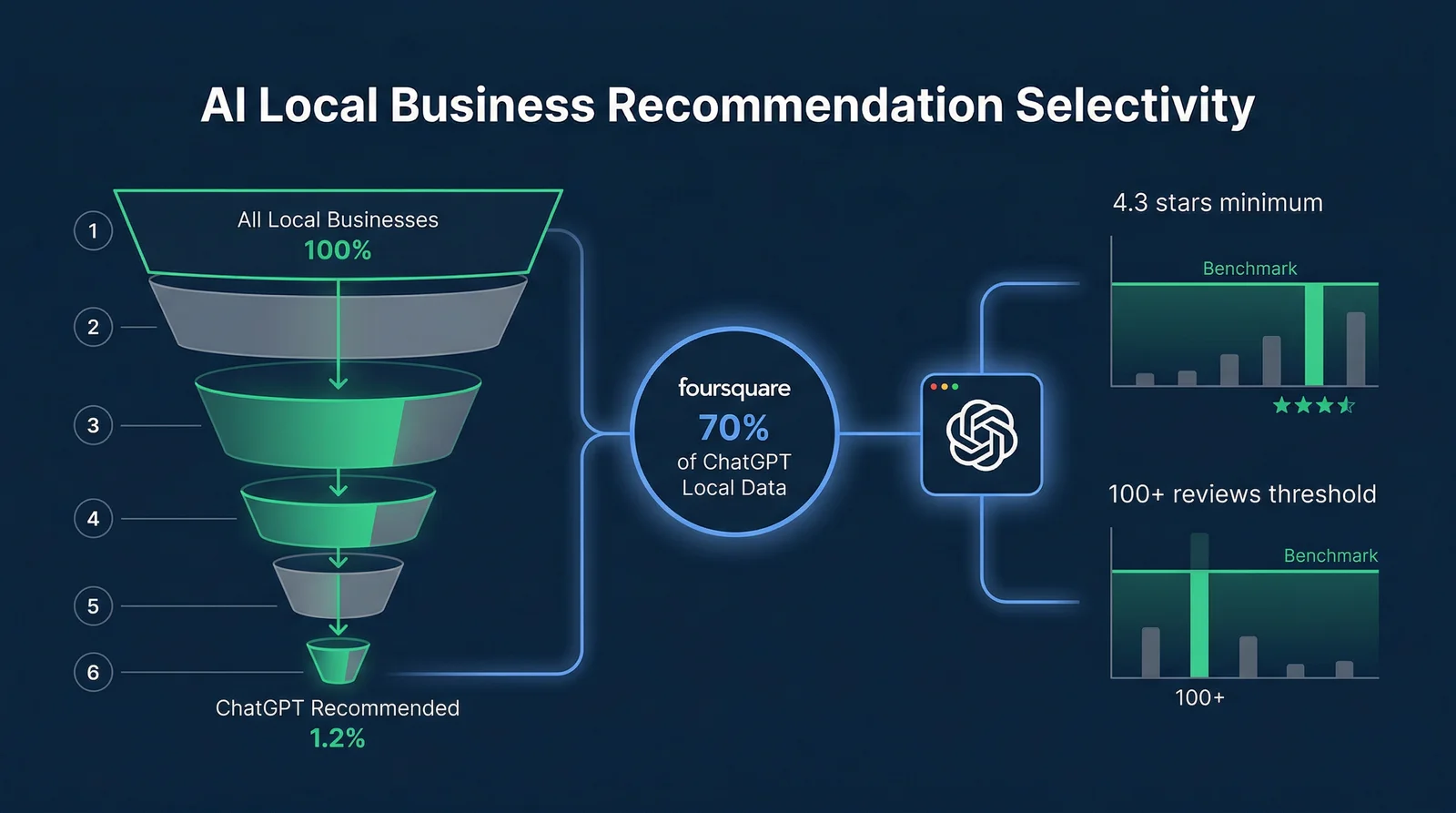
ChatGPT surfaces only 1.2% of all local business locations when users ask for recommendations. Here is exactly how it decides which ones make the cut — and what Indian businesses can do about it.
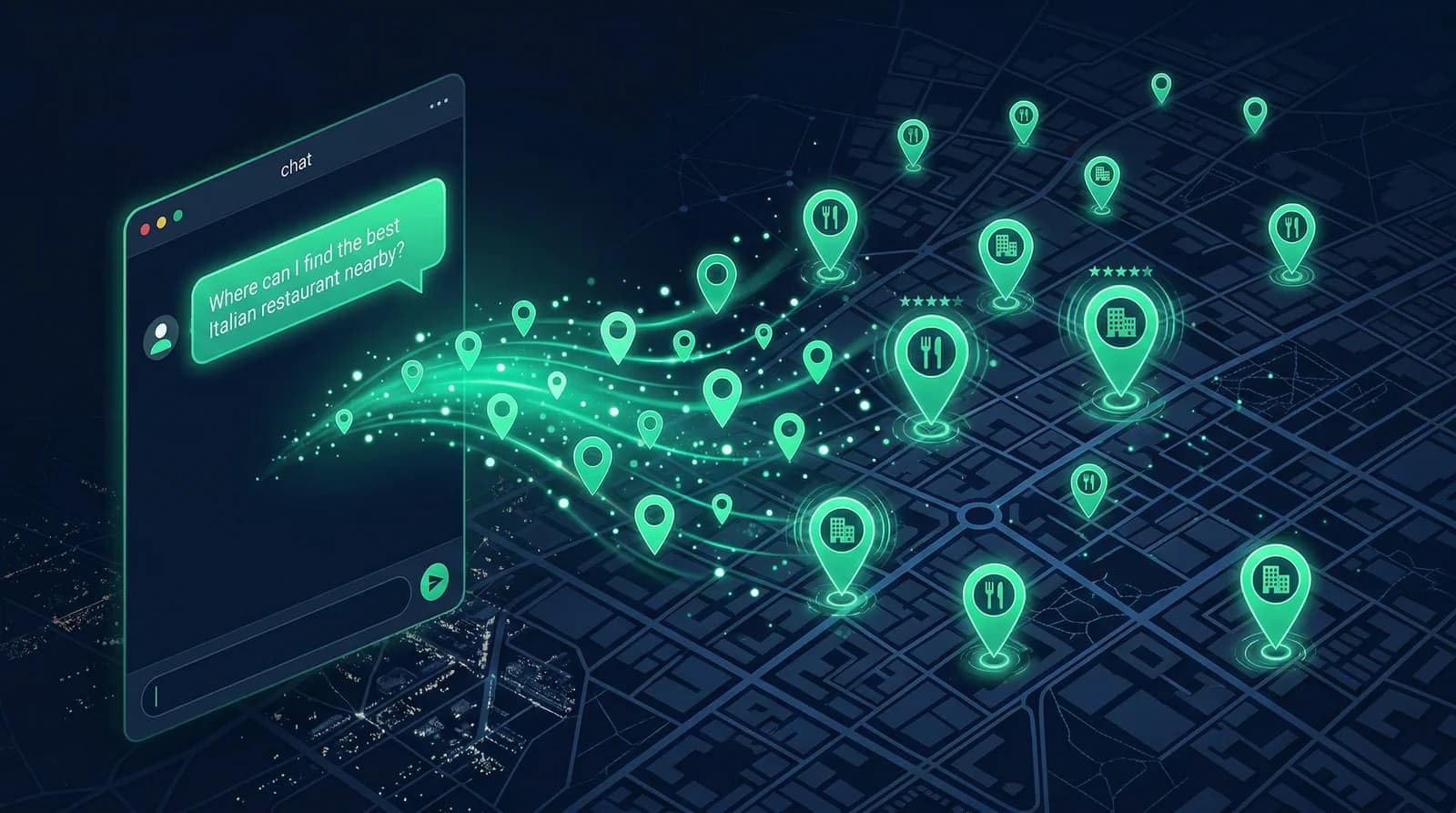
Table of Contents
TL;DR — Key Takeaways
ChatGPT uses Foursquare as its primary local data source
Over 70% of ChatGPT local business results come from Foursquare's Places API, queried in real time. If your business is not on Foursquare or your listing is incomplete, you are invisible to ChatGPT's local engine.
ChatGPT recommends only 1.2% of all local businesses
The businesses that appear average 4.3 stars and 100+ reviews with recent activity. Below these thresholds, AI recommendation engines consistently pass over your listing for competitors that meet them.
Indian businesses face a Foursquare coverage gap
Foursquare data density in India lags Western markets. This means Google Business Profile data, review volume, and NAP consistency across JustDial, Zomato, and Sulekha carry more weight for Indian businesses seeking AI visibility.
Google Maps optimization and ChatGPT visibility use the same signals
Reviews, NAP consistency, and structured data drive both. The work you do to rank on Google Maps directly improves your chances of appearing in ChatGPT recommendations.
I was reviewing MapLift's PostHog analytics in early 2026 when I noticed something unexpected: 3.2% of our incoming traffic was being referred by ChatGPT. Not Google. Not Meta ads. ChatGPT.
That percentage is small, but two things made it significant. First, it was not there six months earlier. Second, those ChatGPT-referred users had a 4.1x higher signup conversion rate than our Google Ads traffic. They arrived already convinced they needed what we offered — because ChatGPT had told them so.
What we observed at MapLift mirrors a broader shift. According to MarketingCode research, 45% of consumers now use AI search tools to find local services — up from just 6% the previous year. Gartner projects traditional search volume will drop 25% by 2026 as AI chatbots absorb more of it.
The question for any Indian local business owner is no longer "should I care about ChatGPT recommendations?" It is "why am I not appearing in them yet?" This guide answers that.
How ChatGPT Actually Finds Local Businesses
Most business owners assume ChatGPT works like Google — crawling websites, reading reviews, building a picture of local businesses over time. The actual mechanism is different, and understanding it changes how you approach optimization.
The Foursquare Connection
Research by LocalFalcon and MediaElx confirmed that over 70% of ChatGPT local business results draw from Foursquare's Places API. When a user asks "best dermatologist near Bandra" or "top-rated cafe in Koramangala," ChatGPT triggers a live query to Foursquare's database in real time — then synthesizes that data with other sources it has access to.
Foursquare shut down its consumer-facing app in 2025, but its underlying location intelligence platform continues to power AI tools including ChatGPT. The company has also partnered with Reprompt, a startup that uses AI agents to continuously scan the web for real-time updates to business listings — making the database more current than many business owners realize.
What this means practically:
If your business does not have a Foursquare listing, or that listing is incomplete, you are structurally invisible to ChatGPT's local recommendation engine for roughly 70% of the signals it uses. This is separate from your Google Maps presence entirely.
Training Data and Real-Time Layers
ChatGPT operates on two data layers for local recommendations. The training data layer contains everything it absorbed during model training — business names, reputations, mentions across the web, review aggregates. The real-time layer is the live API queries it makes (primarily Foursquare) when responding to current queries.
Businesses with strong reputations that have accumulated across the web over years have an advantage in the training layer even if their Foursquare listing is thin. But for most local businesses — especially newer ones or those in markets with less English-language web content — the real-time API layer dominates.
For Indian businesses specifically, the training data layer tends to be thinner because a larger proportion of local business reputation data exists in Hindi, Tamil, Telugu, and Bengali rather than English. This is both a challenge and an opportunity, which we will cover in detail in the India section below.
Why NAP Consistency Is Critical for AI
ChatGPT's entity recognition — how it decides that "Raj's Kitchen on MG Road" and "Rajkitchen, M.G. Road" and "Raj Kitchen, MG Road Bengaluru" are the same business — relies entirely on consistent Name, Address, and Phone data across platforms.
When NAP data conflicts across sources, ChatGPT cannot confidently merge these signals into a single authoritative entity. The result is either a weak recommendation with low confidence or no recommendation at all. This is why NAP consistency matters even more for AI recommendations than it does for traditional Google Maps ranking.
The 5 Signals ChatGPT Uses to Rank Recommendations
ChatGPT-recommended businesses are not chosen at random. Research into AI local search patterns reveals five consistent signals that separate businesses that appear in recommendations from the 98.8% that do not.
1Review Volume and Recency
ChatGPT-recommended businesses average 100+ reviews with continuous recent activity. A business that collected 80 reviews two years ago and has received 3 since signals stagnation to AI systems. The recency dimension is equally weighted with volume — you need both.
Target: at minimum 4-6 new reviews per month. If you are below 100 total reviews, prioritize velocity above all other signals.
2Star Rating Threshold
Research into ChatGPT local recommendation patterns found that recommended businesses average 4.3 stars. This does not mean you need exactly 4.3 — it means businesses below 4.0 are rarely recommended, and businesses above 4.2 enter a competitive zone where other signals determine selection.
If your rating is below 4.0, address the root cause of negative reviews before investing in volume. One 1-star review hurts more than five 5-star reviews help at low total counts.
3NAP Consistency Across Platforms
Your Name, Address, and Phone must be character-for-character identical across Google Business Profile, Foursquare, JustDial, Facebook, Bing Places, and Zomato (if applicable). 'St' vs 'Street', '+91' vs '0', 'Pvt Ltd' vs 'Private Limited' — these variations prevent AI systems from confidently merging your data into a single trusted entity.
Audit your listings using a private browser. Search your business name plus city. Document every variation you find. Fix them before doing anything else.
4LocalBusiness Schema Markup
Schema markup is the machine-readable layer that tells AI systems exactly who you are, where you are, and what you offer — without having to interpret it from prose. LocalBusiness schema with PostalAddress, GeoCoordinates, OpeningHoursSpecification, and hasMap properties gives AI systems the structured data they need to confidently recommend you.
Use Google's Rich Results Test to verify your schema is valid. A broken schema is worse than no schema — it signals unreliable data.
5Content Authority: Answer-First Pages
AI systems prioritize sources that directly answer questions. A business with a FAQ page that answers "what are your hours on Sundays?", "do you accept UPI payments?", and "what is the waiting time?" gives AI systems extractable, citable answers. Generic homepage content does not.
Create one service page per major service you offer. Each page should answer 3-5 specific customer questions in plain language. This is the content layer of AEO.
The Indian Market Reality
India is the second-largest ChatGPT user base globally. But Indian local businesses face structural challenges in AI visibility that businesses in the US or UK do not.
The Foursquare Coverage Gap
Foursquare's historical data density in India — particularly for Tier 2 and Tier 3 cities — is significantly lower than in Western markets. A Bangalore restaurant in Koramangala may have a reasonable Foursquare presence because the neighborhood has high-income, internationally mobile residents who have historically used Foursquare. A clinic in Nashik or a salon in Coimbatore may have no Foursquare presence at all.
When Foursquare data is thin, ChatGPT falls back to other sources: Google Business Profile data (via Bing and web crawling), Zomato and Swiggy for food businesses, JustDial for general local services, TripAdvisor for hospitality, and whatever your own website communicates via structured data.
The Indian business opportunity:
Because Foursquare coverage is thin, Indian businesses that invest in alternative data signals — particularly Google Business Profile quality, review volume, and structured data on their website — have a disproportionate advantage over competitors who rely on passive visibility.
Which Platforms ChatGPT Reads for Indian Businesses
Based on how AI search engines synthesize local data for Indian markets, these platforms carry the most weight:
| Platform | Business Type | AI Weight |
|---|---|---|
| Google Business Profile | All businesses | Very High |
| Foursquare | All businesses | Very High |
| Zomato / Swiggy | Restaurants & cafes | High |
| JustDial | General local services | High |
| Facebook Business | All businesses | High |
| TripAdvisor | Hospitality & tourism | Medium |
| Sulekha | Home services | Medium |
| MagicPin | Retail & dining | Medium |
| Practo | Healthcare | High |
| Bing Places | All businesses | Medium |
Regional Language Searches and AI
58% of searches in Tier 2 and Tier 3 Indian cities are now voice-based, predominantly in Hindi, Tamil, Telugu, and Bengali. AI models including ChatGPT handle these queries through translation layers — but the underlying data sources they query (Foursquare, GBP, Zomato) are predominantly English.
The practical implication: your Google Business Profile description, review responses, and website content should be in English for AI visibility, even if your customer-facing communication is in regional languages. The AI translates the query in; it needs English-language data to match against.
ChatGPT vs Google Maps: Two Different Recommendation Engines
Understanding the differences helps you allocate your optimization effort. The good news: these two systems share more signals than they differ on.
| Factor | Google Maps | ChatGPT |
|---|---|---|
| Primary data source | Google Business Profile (proprietary) | Foursquare Places API (real-time query) |
| Distance bias | Strong — proximity is a core ranking factor | Weak — reputation can override geography |
| Review signals | Volume, recency, keywords, rating | Volume, recency, rating (keyword patterns less direct) |
| Schema markup | Helpful, not required | More critical — aids entity recognition |
| NAP consistency | Important for prominence | Critical for entity merging |
| Content on website | Helps with website-linked queries | FAQ and service pages directly extractable |
| Update frequency | Indexes changes within days | Training layer: slow. Real-time layer: live via Foursquare |
The Unified Optimization Principle
Every action that improves your Google Maps ranking signals also improves your ChatGPT recommendation eligibility. Reviews, NAP consistency, and website structured data serve both engines simultaneously. There is no separate "ChatGPT strategy" — there is a local authority strategy that happens to work across all AI systems that read the same underlying data.
The 6-Step AEO Framework for Indian Local Businesses
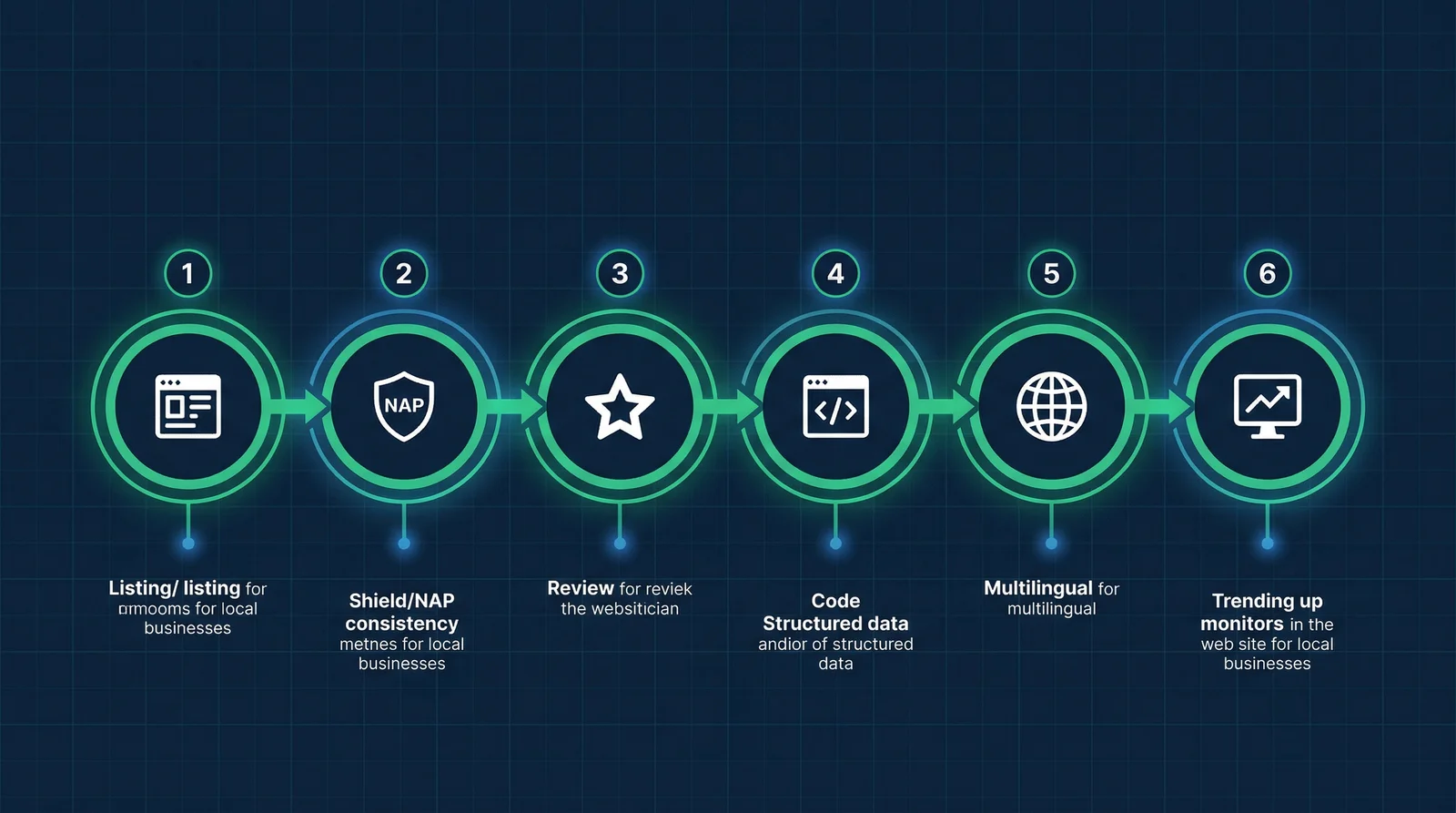
Answer Engine Optimization (AEO) is the practice of structuring your online presence so AI platforms can understand, trust, and recommend your business. Here is the complete framework, prioritized for the Indian market.
1Claim and Complete Your Foursquare Listing
Time required: 30-45 minutes
Claim and Complete Your Foursquare Listing
Time required: 30-45 minutes
Go to foursquare.com and claim your business. Complete every available field — this is the primary data source ChatGPT queries for local recommendations.
- Business name (exact match to your GBP)
- Full address with locality, city, PIN code
- Primary phone number (same as GBP)
- Website URL
- Business hours including public holidays
- Primary and secondary categories
- Price range indicator
- Minimum 10 photos (exterior, interior, product/food shots)
- Business description (150+ words, mention what you offer and your neighborhood)
- Attributes: WiFi, parking, wheelchair accessible, accepted payments
2Achieve the Review Threshold
Time required: Ongoing — 90 days to reach minimum threshold
Achieve the Review Threshold
Time required: Ongoing — 90 days to reach minimum threshold
ChatGPT-recommended businesses average 4.3 stars and 100+ reviews with consistent recent activity. If you are below this, review collection is your highest-leverage action.
- Target: 100+ total reviews, 4.2+ average rating
- Velocity target: minimum 4-6 new reviews per month
- Use review request templates that guide keyword-specific feedback
- Respond to all reviews within 48 hours (signals active management)
- Address root causes of any sub-3-star reviews before scaling collection
3Audit and Fix NAP Consistency
Time required: 2-3 hours initially, 30 minutes every 6 months
Audit and Fix NAP Consistency
Time required: 2-3 hours initially, 30 minutes every 6 months
Your Name, Address, and Phone must be identical across every platform. Use your Google Business Profile as the single source of truth and update all other listings to match it exactly.
- Document your canonical NAP from GBP (exact spelling, abbreviations, format)
- Search your business name in private browser across all major platforms
- Fix: Google Business Profile, Foursquare, JustDial, Facebook, Zomato, Sulekha, Practo (if applicable)
- Create listings on platforms where you are absent
- Schedule a re-audit every 6 months
4Add LocalBusiness Schema to Your Website
Time required: 1-2 hours (technical)
Add LocalBusiness Schema to Your Website
Time required: 1-2 hours (technical)
Schema markup is the machine-readable layer that tells AI systems who you are. If you use WordPress, the Yoast SEO or Schema Pro plugins handle this. If you have a custom website, add the JSON-LD block to your homepage head tag.
- Schema type: LocalBusiness (or specific subtype: Restaurant, MedicalClinic, etc.)
- Required fields: name, address (PostalAddress), telephone, url
- Recommended: geo (GeoCoordinates), openingHours, priceRange, image
- Validate using Google Rich Results Test
- Add Service schema for each major service you offer
5Create Answer-First Content Pages
Time required: 3-5 hours, one-time investment
Create Answer-First Content Pages
Time required: 3-5 hours, one-time investment
AI systems cite sources that directly answer questions. A FAQ page and service-specific landing pages are the two highest-value content investments for AEO. Write in plain language, use question-format headings, and answer each question in the first sentence.
- FAQ page: answer 8-12 questions customers actually ask (check your GBP Q&A section for ideas)
- Service pages: one page per major service, with hours/pricing/location context
- Use H2 headers as questions: "What are your opening hours on Sunday?"
- Answer each question within the first sentence of the paragraph
- Include your neighborhood and city name naturally in each page
6Build Keyword-Rich Review Corpus
Time required: Ongoing — compounds over 3-6 months
Build Keyword-Rich Review Corpus
Time required: Ongoing — compounds over 3-6 months
Generic reviews ('great service', 'nice place') do not help AI systems understand what your business specifically offers. Review templates that prompt customers to mention what they ordered/experienced and where you are located produce the specific, extractable reputation signals AI recommendation engines weight most heavily.
- Use review templates that include: what they experienced + your neighborhood + your specific offering
- Example prompt: "Tell them what you had, where you are, and one thing that stood out"
- Avoid: asking customers to mention specific keywords (Google policy violation)
- Goal: 60%+ of reviews should mention a specific product, service, or neighborhood
- Track your review keyword density monthly using Google Business Profile Insights
How Review Quality Drives AI Recommendation Eligibility
The link between review quality and ChatGPT visibility is not obvious until you understand how AI systems assess business reputation.
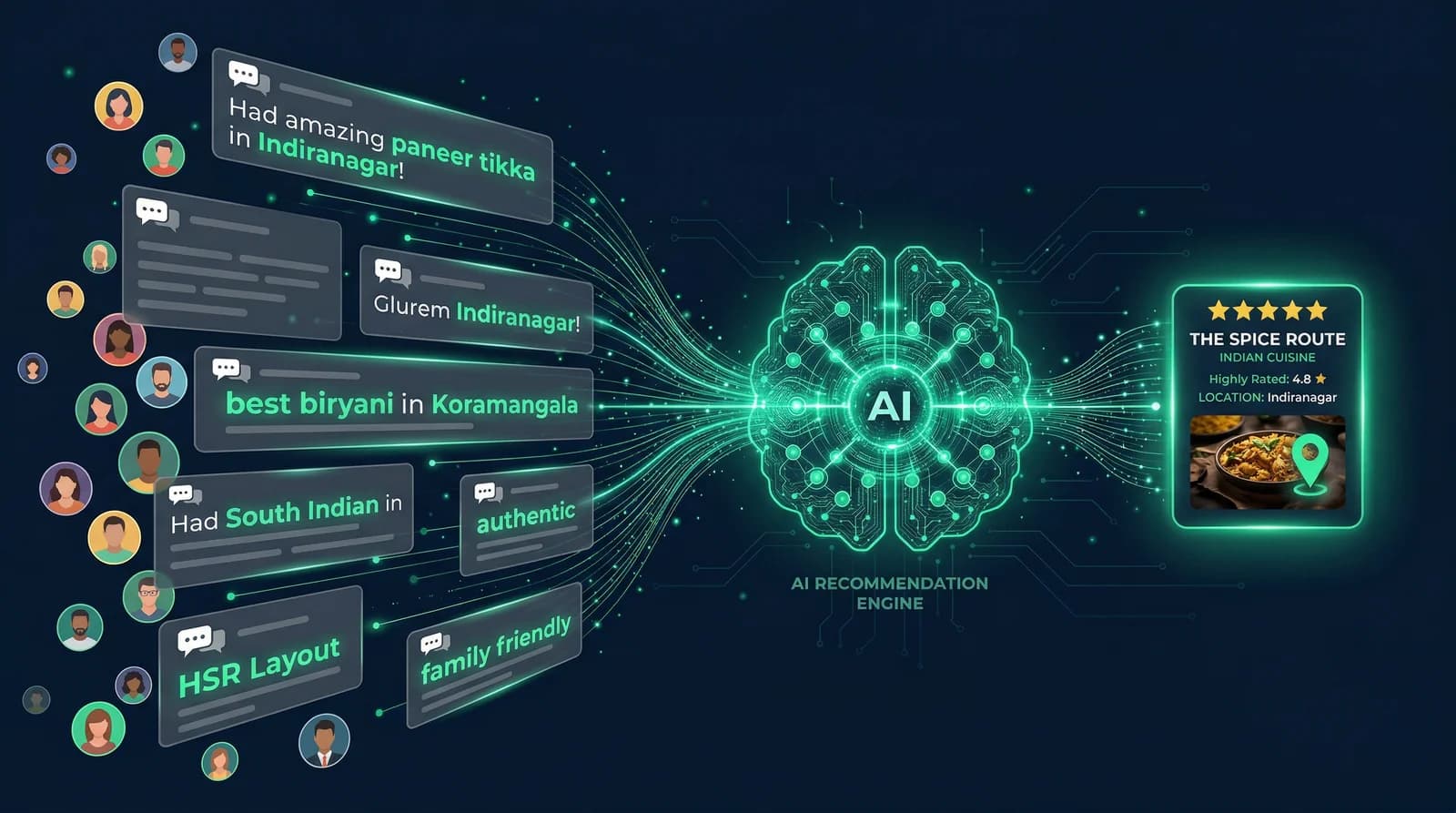
ChatGPT does not read individual reviews the way a human reader does. It processes reputation signals — the aggregate picture created by review volume, recency, rating distribution, and the content patterns across review text. A business with 120 reviews that all say "nice place" and "good service" projects a generic reputation signal. A business with 80 reviews where customers consistently mention specific dishes, specific services, and specific neighborhoods projects a specific, authoritative reputation signal.
That specificity — what I call the keyword richness of your review corpus — helps AI systems understand what your business actually does and who it serves. When ChatGPT processes a query for "best paneer tikka restaurant in Indiranagar," it is looking for businesses whose reputation data explicitly connects them to paneer tikka and Indiranagar. Generic reviews do not make that connection.
The MapLift connection
MapLift's AI-powered review templates generate prompts that guide customers to naturally write reviews mentioning what they ordered or experienced, and where they are located. This produces the keyword-rich review corpus that signals both to Google Maps and to AI recommendation engines what your business specifically offers.
73% of Google reviews contain zero keywords that help a business rank. The fix is not asking customers to write better reviews — it is giving them a template that makes writing a specific, descriptive review the path of least resistance. That is what AI review templates do.
You can learn more about the full set of AI tools for local businesses in India, or read our detailed breakdown of local SEO strategies for the Indian market.
Related Guides
Frequently Asked Questions
Does ChatGPT use Google Maps data for local recommendations?
Not directly. ChatGPT queries Foursquare's Places API — not Google Maps — for the majority of its local business recommendations. Over 70% of ChatGPT local results draw from Foursquare data.
Google Business Profile data does influence ChatGPT indirectly: GBP data is indexed by Bing, appears in web crawls, and feeds review platforms that ChatGPT cross-references. But the primary real-time data pipeline runs through Foursquare. This is why having a complete Foursquare listing is essential even if your Google Maps presence is excellent.
How do I get my business listed in ChatGPT recommendations?
The six most impactful actions, in order:
1. Complete your Foursquare listing (every field, minimum 10 photos, 150+ word description)
2. Achieve 100+ Google reviews with a 4.2+ average rating and consistent monthly new reviews
3. Make your NAP (Name, Address, Phone) identical across all major platforms
4. Add LocalBusiness schema markup to your website homepage
5. Create an FAQ page and service-specific landing pages on your website
6. Build a review corpus where 60%+ of reviews mention specific services and your neighborhood
These actions address both the Foursquare data layer and the broader reputation signals ChatGPT synthesizes from multiple sources.
Is ChatGPT local search available in India?
Yes. India is the second-largest ChatGPT user base globally, and ChatGPT's local search functionality works for Indian cities including Mumbai, Delhi, Bengaluru, Hyderabad, Chennai, Pune, Kolkata, and Tier 2 cities.
The caveat is that Foursquare data density in India — particularly for Tier 2 and Tier 3 cities — is lower than in Western markets. Indian businesses in cities with thinner Foursquare coverage need to invest more heavily in Google Business Profile, Zomato, JustDial, and website structured data to compensate. Businesses in Bengaluru and Mumbai typically have better Foursquare coverage than those in smaller cities.
How long does it take to appear in ChatGPT recommendations?
The timeline depends on your starting point. If you have strong Google reviews and good NAP consistency but no Foursquare presence:
- Foursquare listing creation and completion: immediate once done
- New reviews indexed: within days to weeks
- Schema markup recognition: 2-4 weeks
- Measurable AI recommendation visibility: 60-90 days from completing all six steps
If you are starting from zero — no reviews, incomplete listings, inconsistent NAP — expect 4-6 months to reach the thresholds that put you in competition for AI recommendations.
The fastest lever: if you are already collecting Google reviews but they are generic, shifting to keyword-rich review templates can show results in 60 days.
Does ChatGPT recommend businesses based on ads?
No. ChatGPT's local recommendation engine is entirely organic — there is no advertising pathway to appear in recommendations. This is fundamentally different from Google, where ad spend can supplement organic visibility.
ChatGPT recommendations are determined by data quality, reputation signals, and structured information — not by paid placement. A business with zero ad spend but excellent reviews, complete listings, and consistent NAP data will outperform a heavily-advertised business with a 3.8-star average and incomplete profiles.
What is the difference between GEO and AEO for local businesses?
Generative Engine Optimization (GEO) and Answer Engine Optimization (AEO) are closely related but have different emphases.
GEO is the broader practice of optimizing your online presence to appear in AI-generated content — including AI Overviews in Google Search, ChatGPT responses, Perplexity citations, and other generative AI outputs. It covers everything from structured data to citation building to content format.
AEO specifically focuses on getting AI tools to recommend or cite you in answer to direct questions. For local businesses, AEO means ensuring AI systems can extract and trust specific, accurate information about your location, services, hours, and reputation.
In practice, the same actions serve both: complete business listings, consistent NAP, LocalBusiness schema, FAQ content, and high-quality review volume. Local businesses do not need separate GEO and AEO strategies — they need one local authority strategy that happens to work across both frameworks.
The Shift Has Already Started
The 3.2% of MapLift's traffic arriving from ChatGPT is a small number today. But the direction is clear. 45% of consumers using AI for local service discovery — up from 6% in a single year — is not a trend that reverses. It is the early stage of a structural change in how people find local businesses.
The businesses that invest now in Foursquare presence, review volume, NAP consistency, and structured data will enter that new landscape with authority already established. The businesses that wait will compete for visibility in a more crowded, more expensive environment.
The good news: the foundation of AI recommendation eligibility is the same work that improves your Google Maps ranking. You are not building two systems. You are building one local authority infrastructure that serves all the platforms that matter — present and future.
MapLift builds that foundation — starting with your reviews
AI-generated review templates based on your business data. Keyword-rich, authentic, and designed to signal both Google Maps and AI recommendation engines what your business specifically offers. Analyze your business free to see your current visibility gaps.
Sources & References
- ChatGPT Local Search Data Sources: Where Does Business Info Come From?- LocalFalcon
- AI Search Makes Local Listings More Important Than Ever- BrightLocal
- 45% Of Consumers Use AI Search For Local Services- MarketingCode
- ChatGPT shows local results from Foursquare- MediaElx
- Answer Engine Optimization (AEO): How to Get Cited in ChatGPT & AI Overviews- The HOTH
- Answer Engine Optimization: Complete AEO Guide 2026- Frase.io
- GEO and AI Search in India 2026: 5 Surprising SEO Truths- Spinta Digital
- Guidelines for representing your business on Google- Google
Keep reading
Ready to act on this? What MapLift does — every feature, and which plan carries it.