
Negative Review Crisis Management: How to Protect Your Business Reputation
One unaddressed negative review can drive away 30 potential customers. But a business that responds well recovers 73% of unhappy customers — and turns the review into a public trust signal. Here is the complete playbook for Indian businesses.
Table of Contents
TL;DR — Key Takeaways
One unanswered negative review costs you 30 customers
But businesses that respond professionally recover 73% of unhappy customers and see 35% more revenue than businesses that never respond to reviews at all
There are 4 types of negative reviews — each needs a different response
Legitimate complaints, fake or competitor reviews, emotional explosions, and miscommunication reviews each require a distinct strategy — not one generic template
The HEARD framework turns complaints into trust signals
Hear, Empathize, Apologize, Resolve, Diagnose — a five-step protocol used across hospitality and customer service that works for Google review responses
Fake reviews can be removed — but only with the right process
Google removes reviews that violate policy. Flag the review, wait 7 days, then escalate with a documented appeal — your one shot at human review
The review firewall is your long-term protection
Generate positive reviews at 5x the rate of any negatives you receive. Volume, quality, and response consistency together make individual bad reviews mathematically irrelevant
Three weeks ago, a restaurant owner in Pune reached out in a panic. A competitor had clearly orchestrated a wave of 1-star reviews — five in two days, all from accounts with no history, all vague and unverifiable. His rating dropped from 4.6 to 4.2. Reservations slowed the following weekend.
After six years helping over 200 Indian businesses manage their Google Maps presence, this scenario is not unusual. What IS unusual is knowing exactly what to do when it happens.
Most business owners either ignore negative reviews — which 94% of consumers notice and interpret as indifference — or respond defensively, which amplifies the damage. A third group follows a structured protocol that turns each negative review into a demonstration of professionalism. This guide gives you that protocol.
We cover the four types of negative reviews, the HEARD response framework, step-by-step instructions for flagging fake reviews on Google, India-specific platform considerations for Zomato, Swiggy, and Practo, and the long-term review firewall that makes individual negative reviews mathematically irrelevant.
Why Negative Reviews Hit So Hard
Before we get to solutions, you need to understand the actual mechanics of the damage — because the numbers are more serious than most business owners realize.
30
Potential customers lost per single unaddressed negative review
Wiserreview, 2026
94%
Consumers who have avoided a company because of negative reviews
Wiserreview, 2026
73%
Unhappy customers recovered when a business responds well
ReviewTrackers, 2025
35%
More revenue for businesses that respond to at least 25% of reviews
BrightLocal, 2026
88%
Consumers more likely to choose a business that responds to every review
BrightLocal, 2026
70%
Potential customers lost when a business has 4+ negative reviews
Wiserreview, 2026
The asymmetry is significant: one negative review requires many positive ones to neutralize its psychological effect on potential customers. For Indian businesses, the stakes are amplified — with over 900 million internet users and the overwhelming majority of local searches happening on mobile, your star rating is often the first and only impression you make before a customer decides whether to contact you.
But here is what changes the equation. Businesses that respond to at least 25% of their reviews average 35% more revenue than businesses that never respond. And 88% of consumers are more likely to choose a business that responds to every review.
A negative review that receives a professional response stops being a liability
Potential customers see that you care, that you listen, and that you solve problems. The goal is not to eliminate negative reviews. It is to respond so well that they work for you.
The 4 Types of Negative Reviews (and Why Each Needs a Different Response)
Responding to a fake competitor review the same way you would respond to a legitimate customer complaint is a strategic error. Before you write a single word, identify which type you are dealing with.
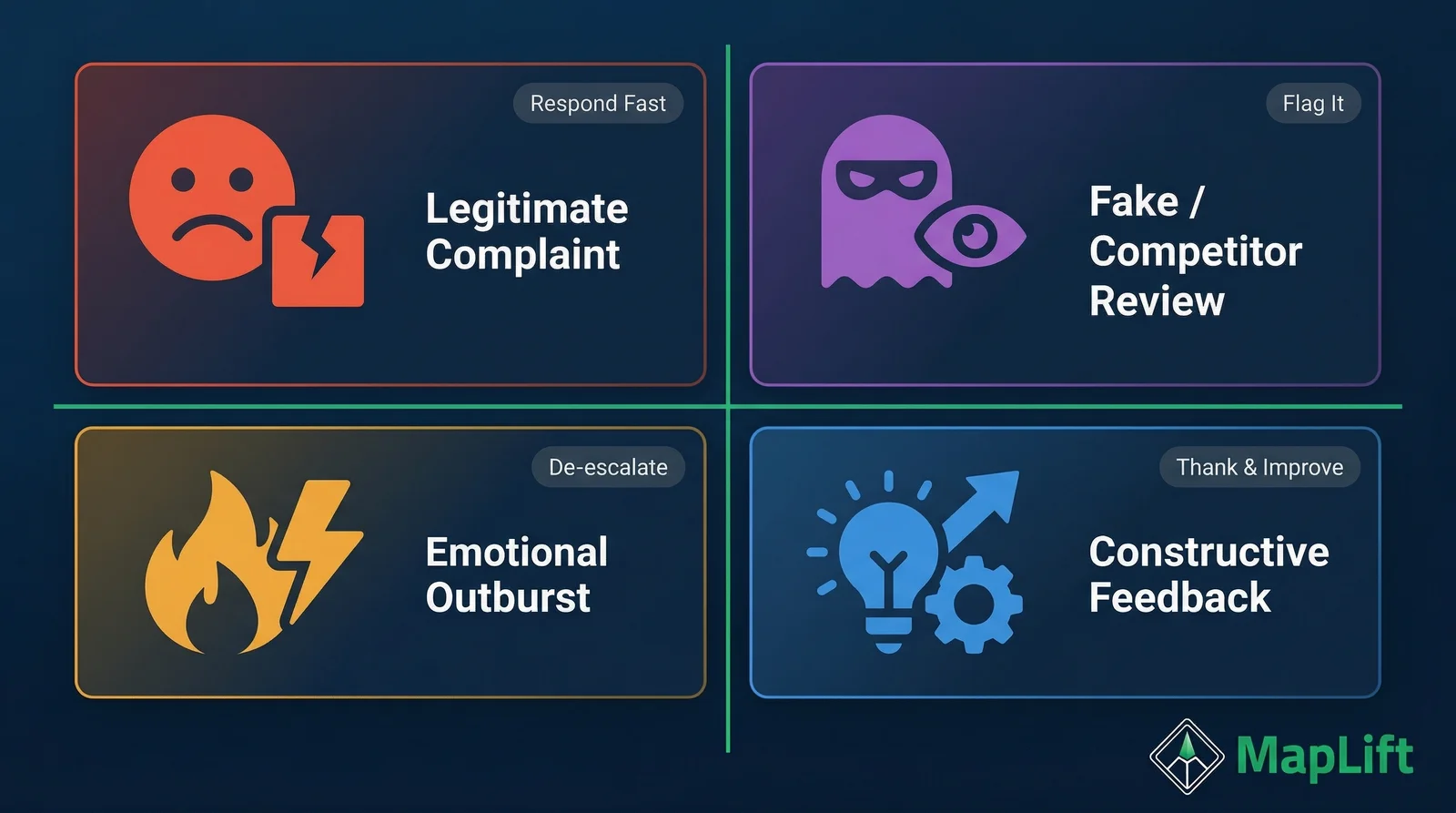
1The Legitimate Complaint
How to identify it
Reviewer has plausible account history. The complaint is specific, matches an experience that could have happened at your business, and the details are internally consistent.
Response goal
Apologize sincerely, take responsibility, offer a private resolution, and demonstrate that you have taken steps to prevent recurrence.
Getting defensive, making excuses, or offering a public discount in exchange for changing the review — this violates Google policy.
2The Fake or Competitor Review
How to identify it
New account with no review history. Review lacks any specific details about your business. Timing correlates with a competitor opening nearby, a dispute with an ex-employee, or multiple similar reviews appearing within days.
Response goal
A brief, factual public response noting you cannot find any matching customer record, combined with an immediate flag to Google for policy review.
Arguing extensively in the public response, which amplifies the review's visibility and can make it appear more credible to readers.
3The Emotional Explosion
How to identify it
Real customer, real visit, but language is disproportionate ("WORST IN ALL OF INDIA") and specific details are mixed with obvious hyperbole. The core complaint may be real.
Response goal
De-escalate, acknowledge the emotion without amplifying it, offer to take the conversation offline, and demonstrate calm professionalism to future readers.
Matching their energy or defending against the hyperbole point by point — you are not writing for the angry reviewer, you are writing for the 1,000 people who will read the exchange.
4The Miscommunication Review
How to identify it
The core complaint contradicts your written policies, menu, or standard practices. The customer isn't fabricating — they received or remembered information incorrectly.
Response goal
Gently clarify the facts, acknowledge how the miscommunication might have happened, and take responsibility for any communication gap on your end.
Making the customer feel stupid for misunderstanding. Your response is read by thousands of future customers — demonstrate patience and clarity.
The HEARD Framework — Your Review Response Protocol
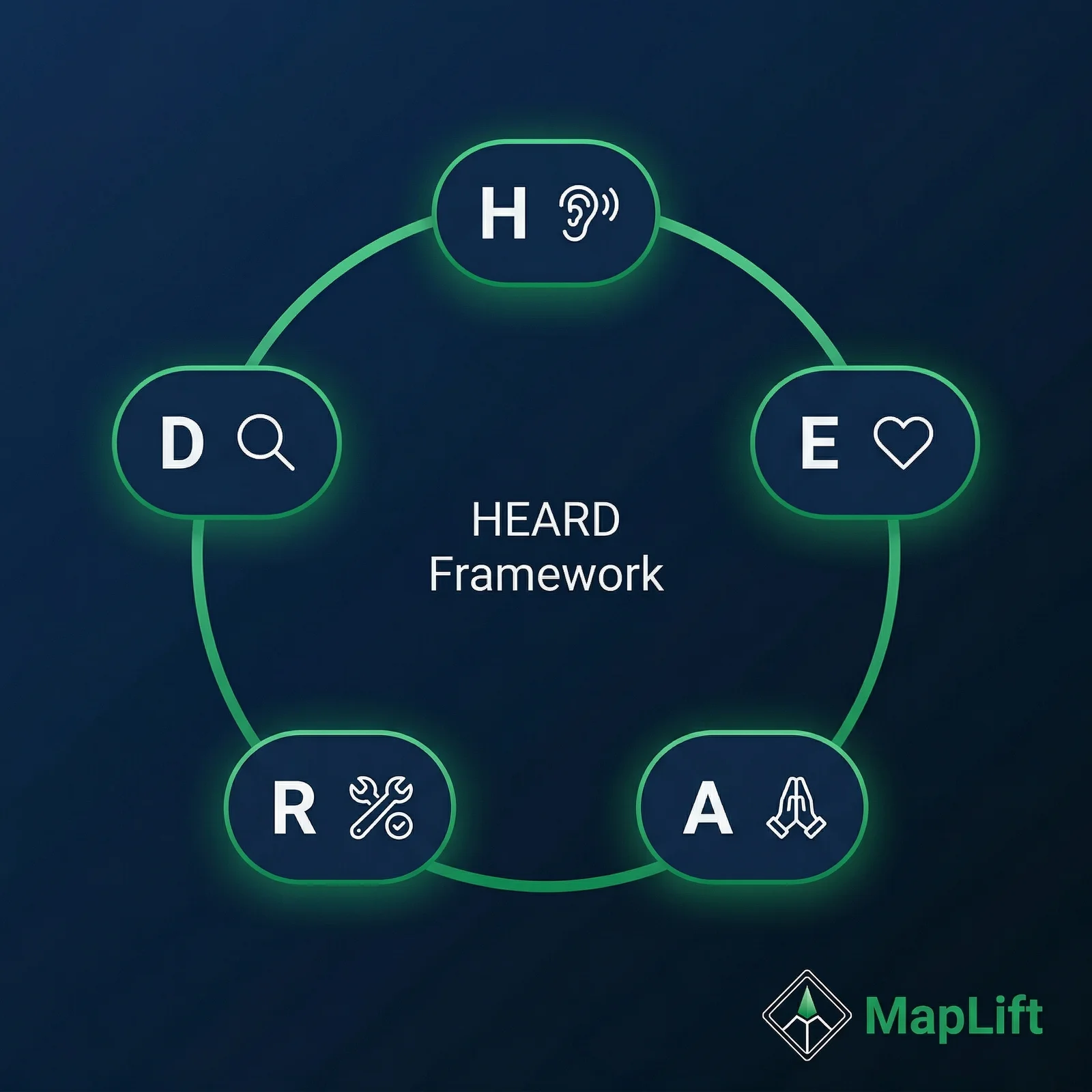
The HEARD framework — originally developed in the hospitality industry and widely adopted in customer service training — provides a structured approach that works across all four review types. Over six years working with Indian restaurants, salons, and clinics, I have found this framework consistently converts skeptical review-readers into customers who trust the business.
Hear — Show You Actually Read Their Review
Start your response by demonstrating that you have processed what the customer said — not just seen the star rating. Reference specific details from their review. This signals to both the original reviewer and future readers that you take individual feedback seriously.
Do this
"I understand you waited over 30 minutes for your order during your visit last Saturday..."
Not this
"Thank you for your review. We take all feedback seriously and strive to provide excellent service." (Proves you read nothing.)
Empathize — Validate Before You Explain
Validate the customer's frustration before you explain or resolve. The emotional acknowledgment comes first — always. Even if you believe the complaint is exaggerated, the customer's frustration is real and deserves recognition.
Do this
"I completely understand how frustrating that experience must have been, especially when you came in specifically to celebrate."
Not this
"Unfortunately our kitchen was very busy that evening." (Explanation before acknowledgment = defensiveness.)
Apologize — A Real One, Not a Liability Hedge
A sincere apology focused on the customer's experience, not a legal non-apology. The phrase "I'm sorry you felt that way" puts responsibility on the customer's feelings rather than your business's performance.
Do this
"I sincerely apologize that we failed to meet your expectations during your visit."
Not this
"We're sorry if there was any inconvenience." (Conditional language is not an apology.)
Resolve — Offer a Concrete Next Step
Offer a specific path forward — always by taking the conversation offline. "Please contact me directly at [phone/email] so we can make this right." For legitimate complaints, privately discuss what resolution is appropriate.
Do this
"Please contact me directly at [email/phone] and I will personally ensure we make this right."
Not this
"We offer a 20% discount on your next visit." (Compensation in the public response violates Google policy.)
Diagnose — Internal Step to Fix the Root Cause
The public response ends at Resolve. Diagnose is your internal step. If three separate reviews mention slow service on Friday evenings, that's a staffing problem. Five reviews about parking signal a GBP attribute gap. Negative reviews are operational intelligence.
Do this
Document patterns across reviews monthly. Use findings to improve operations and update GBP posts about improvements made.
Not this
Treating each negative review as an isolated incident and never identifying systemic issues.
Critical rule: Never offer compensation in the public response
Offering discounts, free items, or refunds in the public review response violates Google's review policy and signals to other customers that bad reviews earn rewards. Handle any compensation privately — after the public response has directed the customer to contact you offline.
Response Templates for Each Review Type
Use these as starting points, not verbatim scripts. A personalized response always outperforms a pure template — but a template beats silence every time.
Template 1: Legitimate Complaint
"Dear [Name], thank you for taking the time to share your experience. I sincerely apologize that [specific issue] fell short of the standard we hold ourselves to — this is not the experience we want any customer to have, and I take full responsibility. I'd like to make this right. Please reach out to me directly at [email/phone] so we can discuss how to do that. We have also taken immediate steps to address [the underlying issue] to ensure this does not happen again. I hope we get the opportunity to earn back your trust."
Personalize by referencing the specific complaint. Never mention compensation here — handle that privately after they contact you.
Template 2: Fake or Unverifiable Review
"Thank you for your feedback. I have reviewed our records carefully and am unable to find any customer interaction matching the experience you have described. We take every review seriously, so if you are a genuine customer of ours, please contact me directly at [contact] so I can investigate this personally. We remain committed to providing every customer with a positive experience."
Keep this brief and factual. Flag the review through your Business Profile simultaneously. Do not accuse directly in the public response.
Template 3: Emotional or Exaggerated Review
"Thank you for sharing your experience, [Name]. I can see this visit was genuinely frustrating, and I'm sorry we did not meet your expectations. I would very much like to understand exactly what happened — please contact me directly at [contact] so we can discuss this properly and find a resolution. Your feedback matters to us, and I want to make sure we address whatever went wrong."
Do not engage with the hyperbole. Your calm tone is visible to every future reader — that is your audience.
Template 4: Miscommunication Review
"Thank you for your honest feedback, [Name]. I'm sorry for the confusion regarding [specific issue] — I understand how frustrating it is when expectations and reality do not match. Our [policy/pricing/menu] is [brief clarification], and I realize we could have communicated this more clearly. I take responsibility for that gap. Please reach out to me at [contact] and I will be happy to clarify anything further and ensure your next experience is a much better one."
Clarify the facts gently — once. Demonstrating patience and clarity here builds trust with future customers reading the exchange.
Need positive reviews to balance the negatives?
MapLift generates AI-powered review request templates tailored to your specific business, services, and customer type. The templates prompt customers to write detailed, specific reviews — the kind that build your rating and your review firewall. See our complete Google review response guide for more response strategy.
How to Flag and Remove Fake Reviews on Google
Fake reviews are a documented problem in competitive Indian markets — restaurants, salons, and healthcare providers are the most commonly targeted categories. Google does remove reviews that violate its policies, but only if you follow the correct process.
What Google Will Remove
Google will NOT remove:
A review simply because it is negative, critical, or because you disagree with it. Google does not arbitrate factual disputes between businesses and customers.
Step-by-Step: Flagging a Review
Go to your Google Business Profile Manager at business.google.com
Navigate to the Reviews section from the left sidebar
Find the review you want to flag
Click the three-dot menu (more options) next to that review
Select "Flag as inappropriate"
Choose the violation category that best matches the content
Submit the report — Google typically responds within 3 business days
If no action after 7 days, use the one-time appeal to submit documented evidence
The Appeal Process — Your Most Important Lever
If Google reviews your flag and decides not to remove the review, you have one opportunity to file a formal appeal for additional human review. This is your highest-value action for genuine fake reviews — and it requires documented evidence.
Use this appeal to provide: screenshots showing the reviewer's account was created the same week as the review, documentation that no customer record matches the reviewer, evidence of a coordinated pattern (multiple new-account reviews in a short window), or proof of competitor affiliation.
According to BrightLocal's research, detailed appeals with documented evidence have meaningfully higher removal success rates than flagged reviews alone. You get one appeal per review — prepare it thoroughly before submitting.
While waiting for a decision — respond professionally
While a review is under appeal, use Template 2 (Fake/Unverifiable Review) to respond publicly. This demonstrates active management to Google, signals to future customers that you dispute the review, and prevents it from standing as an uncontested statement. See our negative review response examples for more dispute response language.
Cross-Platform Reputation Management in India
For Indian businesses, reputation management does not stop at Google. Depending on your category, you likely have a presence on Zomato, Swiggy, JustDial, MagicPin, Practo, or Sulekha — and negative reviews on any of those platforms affect your overall reputation.
🍽Restaurants: The Zomato and Swiggy Dimension
A restaurant with excellent Google reviews but a 3.2 rating on Zomato loses customers to competitors strong on both platforms. Zomato's review system rates food, service, and ambience separately — meaning a delivery issue caused by the delivery partner can damage your dine-in reputation if not addressed.
🏥Healthcare: The Practo Dimension
For clinics and practitioners, Practo reviews carry significant weight in patient acquisition. A pattern of negative reviews about wait times or billing disputes requires the same structured response approach as Google — the HEARD framework applies identically.
🔧Services: JustDial Still Matters
JustDial remains a primary discovery platform for home services, tutors, repair services, and local contractors across India. A negative review on JustDial that goes unanswered for weeks creates the same trust deficit as an ignored Google review.
The key insight on multi-platform reputation
Your reputation is not the sum of your Google reviews. It is the aggregate signal across every platform where your customers are evaluating you. Consistent, professional response behavior across all platforms — using the same HEARD principles — is the reputation management strategy that compounds over time. For a deeper look at managing your overall presence, see our guide on online reputation management for small businesses.
Building Your Review Firewall
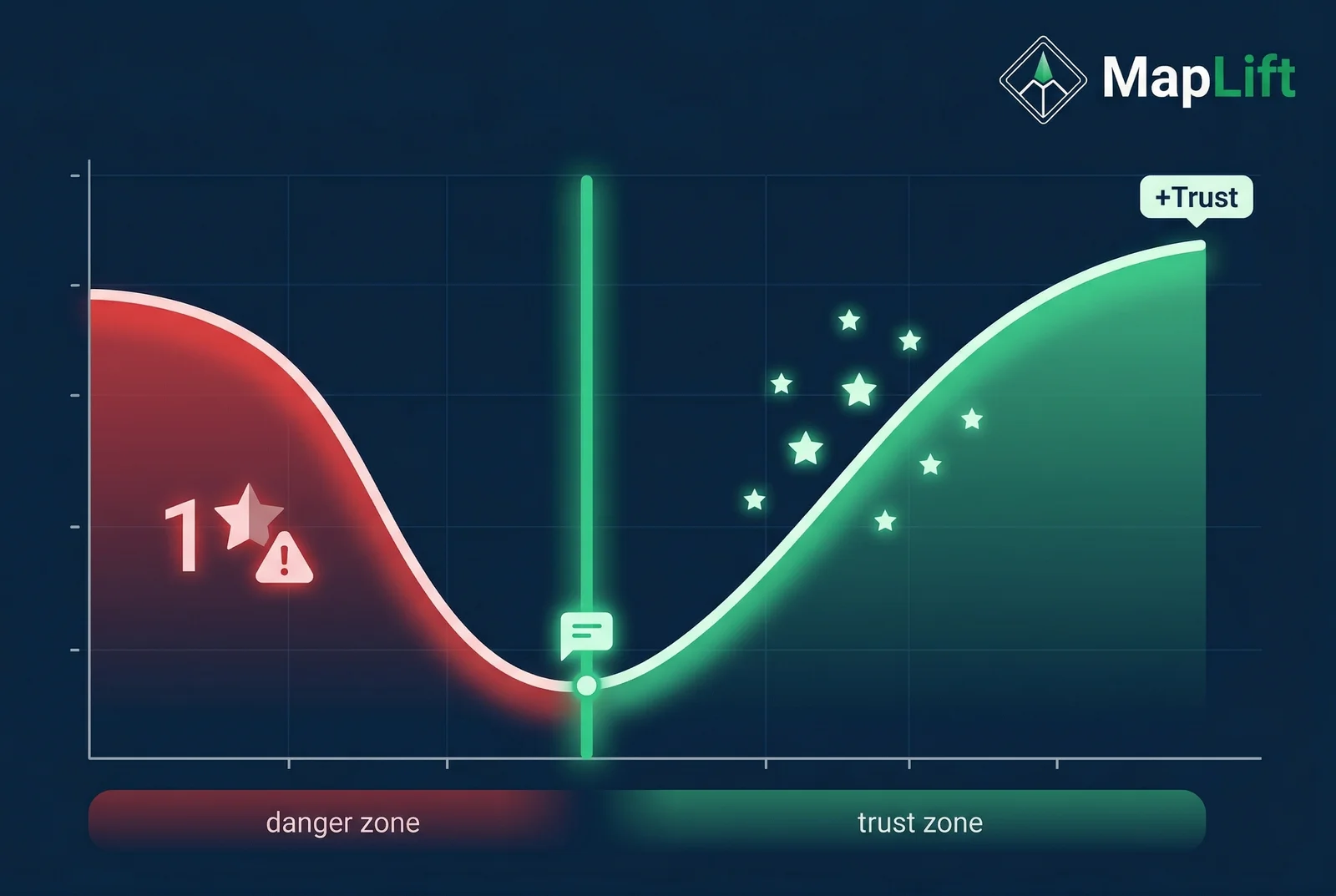
The most durable response to negative reviews is mathematical. A business with 200 positive reviews and 3 negative ones has a stable reputation. A business with 15 reviews and 3 negative ones has a crisis. The review firewall is the strategy that makes individual negative reviews irrelevant.
Component 1: Systematic Volume Generation
After each positive customer interaction, ask directly: "Would you mind sharing your experience on Google? It really helps us." A post-visit WhatsApp message with a direct review link converts at 20-30% — far higher than QR codes or generic email requests.
Target
Generate positive reviews at 5x the rate of any negatives you receive. For 1-2 negatives per month, aim for 5-10 new positives per month minimum.
Component 2: Semantic Review Quality
Not all positive reviews protect equally. A detailed review ("the physiotherapy sessions here transformed my knee recovery — the approach is specific and personalized") is far more credible than "great place." Use structured templates that prompt customers to describe their specific experience.
Target
Aim for 40%+ of your positive reviews to contain specific service names, outcomes, or descriptive language — not just star ratings.
Component 3: Owner Response Consistency
Businesses that respond to every review — positive and negative — build a meta-reputation that potential customers notice. Responding only to negatives looks defensive. Responding to everything signals a confident, customer-centric operation.
Target
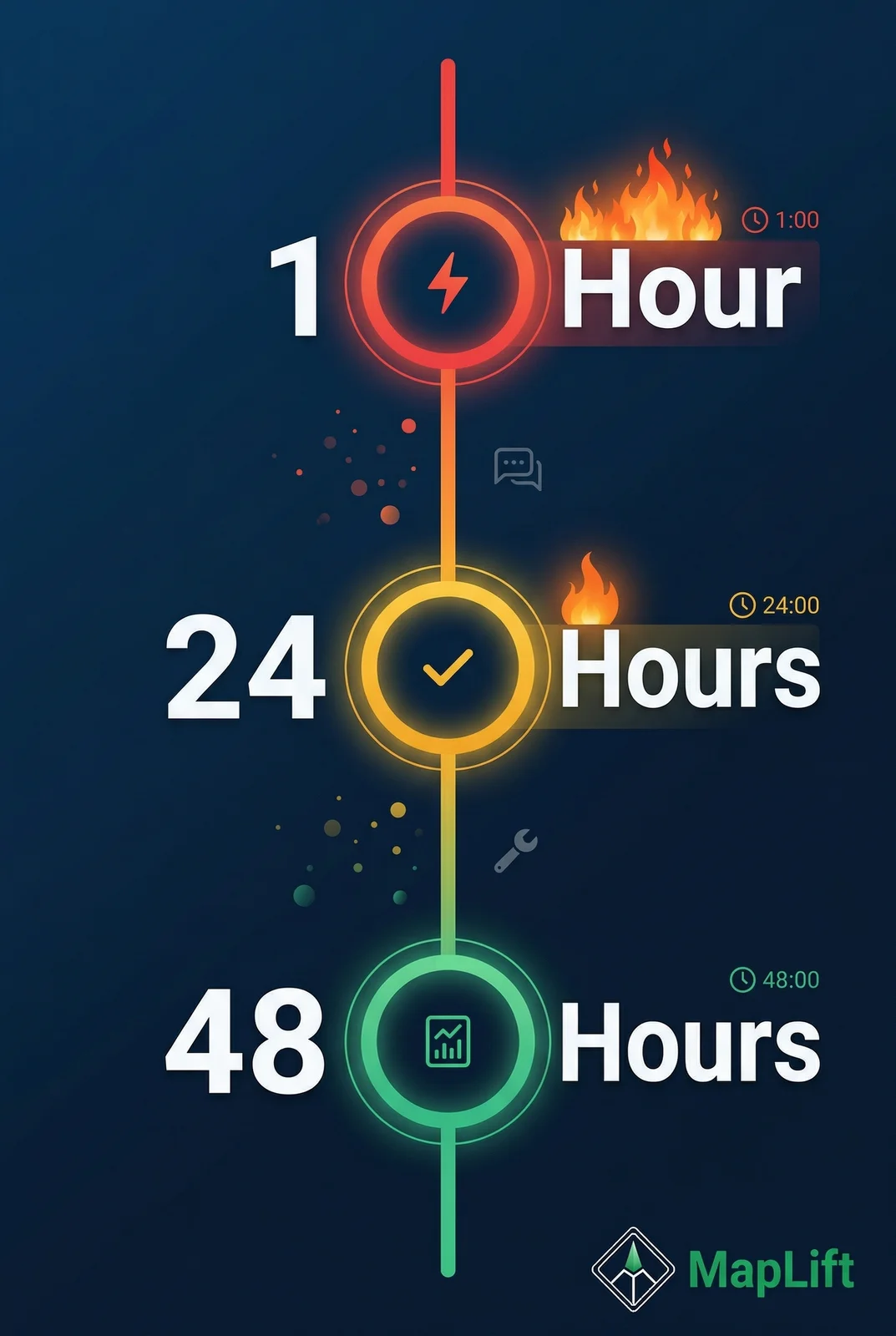
Respond to 100% of reviews within 48 hours. This single habit distinguishes the top 12% of local businesses on Google.
MapLift makes positive review generation systematic
MapLift analyzes your business profile and generates AI-powered review request templates tailored to your specific services and customer types — so positive review generation becomes a repeatable system, not an afterthought. Templates are optimized to prompt customers to write detailed, specific reviews that strengthen your reputation and improve your Google star rating over time.
The 72-Hour Crisis Response Protocol
When multiple negative reviews hit in a short window — the pattern suggests either a systematic service failure or a coordinated attack — the response needs to be immediate and structured. Here is the protocol used with clients when a review crisis arrives.
Hours 0–4
Triage
Hours 4–24
Investigation
Hours 24–72
Escalation
Beyond 72 Hours
Recovery
Frequently Asked Questions
Can Google actually remove negative reviews?
Yes, but only reviews that violate Google's content policy. Google removes reviews that are spam or fake (not based on a real experience), written with a conflict of interest (competitor, ex-employee), off-topic, or contain prohibited content like hate speech or personal information. Google will not remove a review simply because it is negative or because you disagree with it. The process requires flagging the review through your Business Profile. If the review is not removed after 7 days, you have one opportunity to submit a formal appeal with documented evidence.
Should I respond to every negative review, even fake ones?
Yes. According to BrightLocal's 2026 research, 88% of consumers are more likely to choose a business that responds to every review. For fake reviews, keep the response brief and factual — note that you cannot find any matching customer record and invite them to contact you if they are a genuine customer. This signals to future readers that you dispute the review without engaging in a public argument. An unanswered negative review signals indifference regardless of whether it is real or fake.
How long does it take for Google to remove a flagged review?
Google typically processes flagged reviews within 3 business days. If the review is not removed after 7 days, you can submit a one-time appeal for additional human review. The appeal process can take an additional 5-10 business days. During this time, respond to the review publicly using the appropriate template — this demonstrates active management and prevents the review from standing as an uncontested statement.
Can I offer a discount to a customer in exchange for changing their review?
No. Offering incentives in exchange for changing or removing a review violates Google's review policy and can result in your reviews being removed or your Business Profile being penalized. Handle any compensation privately — after the public response has directed the customer to contact you offline. If you resolve the issue genuinely and the customer decides to update their review on their own, that is acceptable. The key is that the update must be the customer's voluntary decision, not a transaction.
What is the fastest way to recover a star rating after a negative review wave?
The fastest recovery combines professional responses (which stop the rating from being the only signal a customer sees) with an aggressive positive review generation campaign. A business with a systematic WhatsApp review request process can generate 10-20 new positive reviews in 2-4 weeks, which meaningfully raises the average rating and buries the negative reviews below the fold. The responses alone do not raise your rating — they protect it from further damage while the positive volume strategy does the mathematical recovery work.
Do negative reviews on Zomato or Swiggy affect my Google Maps ranking?
Negative reviews on Zomato and Swiggy do not directly affect your Google Maps star rating, since these are separate platforms with separate review systems. However, they affect your overall customer acquisition — a restaurant with 4.5 stars on Google but 3.1 on Zomato loses customers who check both platforms before deciding. There is also an indirect effect: Google's AI (Gemini) is known to pull data from external platforms including Zomato when building business recommendations through features like Ask Maps. A poor cross-platform reputation weakens your overall digital presence.
Negative Reviews Are a Test of Character — Pass It Publicly
Every negative review is a public test of how your business handles adversity. Potential customers who read a negative review and then see a professional, empathetic, solution-oriented response are often more likely to trust your business than if they had seen only positive reviews. That is the counterintuitive power of good negative review management.
The protocol in this guide — classify the review type, apply the HEARD framework, take it offline, flag genuine violations, and build your review firewall systematically — works for restaurants in Bengaluru facing fake review attacks, clinics in Mumbai managing patient complaints, and salons in Delhi handling miscommunication reviews. The principles are universal; the Indian context makes them more urgent.
Start with the templates in this guide. Respond to every review you have received in the past 30 days — positive and negative. Then build the systematic positive review generation process that makes future crises manageable. Each step compounds over time.
MapLift generates review templates in 15 seconds — build your firewall today
Based on your actual business — your services, categories, location, and customer type — MapLift's AI generates review request templates that prompt customers to write detailed, specific reviews. Free plan available. Essentials from Rs.299/month.
Sources & References
- Local Consumer Review Survey 2026- BrightLocal
- 77 Online Review Statistics (New 2026 Data)- Wiserreview
- How to Handle Negative Google Reviews & Protect Your Brand- Search Engine Land
- The HEARD Method For Customer Service: What It Is & How To Apply It- Pollack Peacebuilding Systems
- Report Inappropriate Reviews on Your Business Profile- Google Business Profile Help
- How to Spot and Remove Fake Google Reviews in 2026- SocialPilot
- Respond to Negative Reviews: Best Practices 2025 Guide- Shapo
- Powerful Examples of How to Respond to Negative Reviews- ReviewTrackers
- Guidelines for representing your business on Google- Google
Keep reading
Ready to act on this? What MapLift does — every feature, and which plan carries it.